Calamospiza melanocorys
Lark Bunting
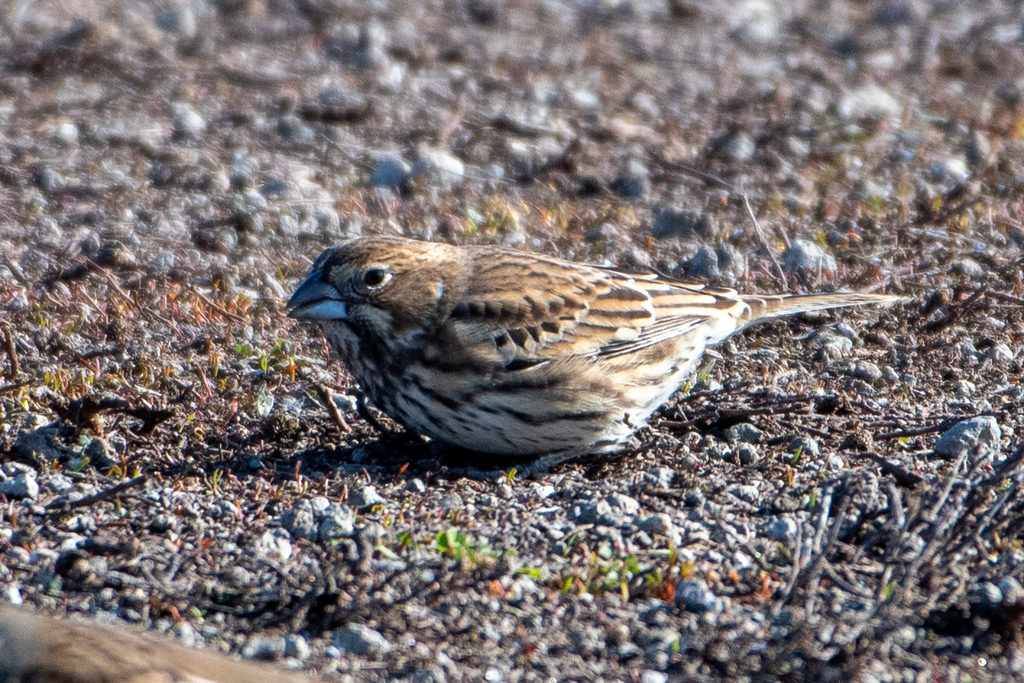
(c) Jonathan Eisen, some rights reserved (CC BY) · licence
Family: Passerellidae · Class: Aves · Order: Passeriformes
Calamospiza melanocorys (Lark Bunting) is a California animal in the Passerellidae family.
The Lark Bunting is a medium-sized songbird measuring 14 to 17 cm (5.5 to 6.7 inches) in length with a wingspan of 24 to 27 cm (9.4 to 10.6 inches). Adult males in breeding plumage display entirely black bodies with contrasting white wing patches that are prominent during flight and courtship displays. The white patches are formed by white secondary flight feathers and wing coverts. Non-breeding males and females show brownish-gray upperparts with dark streaking, buff to whitish underparts with fine dark streaks, and retain the distinctive white wing patches, though these are less conspicuous. The bill is thick and conical, adapted for seed consumption, appearing bluish-gray during breeding season and brownish otherwise. Historically, Lark Buntings bred across the Great Plains from southern Saskatchewan and Alberta south to northern New Mexico and Texas. In California, the species occurs primarily as a vagrant and occasional winter visitor to the southeastern desert regions, particularly the Mojave and Colorado deserts. Records exist from Imperial, Riverside, San Bernardino, and Kern counties, with most sightings occurring during fall migration and winter months between September and March. The species is considered casual to rare in California, with irregular occurrence patterns. Lark Buntings inhabit open grasslands, prairies, and shrubsteppe environments. During migration and winter in California, they are found in desert scrub, agricultural fields, weedy areas, and sparse grasslands at elevations typically below 1,000 meters (3,280 feet). The species shows preference for areas with scattered shrubs or fence posts that serve as singing perches, and open ground for foraging. The diet consists primarily of seeds from grasses and forbs, supplemented with insects during breeding season. Lark Buntings are ground foragers, using a double-scratch technique to uncover food items. They are highly social outside the breeding season, forming flocks that can number in the hundreds during migration. Breeding occurs from May through July on their Great Plains breeding grounds, with females constructing cup-shaped nests on the ground, often partially concealed under vegetation or beside rocks. Clutch size ranges from three to five pale blue eggs with brown spotting. The Lark Bunting is not federally or state listed in California due to its status as a vagrant rather than a resident species. However, the species has experienced significant population declines across its core Great Plains range, with North American Breeding Bird Survey data indicating a cumulative decline of approximately 60% since 1970. Primary threats include habitat loss due to agricultural conversion of native grasslands, urban development, and climate change affecting precipitation patterns on the Great Plains. The species benefits from grassland conservation programs and restoration of native prairie habitats within its primary range.
Classification
Class: Aves · Order: Passeriformes · Family: Passerellidae
Frequently asked questions
How is Calamospiza melanocorys classified?
Calamospiza melanocorys belongs to class Aves, order Passeriformes, family Passerellidae.
What family does Calamospiza melanocorys belong to?
Calamospiza melanocorys is in the Passerellidae family.
What is Calamospiza melanocorys?
The Lark Bunting is a medium-sized songbird measuring 14 to 17 cm (5.5 to 6.7 inches) in length with a wingspan of 24 to 27 cm (9.4 to 10.6 inches).
Is Calamospiza melanocorys found in California?
Yes. Calamospiza melanocorys is recorded in California in The California Species Project's catalogue.
Related species
Other California species in the same genus, family, or bioregion.
Data from The California Species Project — 14,000+ California species with verified data from CNPS, CDFW, USFWS, and more.