Calasellus longus
An Isopod
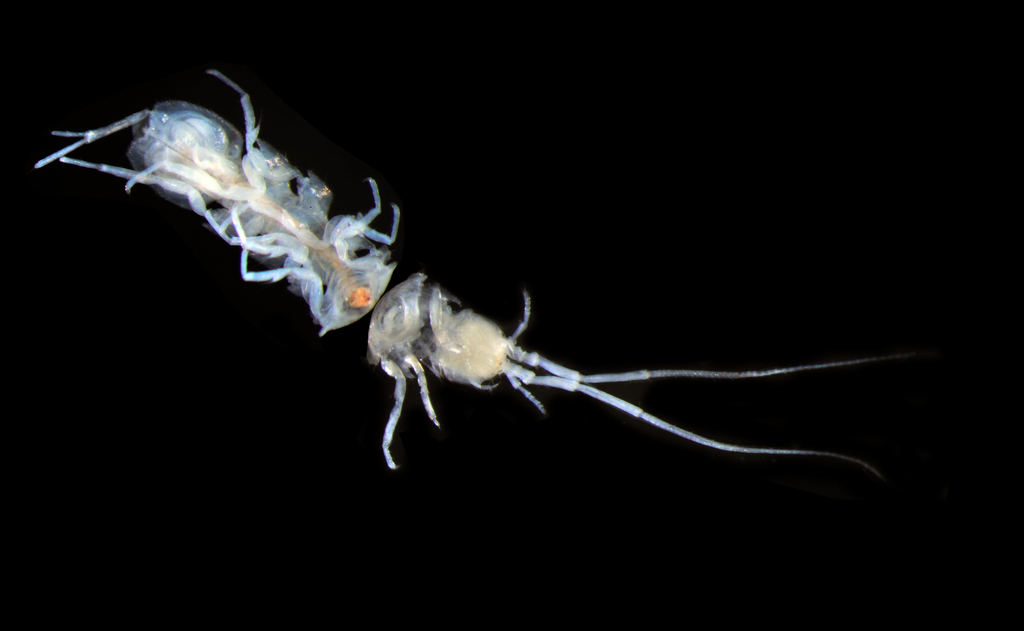
(c) Dr. Andrew G. Cannizzaro, some rights reserved (CC BY) · licence
Family: Asellidae · Class: Malacostraca · Order: Isopoda
Conservation status: G1 S1
Calasellus longus (An Isopod) is a California animal in the Asellidae family.
Calasellus longus is a small, troglobitic (cave-dwelling) isopod crustacean endemic to a highly restricted area in California's Sierra Nevada mountains. This pale, elongated freshwater isopod belongs to the family Asellidae and represents both a monotypic genus and species described specifically from groundwater habitats near Shaver Lake in Fresno County. As a troglobitic species, C. longus exhibits typical adaptations to subterranean life, including reduced pigmentation and likely enhanced sensory structures for navigating dark environments. The species displays the characteristic flattened, segmented body plan of isopods, with seven pairs of walking legs and a tail fan (uropods) used for swimming and respiration. Specific morphological measurements have not been well documented in available literature. The known range of Calasellus longus is extraordinarily limited, consisting only of springs around Shaver Lake in Fresno County, California (Rogers 2005). This restriction to a single locality in the southern Sierra Nevada makes it one of California's most geographically restricted crustaceans. The species occurs at elevations associated with the Shaver Lake area, approximately 1,600 meters (5,200 feet) above sea level. Calasellus longus inhabits groundwater-fed spring systems and associated subterranean waters. These springs likely maintain relatively constant temperatures year-round and provide the stable aquatic conditions required by obligate groundwater fauna. The species depends entirely on groundwater-dependent ecosystems, making it particularly vulnerable to water table fluctuations and groundwater contamination. The springs around Shaver Lake represent specialized karst or fractured bedrock systems that support this endemic fauna. Little is documented about the specific ecology and behavior of C. longus. Like other asellid isopods, it likely feeds on detritus, bacteria, and organic matter present in the groundwater environment. The species presumably reproduces through direct development, with females carrying eggs and young in a brood pouch (marsupium) until they reach juvenile form. Seasonal activity patterns and population dynamics remain unstudied. Calasellus longus faces significant conservation challenges due to its extremely limited distribution and dependence on groundwater systems. The species carries a Global/State Rank of G1 S1, indicating it is critically imperiled both globally and within California. This ranking reflects the species' vulnerability to habitat modification, groundwater depletion, and contamination from surface activities in the Shaver Lake watershed. Development pressures, recreational activities, and potential climate change impacts on groundwater recharge pose ongoing threats to this endemic isopod. The species' restriction to a single locality means that any local disturbance could potentially affect the entire known population. Conservation of C. longus requires protection of the groundwater systems around Shaver Lake and maintenance of natural hydrological processes that sustain these spring habitats.
Classification
Class: Malacostraca · Order: Isopoda · Family: Asellidae
Conservation status
G1 S1
Frequently asked questions
How is Calasellus longus classified?
Calasellus longus belongs to class Malacostraca, order Isopoda, family Asellidae.
What family does Calasellus longus belong to?
Calasellus longus is in the Asellidae family.
Is Calasellus longus protected or of conservation concern?
Calasellus longus carries the following status: G1 S1.
What is Calasellus longus?
Calasellus longus is a small, troglobitic (cave-dwelling) isopod crustacean endemic to a highly restricted area in California's Sierra Nevada mountains.
Is Calasellus longus found in California?
Yes. Calasellus longus is recorded in California in The California Species Project's catalogue.
Related species
Other California species in the same genus, family, or bioregion.
Data from The California Species Project — 14,000+ California species with verified data from CNPS, CDFW, USFWS, and more.