Calcarius pictus
Smith's Longspur
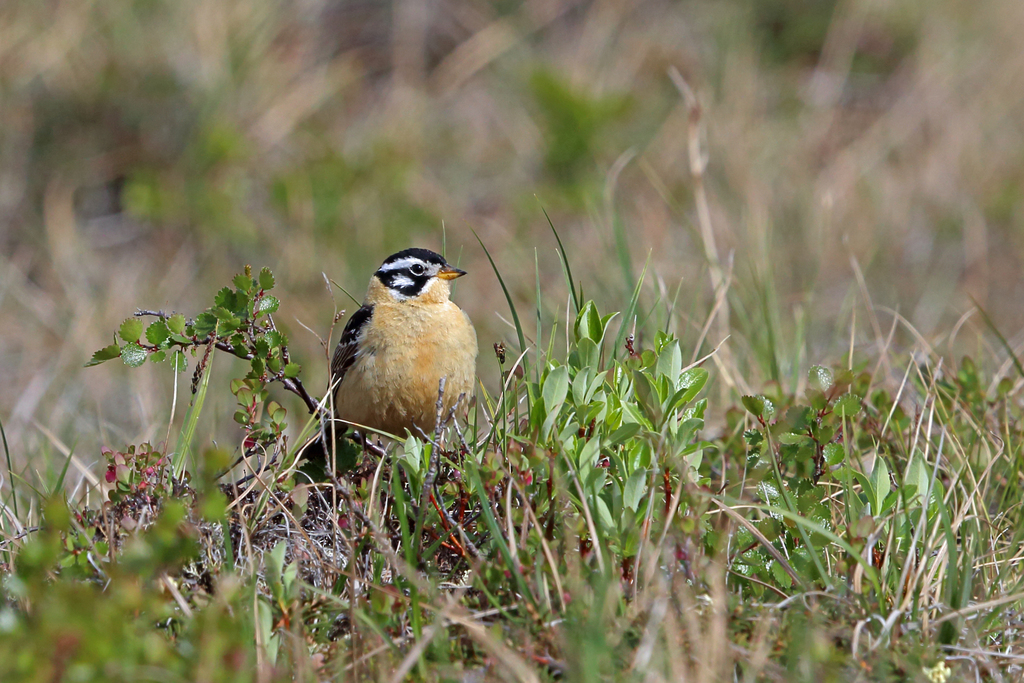
(c) Nigel Voaden, some rights reserved (CC BY) · licence
Family: Calcariidae · Class: Aves · Order: Passeriformes
Calcarius pictus (Smith's Longspur) is a California animal in the Calcariidae family.
Smith's Longspur is a medium-sized songbird measuring 14 to 16.5 cm (5.5 to 6.5 inches) in length with a wingspan of approximately 25 to 28 cm (10 to 11 inches). During breeding season, males display distinctive plumage with a black head and throat, white cheek patches, and a prominent white collar. The nape shows bright chestnut-orange coloration, while the back is streaked brown and black. The underparts are pale buff to white with black streaking on the sides. Breeding females are more subdued, showing brownish upperparts with dark streaking and pale underparts. In winter plumage, both sexes appear more uniform brown with streaked patterns, making field identification challenging. The species has a relatively short, thick bill typical of seed-eating birds and shows white outer tail feathers in flight. Smith's Longspur breeds in the Arctic and subarctic regions of Alaska and northern Canada, primarily in areas north of the treeline. The species winters in the central Great Plains of the United States, with the core wintering range extending from Kansas through Texas and into northern Mexico. In California, Smith's Longspur is considered a rare vagrant, with scattered records primarily from the Central Valley and coastal areas during migration and winter months. Most California observations occur between October and March, with individuals typically found among flocks of other longspur species. The breeding habitat consists of wet tundra with sedge tussocks, low shrubs, and scattered patches of bare ground. During winter, the species occupies short-grass prairies, agricultural fields, and airports with closely cropped vegetation. Smith's Longspurs show a strong preference for areas with sparse ground cover that allows for easy movement while foraging. The species typically occurs at elevations below 500 meters during winter, though breeding areas in the Arctic may reach higher elevations. Smith's Longspurs are ground-dwelling birds that feed primarily on seeds during winter and insects during the breeding season. The diet includes grass seeds, particularly from Panicum and Setaria species, as well as beetles, flies, and caterpillars when feeding young. Breeding occurs from June to August in the Arctic, with females constructing cup-shaped nests on the ground among vegetation. Clutch size ranges from three to five eggs, with an incubation period of 11 to 13 days. The species exhibits a unique mating system where females may mate with multiple males, and males may assist in caring for young that are not their offspring. Smith's Longspur is not federally listed under the Endangered Species Act. The species is classified as Least Concern by the International Union for Conservation of Nature, though population trends are difficult to assess due to the remote breeding range. Climate change poses potential threats to Arctic breeding habitats, while conversion of grassland wintering habitats to agriculture may impact winter survival. The species benefits from grassland conservation programs in the Great Plains states.
Classification
Class: Aves · Order: Passeriformes · Family: Calcariidae
Frequently asked questions
How is Calcarius pictus classified?
Calcarius pictus belongs to class Aves, order Passeriformes, family Calcariidae.
What family does Calcarius pictus belong to?
Calcarius pictus is in the Calcariidae family.
What is Calcarius pictus?
Smith's Longspur is a medium-sized songbird measuring 14 to 16.5 cm (5.5 to 6.5 inches) in length with a wingspan of approximately 25 to 28 cm (10 to 11 inches).
Is Calcarius pictus found in California?
Yes. Calcarius pictus is recorded in California in The California Species Project's catalogue.
Related species
Other California species in the same genus, family, or bioregion.
Data from The California Species Project — 14,000+ California species with verified data from CNPS, CDFW, USFWS, and more.