Calephelis wrighti
Wright's Metalmark
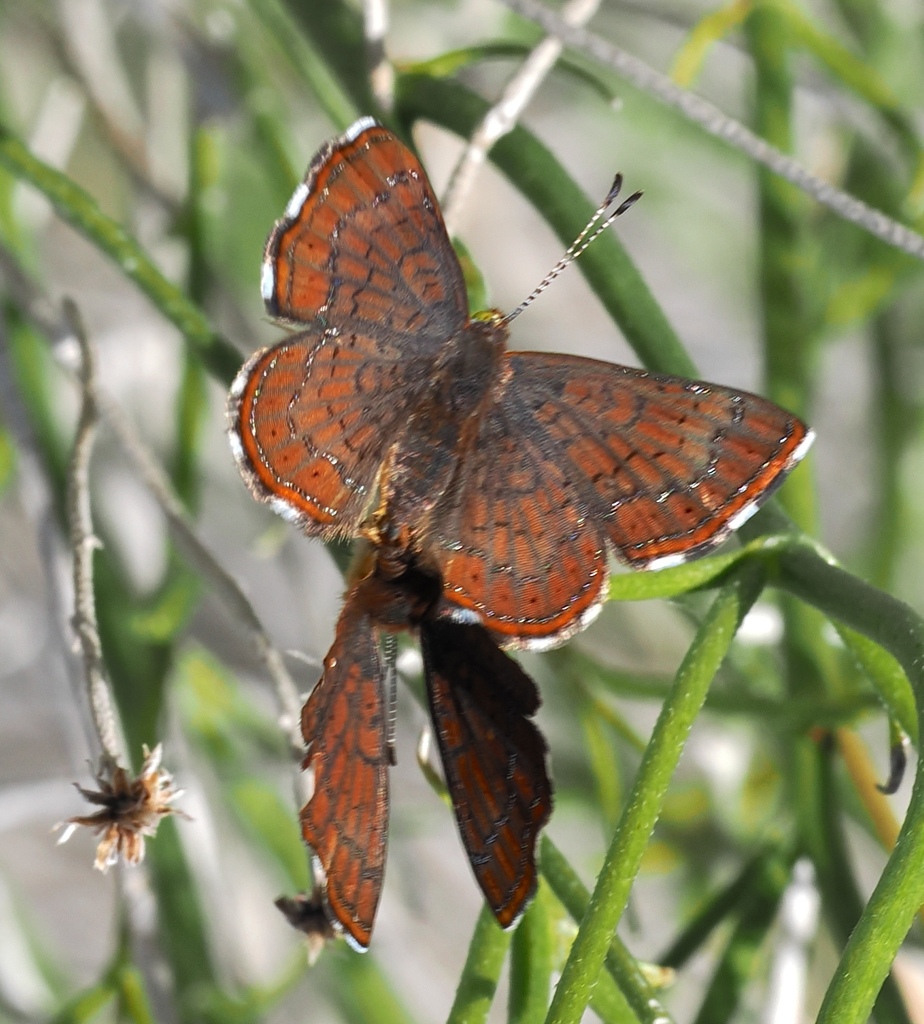
(c) desertnaturalist, some rights reserved (CC BY) · licence
Family: Riodinidae · Class: Insecta · Order: Lepidoptera
Calephelis wrighti (Wright's Metalmark) is a California animal in the Riodinidae family.
Wright's Metalmark is a small butterfly in the family Riodinidae, characterized by metallic spots on the wing undersides that give the metalmark group its distinctive name. Adults have a wingspan of approximately 19-25 mm (0.75-1.0 inches). The dorsal wing surfaces are dark brown to black with orange-red markings, while the ventral surfaces display a complex pattern of metallic silver spots against a mottled brown and gray background. Males typically exhibit more vibrant coloration than females, with brighter orange markings on the forewings. Wright's Metalmark occurs in southern California and western Arizona, extending south into Baja California, Mexico. In California, the species is documented from desert regions of Imperial, Riverside, and San Bernardino counties. The distribution follows the range of its host plant through the Sonoran Desert ecosystem, where suitable habitat patches support localized populations. This species inhabits desert washes, rocky hillsides, and disturbed areas where Sweet-bush (Bebbia juncea) grows. Sweet-bush, a member of the sunflower family (Asteraceae), serves as the exclusive larval host plant. The butterfly typically occurs at elevations from sea level to approximately 1,200 meters (4,000 feet) in areas with scattered shrub cover and exposed rocky or sandy substrates. Adults are often found near flowering plants that provide nectar sources, including desert broom, brittlebush, and other composite flowers. Wright's Metalmark exhibits multiple broods per year in favorable conditions, with adults most commonly observed from March through October, peaking during spring and fall months when temperatures are moderate. Flight is typically low and direct, with males establishing territories near host plants and nectar sources. Females deposit eggs singly on young shoots and leaves of Sweet-bush. Larvae feed on the foliage and develop through several instars before pupating in leaf litter or debris near the base of the host plant. The species overwinters primarily as larvae, resuming development with warming spring temperatures. Conservation status information for Wright's Metalmark is limited, and the species does not appear on federal or state threatened or endangered species lists as of December 2025. However, like many desert butterflies dependent on specific host plants, populations may be vulnerable to habitat degradation from urban development, recreational activities, and changes in precipitation patterns associated with climate change. The species' reliance on Sweet-bush makes it particularly susceptible to factors affecting this plant's distribution and abundance. Overgrazing by livestock and invasive plant species may also impact habitat quality in some areas. Long-term monitoring data are sparse, making population trend assessment difficult. The patchy distribution of suitable habitat and host plants suggests that local populations may be isolated, potentially making them more vulnerable to environmental stochasticity and genetic bottlenecks.
Classification
Class: Insecta · Order: Lepidoptera · Family: Riodinidae
Frequently asked questions
How is Calephelis wrighti classified?
Calephelis wrighti belongs to class Insecta, order Lepidoptera, family Riodinidae.
What family does Calephelis wrighti belong to?
Calephelis wrighti is in the Riodinidae family.
What is Calephelis wrighti?
Wright's Metalmark is a small butterfly in the family Riodinidae, characterized by metallic spots on the wing undersides that give the metalmark group its distinctive name.
Is Calephelis wrighti found in California?
Yes. Calephelis wrighti is recorded in California in The California Species Project's catalogue.
Related species
Other California species in the same genus, family, or bioregion.
Data from The California Species Project — 14,000+ California species with verified data from CNPS, CDFW, USFWS, and more.