Calidris alba
Sanderling
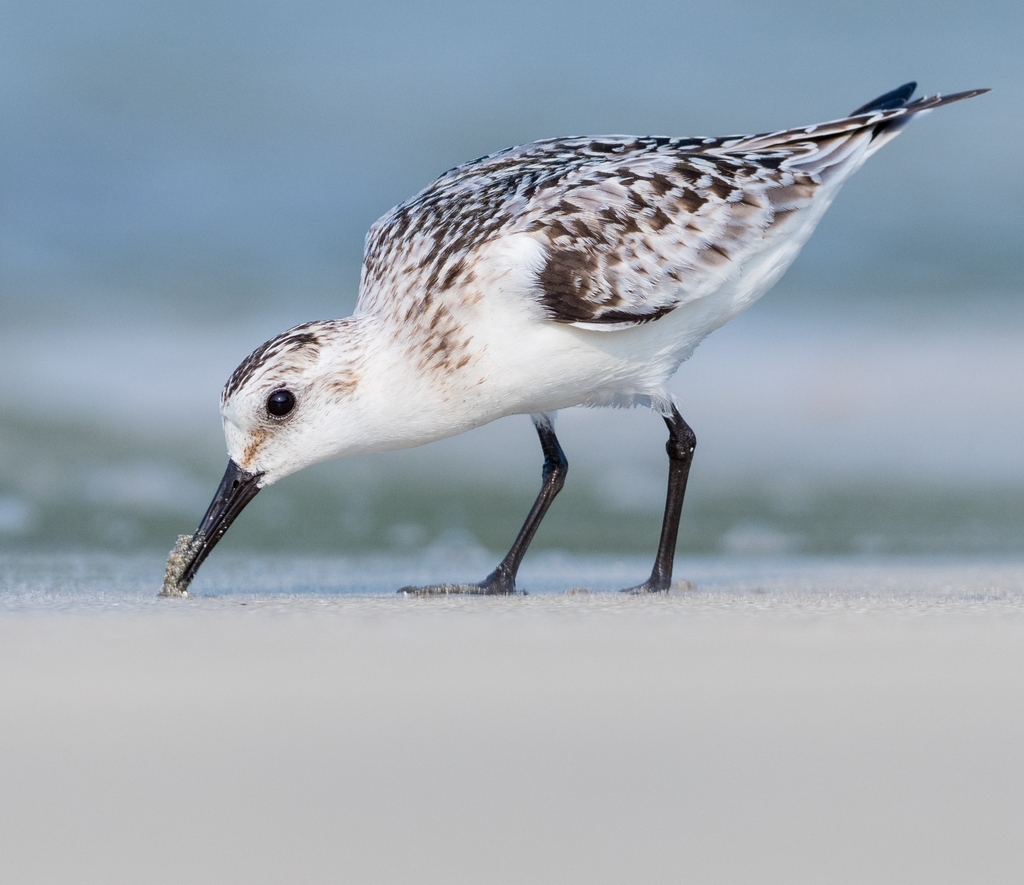
(c) Marco Chan, some rights reserved (CC BY) · licence
Family: Scolopacidae · Class: Aves · Order: Charadriiformes
Calidris alba (Sanderling) is a California animal in the Scolopacidae family.
The Sanderling is a small, robust shorebird measuring 18-20 cm (7-8 inches) in length with a wingspan of 35-39 cm (14-15 inches). Adults weigh 40-100 grams. During breeding season, adults display rusty-red upperparts with black centers and white underparts. Non-breeding adults are pale gray above and white below, earning them the nickname "gray ghost." The bill is straight and black, measuring 2-2.5 cm in length, and the legs are black. Juveniles show a scaly appearance on the upperparts with buff and black markings. Sanderlings breed in the high Arctic tundra of Canada, Alaska, Greenland, and Siberia. In California, they are common migrants and winter residents along the entire coastline from March through May and July through October. Some individuals remain year-round, particularly along central and southern California beaches. The species occurs from the Oregon border south to Mexico, with concentrations at major estuaries including San Francisco Bay, Monterey Bay, and coastal lagoons. This species inhabits sandy beaches, mudflats, and rocky intertidals during migration and winter. Sanderlings show strong preference for wave-swept sandy shores where they probe for invertebrates in the surf zone. They also utilize salt ponds, lagoons, and occasionally inland alkaline lakes during migration. The species forages primarily in the intertidal zone, following retreating waves to capture exposed prey. Sanderlings are highly gregarious outside the breeding season, forming flocks of dozens to thousands of individuals. They exhibit characteristic "wave-chasing" behavior, running back and forth with the surf to capture small crustaceans, marine worms, and mollusks exposed by receding waves. Their diet includes amphipods, isopods, polychaete worms, and small bivalves. During migration, they may also consume insects and larvae. The species practices sequential polyandry, with females potentially mating with multiple males and leaving them to incubate eggs and raise young. Sanderlings undertake one of the longest migrations of any bird, with some populations traveling over 10,000 km between Arctic breeding grounds and southern wintering areas. California populations include birds from multiple breeding areas across the Arctic. The species completes molt migration, with adults moving to specific staging areas after breeding to undergo complete feather replacement. While not federally or state-listed in California, Sanderlings face conservation challenges from coastal development, human disturbance, and climate change impacts on Arctic breeding habitat. Beach recreation activities can disrupt roosting and foraging behavior. Sea level rise threatens both wintering habitat and Arctic breeding areas. According to the North American Bird Conservation Initiative, Sanderling populations have declined by approximately 80% since 1973 based on Christmas Bird Count data. The species remains relatively common in California but requires continued monitoring and coastal habitat protection to maintain stable populations.
Classification
Class: Aves · Order: Charadriiformes · Family: Scolopacidae
Frequently asked questions
How is Calidris alba classified?
Calidris alba belongs to class Aves, order Charadriiformes, family Scolopacidae.
What family does Calidris alba belong to?
Calidris alba is in the Scolopacidae family.
What is Calidris alba?
The Sanderling is a small, robust shorebird measuring 18-20 cm (7-8 inches) in length with a wingspan of 35-39 cm (14-15 inches).
Is Calidris alba found in California?
Yes. Calidris alba is recorded in California in The California Species Project's catalogue.
Related species
Other California species in the same genus, family, or bioregion.
Data from The California Species Project — 14,000+ California species with verified data from CNPS, CDFW, USFWS, and more.