Calidris alpina
Dunlin
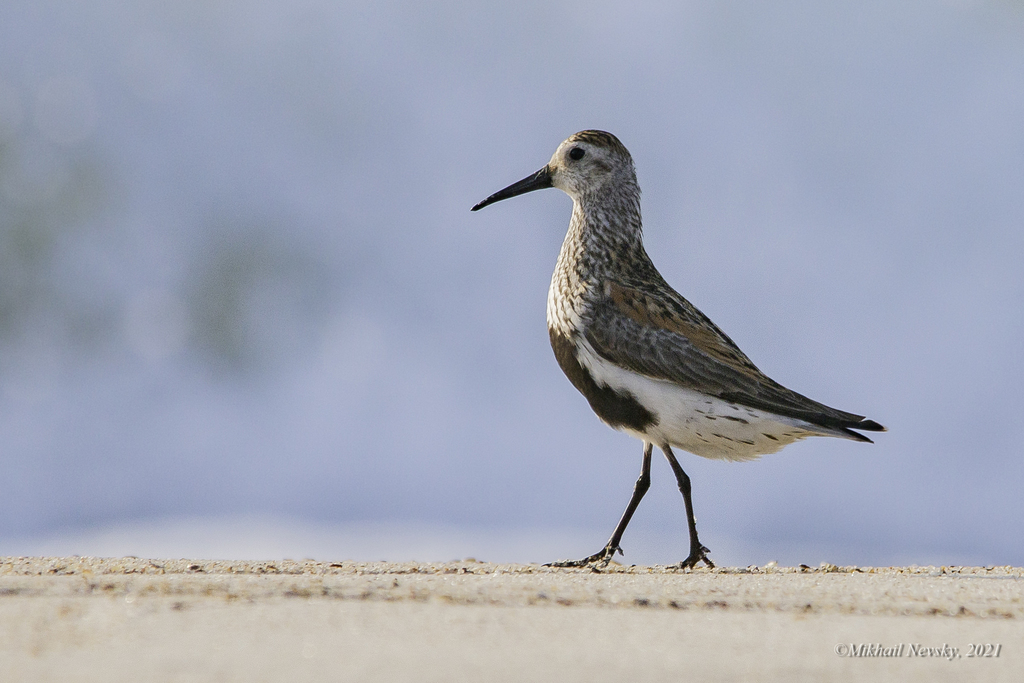
(c) Mikhail Nevsky, some rights reserved (CC BY) · licence
Family: Scolopacidae · Class: Aves · Order: Charadriiformes
Calidris alpina (Dunlin) is a California animal in the Scolopacidae family.
The Dunlin is a medium-sized sandpiper measuring 16 to 22 cm (6.3 to 8.7 inches) in length with a wingspan of 32 to 36 cm (12.6 to 14.2 inches). Adults weigh 48 to 64 grams (1.7 to 2.3 ounces). During breeding season, adults display distinctive rufous and black upperparts with heavy black streaking, a prominent black belly patch, and white underparts. The bill is black, slightly decurved, and measures 28 to 36 mm in length. Non-breeding adults appear gray-brown above with white underparts and lack the distinctive belly patch. Juveniles show buff-edged feathers on the upperparts and fine streaking on the breast. Dunlin breed across the Arctic tundra of Alaska, northern Canada, Greenland, and northern Eurasia. In California, they occur as common winter residents and passage migrants along the entire coast from September through May. Major wintering areas include San Francisco Bay, Humboldt Bay, Bodega Bay, Monterey Bay, Morro Bay, and the Salton Sea. The species also uses coastal estuaries, lagoons, and mudflats throughout the state during migration periods. The species inhabits intertidal mudflats, sandy beaches, salt ponds, shallow coastal lagoons, and estuarine environments. Dunlin prefer areas with soft substrates where they can probe for invertebrates. During high tides, flocks often roost on nearby beaches, salt pond levees, or adjacent grasslands. In the Salton Sea region, they utilize mudflats, agricultural drainage ponds, and shallow lake margins. Dunlin are highly gregarious outside the breeding season, forming flocks that can number in the thousands. They feed primarily by probing in mud and sand for polychaete worms, small mollusks, crustaceans, and aquatic insects. Their foraging behavior includes rapid probing motions and occasional surface gleaning. The species exhibits coordinated synchronized flight displays, with large flocks wheeling and turning in tight formation movements over foraging areas. Breeding occurs on Arctic tundra from May through July. Females lay 3 to 4 eggs in a ground nest lined with vegetation. Incubation lasts 21 to 22 days, with both parents sharing duties. Chicks are precocial and leave the nest within hours of hatching. The female typically departs before the young fledge, leaving parental care to the male. Dunlin populations appear stable globally, and the species is not currently listed under state or federal endangered species legislation. However, coastal habitat loss and degradation pose ongoing threats in California wintering areas. According to San Francisco Bay Bird Observatory data, San Francisco Bay supports approximately 100,000 to 200,000 Dunlin during peak winter months, representing one of the largest concentrations on the Pacific Coast. Climate change may affect prey availability and alter the timing of migration patterns. Conservation efforts focus on protecting and restoring coastal wetland habitats critical for wintering and migrating populations.
Classification
Class: Aves · Order: Charadriiformes · Family: Scolopacidae
Frequently asked questions
How is Calidris alpina classified?
Calidris alpina belongs to class Aves, order Charadriiformes, family Scolopacidae.
What family does Calidris alpina belong to?
Calidris alpina is in the Scolopacidae family.
What is Calidris alpina?
The Dunlin is a medium-sized sandpiper measuring 16 to 22 cm (6.3 to 8.7 inches) in length with a wingspan of 32 to 36 cm (12.6 to 14.2 inches).
Is Calidris alpina found in California?
Yes. Calidris alpina is recorded in California in The California Species Project's catalogue.
Related species
Other California species in the same genus, family, or bioregion.
Data from The California Species Project — 14,000+ California species with verified data from CNPS, CDFW, USFWS, and more.