Calidris bairdii
Baird's Sandpiper
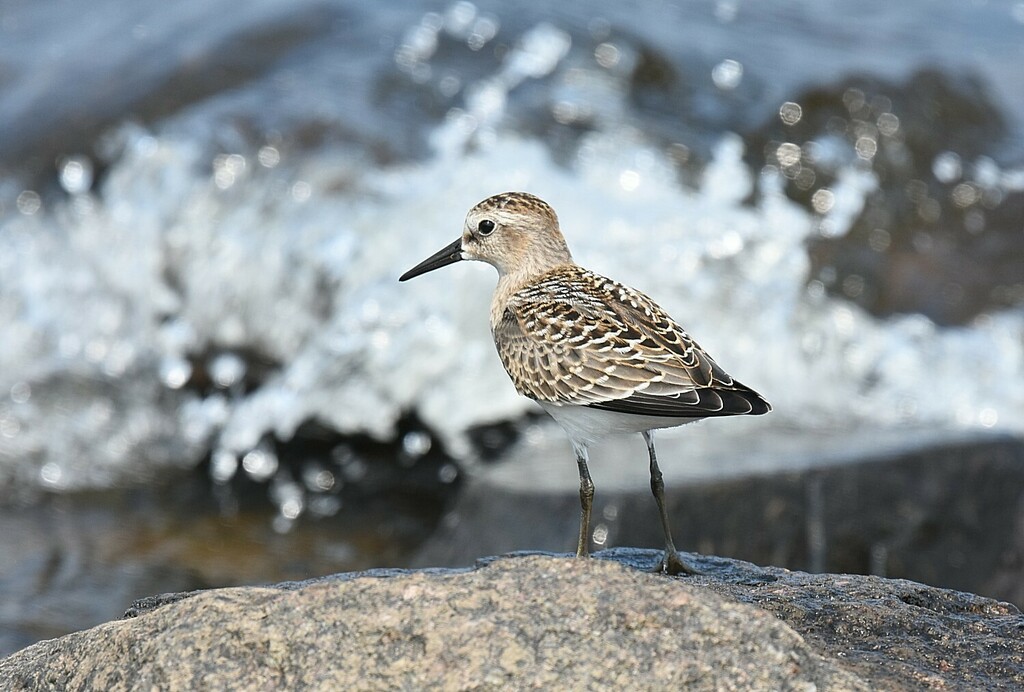
(c) Jimmy Dee, some rights reserved (CC BY-SA) · licence
Family: Scolopacidae · Class: Aves · Order: Charadriiformes
Calidris bairdii (Baird's Sandpiper) is a California animal in the Scolopacidae family.
Baird's Sandpiper is a medium-sized shorebird measuring 14-17 cm (5.5-6.7 inches) in length with a wingspan of 37-40 cm (14.5-15.7 inches). Adults weigh 26-41 grams (0.9-1.4 ounces). The species displays a relatively straight, dark bill slightly shorter than the head length, measuring 20-25 mm. During breeding season, adults show buff-brown upperparts with dark centers and pale edges on feathers, creating a scaled appearance. The breast displays fine dark streaking on a buff background, while the belly remains white. Legs are dark olive to blackish. Non-breeding adults appear grayer above with reduced streaking below. Juveniles are distinguished by their bright buff breast band and scaly upperpart pattern with prominent white feather edges. Baird's Sandpiper breeds across Arctic tundra from eastern Siberia through northern Alaska and northern Canada to western Greenland. The species migrates through the interior of North America, with California representing the western edge of its regular migration corridor. In California, Baird's Sandpiper occurs primarily as an uncommon to rare migrant during spring (April-May) and fall (July-September) passage periods. The species is most frequently observed in the Central Valley, Salton Sea, and scattered locations along the coast, with peak numbers typically recorded during August and September. During migration through California, Baird's Sandpiper utilizes mudflats, shallow ponds, flooded agricultural fields, sewage treatment facilities, and alkaline lakes. Unlike many congeners that prefer coastal habitats, this species shows a strong preference for inland freshwater and saline wetlands. The species frequently associates with mixed shorebird flocks but can be found in single-species groups. Optimal habitat includes areas with exposed mud or short vegetation where invertebrate prey is accessible. Baird's Sandpiper employs a pick-and-probe foraging strategy, feeding primarily on small invertebrates including chironomid larvae, beetles, flies, and crustaceans. During migration, the species may also consume plant seeds and algae. Breeding occurs on Arctic tundra where females lay four eggs in ground scrapes lined with vegetation. The incubation period lasts 19-22 days, with both sexes participating in nest duties. Chicks are precocial and capable of foraging independently within hours of hatching. Baird's Sandpiper is not federally or state listed in California, reflecting its status as a migrant rather than breeding resident. However, the species faces conservation challenges throughout its range due to habitat loss in staging areas, climate change affecting Arctic breeding grounds, and potential impacts from agricultural practices in wintering areas of South America. Population trends indicate stability across much of the range, though monitoring is complicated by the species' remote breeding locations and dispersed migration pattern. Conservation efforts focus on protecting key stopover sites and maintaining water levels in managed wetlands during migration periods.
Classification
Class: Aves · Order: Charadriiformes · Family: Scolopacidae
Frequently asked questions
How is Calidris bairdii classified?
Calidris bairdii belongs to class Aves, order Charadriiformes, family Scolopacidae.
What family does Calidris bairdii belong to?
Calidris bairdii is in the Scolopacidae family.
What is Calidris bairdii?
Baird's Sandpiper is a medium-sized shorebird measuring 14-17 cm (5.5-6.7 inches) in length with a wingspan of 37-40 cm (14.5-15.7 inches).
Is Calidris bairdii found in California?
Yes. Calidris bairdii is recorded in California in The California Species Project's catalogue.
Related species
Other California species in the same genus, family, or bioregion.
Data from The California Species Project — 14,000+ California species with verified data from CNPS, CDFW, USFWS, and more.