Calidris canutus
Red Knot
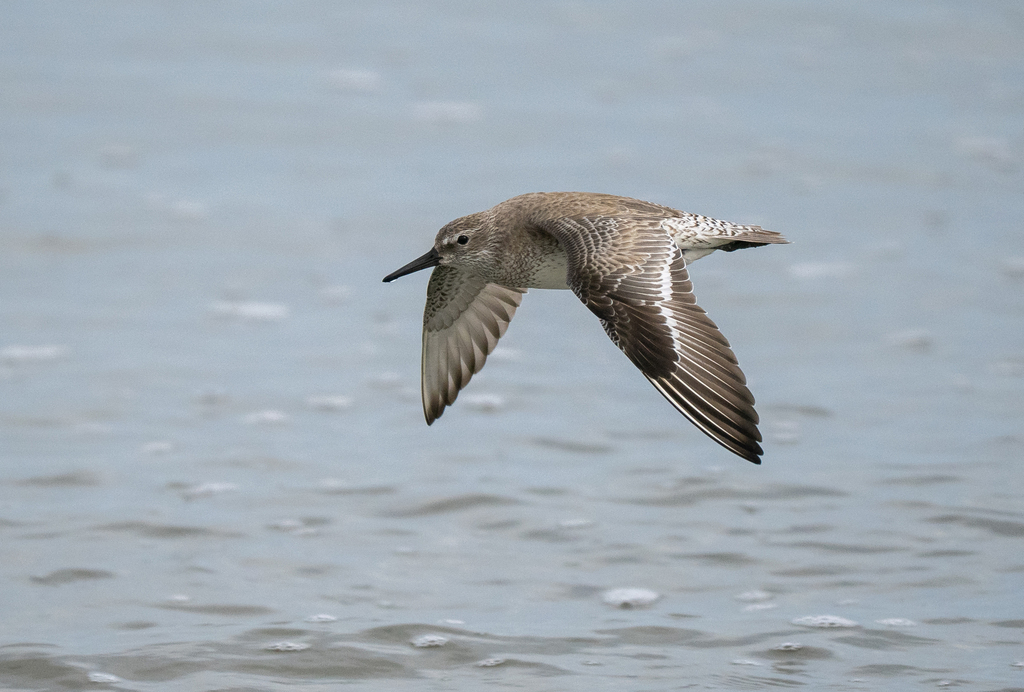
(c) Forest Botial-Jarvis, some rights reserved (CC BY) · licence
Family: Scolopacidae · Class: Aves · Order: Charadriiformes
Calidris canutus (Red Knot) is a California animal in the Scolopacidae family.
The Red Knot is a medium-sized shorebird measuring 23 to 26 cm (9 to 10 inches) in length with a wingspan of 47 to 53 cm (18.5 to 21 inches). Adults weigh between 95 and 180 grams (3.4 to 6.3 ounces). During breeding season, adults display rusty-red underparts and face, with a mottled brown and black back. Non-breeding plumage is pale gray above and white below, with a faint eyebrow stripe. The bill is straight and black, approximately 3 cm long, adapted for probing in sand and mud. Juveniles resemble non-breeding adults but show more distinct scaly patterns on the back. The Red Knot has one of the longest migration routes of any bird, breeding in the high Arctic tundra of Canada, Alaska, Greenland, and Siberia, and wintering along temperate and tropical coastlines worldwide. In California, the species occurs primarily as a migrant along the Pacific Coast from March through May and July through October. Small numbers overwinter at key sites including San Francisco Bay, Morro Bay, and the Salton Sea. The subspecies C. c. roselaari breeds in Alaska and northwest Canada and is the primary form occurring along the Pacific Coast. Red Knots inhabit sandy beaches, mudflats, rocky shores, and shallow lagoons during migration and winter. They prefer areas with extensive intertidal zones that support abundant invertebrate prey. In California, the species concentrates at major estuarine systems and coastal wetlands where they can access both sandy substrates and mudflats. During high tides, birds roost on beaches, shell bars, and adjacent upland areas. Red Knots are highly gregarious outside the breeding season, forming flocks of hundreds to thousands of individuals. They feed primarily on marine invertebrates including clams, mussels, marine worms, and crustaceans. The species employs both visual and tactile foraging methods, probing sand and mud with their sensitive bill tips or picking prey from the surface. Red Knots time their migration to coincide with peak invertebrate abundance at key stopover sites. During migration, birds can double their body weight to fuel non-stop flights of up to 9,000 km (5,600 miles). The Red Knot is considered a species of conservation concern due to dramatic population declines across multiple subspecies. The rufa subspecies, which migrates through the Atlantic Americas flyway, was listed as federally threatened in 2014 following population declines of over 75% since the 1980s. While the Pacific Coast roselaari subspecies has not experienced declines of similar magnitude, populations have shown concerning downward trends. According to the North American Bird Conservation Initiative, Red Knots are on the 2022 Watch List due to steep population declines and high threats. Primary conservation challenges include habitat loss at critical stopover sites, climate change impacts on prey availability, and human disturbance at roosting and feeding areas. Sea level rise poses additional long-term threats to coastal wintering and stopover habitats.
Classification
Class: Aves · Order: Charadriiformes · Family: Scolopacidae
Frequently asked questions
How is Calidris canutus classified?
Calidris canutus belongs to class Aves, order Charadriiformes, family Scolopacidae.
What family does Calidris canutus belong to?
Calidris canutus is in the Scolopacidae family.
What is Calidris canutus?
The Red Knot is a medium-sized shorebird measuring 23 to 26 cm (9 to 10 inches) in length with a wingspan of 47 to 53 cm (18.5 to 21 inches).
Is Calidris canutus found in California?
Yes. Calidris canutus is recorded in California in The California Species Project's catalogue.
Related species
Other California species in the same genus, family, or bioregion.
Data from The California Species Project — 14,000+ California species with verified data from CNPS, CDFW, USFWS, and more.