Calidris canutus rufa
Rufa red knot
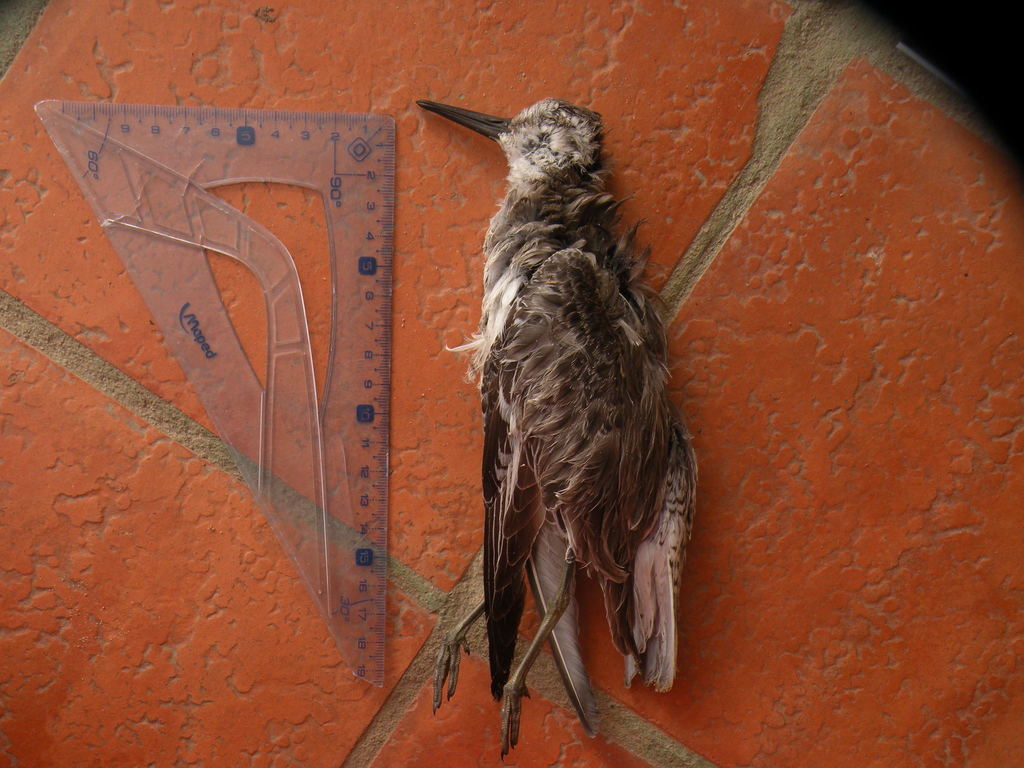
no rights reserved · CC0
Family: Scolopacidae · Class: Aves · Order: Charadriiformes
Conservation status: Threatened
Calidris canutus rufa (Rufa red knot) is a California animal in the Scolopacidae family.
The rufa red knot is a stocky, medium-sized shorebird measuring 23 to 28 centimeters (9 to 11 inches) in length with a wingspan reaching 51 centimeters (20 inches). This robin-sized bird has a proportionately small head, small dark eyes, and a short neck. The black bill tapers from a stout base to a relatively fine tip, with length approximately equal to head length. During breeding season, adults display rusty-red plumage on the head, neck, and underparts, while winter plumage shifts to dull gray dorsally and white ventrally with few distinct markings. The species has relatively short legs compared to other shorebirds and produces flutelike flight songs described as poorr-mee that become a series of poorr-poor calls. The rufa red knot has a global distribution spanning 40 U.S. states, two U.S. territories, and 24 other countries. The subspecies migrates annually between breeding grounds in the central Canadian Arctic and multiple wintering regions including the southeastern United States, northeast Gulf of Mexico, northern Brazil, and Tierra del Fuego at the southern tip of South America. Along the U.S. Atlantic coast and Gulf of Mexico, the species utilizes key staging and stopover areas during both northbound spring and southbound fall migrations. California also serves as part of the species' range, though the Pacific coast is more commonly associated with the related subspecies C. c. roselaari. Rufa red knots inhabit marine and estuarine environments, favoring coastal beaches, mudflats, salt marshes, and tidal areas where they can access abundant invertebrate prey. During breeding season, they prefer drier tundra habitats and sparsely vegetated gravel ridges in arctic regions. Critical stopover sites include Delaware Bay, where the species depends heavily on horseshoe crab eggs during northward migration. This species undertakes extensive long-distance migrations, traveling up to 15,000 kilometers between breeding and wintering grounds (Harrington 2001). Red knots are monogamous and single-brooded, typically laying four-egg clutches. Courtship involves elaborate flight, ground, and vocal displays. The species feeds primarily on marine invertebrates, particularly horseshoe crab eggs during migration, supplemented by mollusks, crustaceans, and marine worms. The U.S. Fish and Wildlife Service listed the rufa red knot as threatened under the Endangered Species Act on December 11, 2014. Population data reveals a severe decline from approximately 82,000 individuals in the 1980s to fewer than 30,000 by 2010 (Harrington 2001). Primary threats include habitat loss at critical stopover sites, overharvest of horseshoe crabs reducing food availability, coastal development, climate change effects on arctic breeding grounds, and human disturbance at feeding areas. Conservation efforts focus on protecting critical habitat, managing horseshoe crab populations, and international coordination given the species' hemispheric range.
Classification
Class: Aves · Order: Charadriiformes · Family: Scolopacidae
Conservation status
Threatened
Frequently asked questions
How is Calidris canutus rufa classified?
Calidris canutus rufa belongs to class Aves, order Charadriiformes, family Scolopacidae.
What family does Calidris canutus rufa belong to?
Calidris canutus rufa is in the Scolopacidae family.
Is Calidris canutus rufa protected or of conservation concern?
Calidris canutus rufa carries the following status: Threatened.
What is Calidris canutus rufa?
The rufa red knot is a stocky, medium-sized shorebird measuring 23 to 28 centimeters (9 to 11 inches) in length with a wingspan reaching 51 centimeters (20 inches).
Is Calidris canutus rufa found in California?
Yes. Calidris canutus rufa is recorded in California in The California Species Project's catalogue.
Related species
Other California species in the same genus, family, or bioregion.
Data from The California Species Project — 14,000+ California species with verified data from CNPS, CDFW, USFWS, and more.