Calidris ferruginea
Curlew Sandpiper
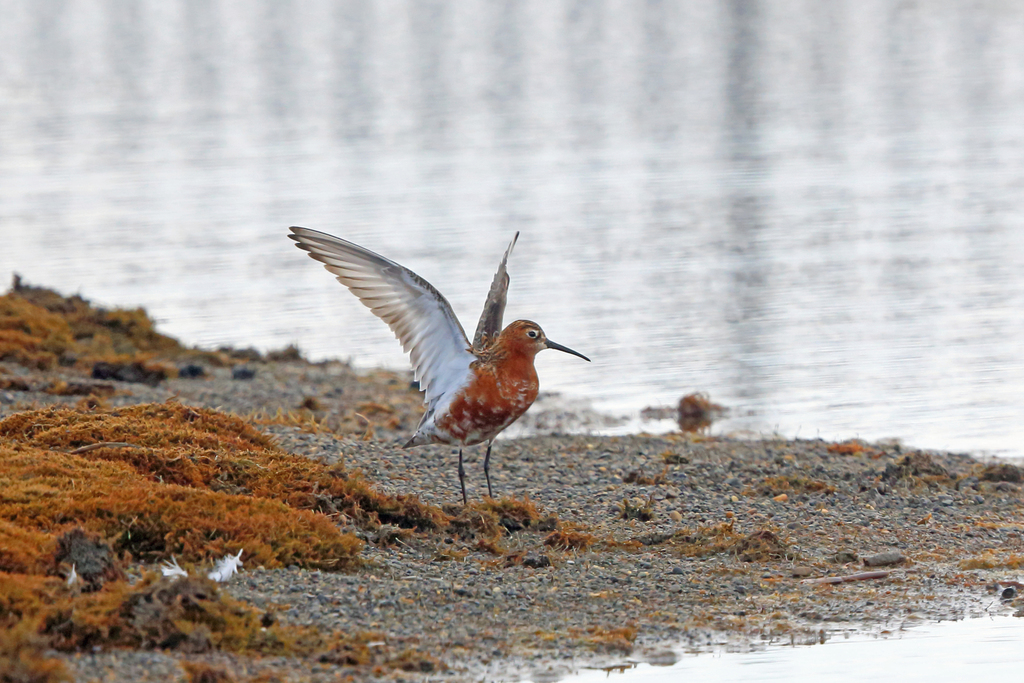
(c) Nigel Voaden, some rights reserved (CC BY) · licence
Family: Scolopacidae · Class: Aves · Order: Charadriiformes
Calidris ferruginea (Curlew Sandpiper) is a California animal in the Scolopacidae family.
The Curlew Sandpiper is a medium-sized shorebird measuring 18 to 23 centimeters (7.1 to 9.1 inches) in length with a wingspan of 38 to 41 centimeters (15 to 16 inches). Adults weigh between 50 to 90 grams (1.8 to 3.2 ounces). The species exhibits distinct seasonal plumage variations. During breeding season, adults display rich rufous-chestnut underparts and head, with dark-streaked upperparts showing rufous and black markings. Non-breeding adults are pale gray above with white underparts and a distinctive white eyebrow stripe. The bill is black, moderately long, and distinctly curved downward, measuring 35 to 41 millimeters in length. Legs are dark gray to black. Juveniles resemble non-breeding adults but show buff-colored feather edges on the upperparts and a peachy wash on the breast. The Curlew Sandpiper breeds in the Arctic tundra of northern Siberia, primarily in the Taymyr Peninsula and adjacent regions. During migration and winter, the species has a nearly global distribution, occurring across Europe, Africa, Asia, and Australia. In North America, the Curlew Sandpiper is a rare vagrant, with most records from Alaska and the Pacific Coast. California records are extremely uncommon, with fewer than 20 documented occurrences since 1900, primarily along the coast from Humboldt County to San Diego County. Most California sightings occur during fall migration between August and October. Curlew Sandpipers inhabit mudflats, estuaries, coastal lagoons, and shallow wetlands with exposed muddy or sandy substrates. During migration and winter, they frequent intertidal zones, salt ponds, sewage treatment facilities, and freshwater marshes. The species prefers areas with water depths of 5 to 15 centimeters where they can effectively probe for invertebrates. In California, vagrant individuals are typically found in large shorebird flocks at major stopover sites including San Francisco Bay, Monterey Bay, and the Salton Sea. Curlew Sandpipers are primarily invertivorous, feeding on polychaete worms, mollusks, crustaceans, and insect larvae. They employ a distinctive probing feeding technique, inserting their curved bills deep into soft sediments to extract prey. The species is highly gregarious outside the breeding season, often forming mixed flocks with other sandpiper species. Breeding occurs from June to July in the Arctic, with females laying 3 to 4 olive-colored eggs with dark markings in a shallow ground scrape lined with vegetation. Incubation lasts 21 to 22 days, performed primarily by the male after the female departs. The Curlew Sandpiper is not federally listed in the United States, reflecting its status as a non-breeding vagrant rather than a resident species. Globally, the species is classified as Near Threatened by the International Union for Conservation of Nature due to declining population trends. The global population is estimated at 2.2 to 2.5 million individuals, with declines documented across much of the wintering range. Primary threats include habitat loss from coastal development, climate change affecting Arctic breeding grounds, and disturbance at critical stopover sites during migration.
Classification
Class: Aves · Order: Charadriiformes · Family: Scolopacidae
Frequently asked questions
How is Calidris ferruginea classified?
Calidris ferruginea belongs to class Aves, order Charadriiformes, family Scolopacidae.
What family does Calidris ferruginea belong to?
Calidris ferruginea is in the Scolopacidae family.
What is Calidris ferruginea?
The Curlew Sandpiper is a medium-sized shorebird measuring 18 to 23 centimeters (7.1 to 9.1 inches) in length with a wingspan of 38 to 41 centimeters (15 to 16 inches).
Is Calidris ferruginea found in California?
Yes. Calidris ferruginea is recorded in California in The California Species Project's catalogue.
Related species
Other California species in the same genus, family, or bioregion.
Data from The California Species Project — 14,000+ California species with verified data from CNPS, CDFW, USFWS, and more.