Calidris fuscicollis
White-rumped Sandpiper
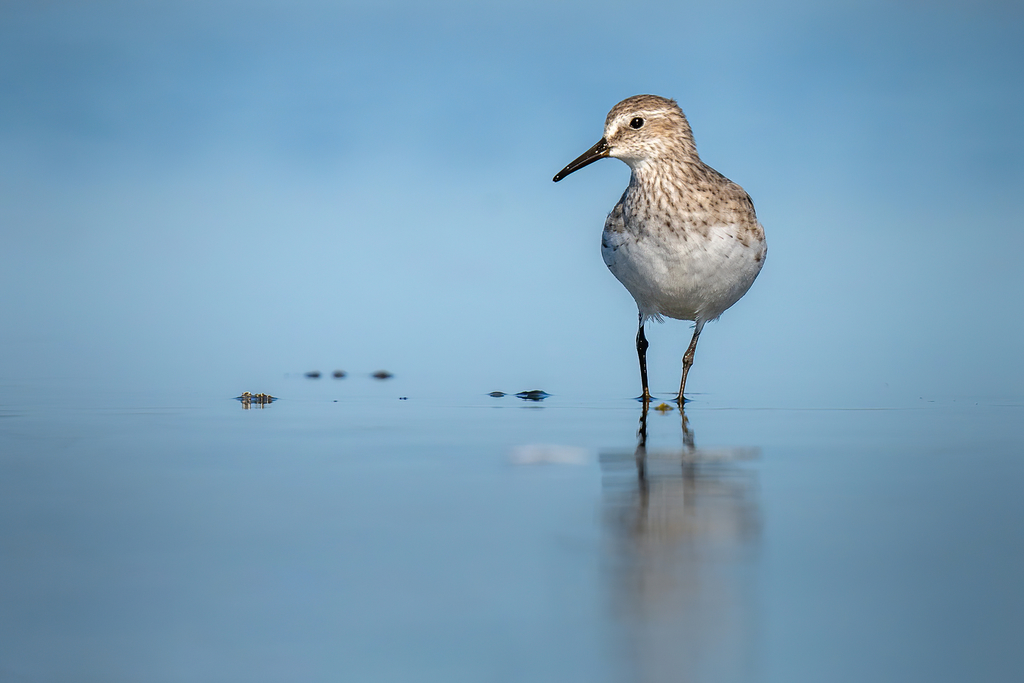
(c) Luciano Massa, some rights reserved (CC BY) · licence
Family: Scolopacidae · Class: Aves · Order: Charadriiformes
Calidris fuscicollis (White-rumped Sandpiper) is a California animal in the Scolopacidae family.
The White-rumped Sandpiper is a small shorebird measuring 18-20 cm (7.1-7.9 inches) in length with a wingspan of 43-46 cm (16.9-18.1 inches). Adults weigh 25-50 grams (0.9-1.8 ounces). In breeding plumage, the species displays a brownish-gray back with dark streaking, white underparts with dark spotting on the breast and flanks, and a distinctive white rump patch that is visible in flight. The bill is black, straight, and relatively short for a sandpiper, measuring approximately 22-25 mm. Non-breeding adults appear grayer above with reduced streaking, while juveniles show buff-colored edges on their back feathers. The white rump patch, from which the species derives its name, distinguishes it from most other small sandpipers. The White-rumped Sandpiper breeds in the Arctic tundra of northern Canada and Alaska, with nesting areas extending from Alaska's North Slope eastward to Hudson Bay and the Canadian Arctic archipelago. During migration, the species follows primarily the Central and Atlantic flyways. In California, White-rumped Sandpipers are uncommon to rare migrants, occurring mainly during spring and fall passage periods from April through May and July through October. They are most frequently observed along the coast and in the Central Valley, with scattered records from inland locations including the Salton Sea. This species inhabits various wetland environments during migration and winter, including mudflats, shallow ponds, flooded fields, sewage treatment facilities, and coastal beaches. White-rumped Sandpipers prefer areas with exposed mud or short vegetation where they can probe for invertebrates. On breeding grounds, they utilize wet tundra areas with low vegetation, often near water bodies such as ponds or streams. Elevation preferences during migration range from sea level to approximately 1,200 meters (3,937 feet). White-rumped Sandpipers are primarily insectivorous, feeding on chironomid larvae, beetles, flies, and other small invertebrates. They employ a probing feeding technique, inserting their bills into soft substrates to extract prey. The species exhibits a distinctive migration pattern, with some individuals traveling over 15,000 km (9,320 miles) annually between Arctic breeding grounds and South American wintering areas. Breeding occurs from June through July, with females laying 3-4 eggs in ground scrapes lined with vegetation. Incubation lasts 21-22 days, and young fledge approximately 16-18 days after hatching. Males typically provide most parental care while females may depart breeding areas early to begin southward migration. The White-rumped Sandpiper is not federally or state-listed in California, and the species maintains stable global populations according to Partners in Flight estimates. However, like many Arctic-breeding shorebirds, the species faces potential threats from climate change affecting tundra breeding habitats, coastal development impacting stopover sites, and pollution in wintering areas. The North American Breeding Bird Survey indicates relatively stable population trends over recent decades, though Arctic-breeding species may be particularly vulnerable to rapid environmental changes in polar regions.
Classification
Class: Aves · Order: Charadriiformes · Family: Scolopacidae
Frequently asked questions
How is Calidris fuscicollis classified?
Calidris fuscicollis belongs to class Aves, order Charadriiformes, family Scolopacidae.
What family does Calidris fuscicollis belong to?
Calidris fuscicollis is in the Scolopacidae family.
What is Calidris fuscicollis?
The White-rumped Sandpiper is a small shorebird measuring 18-20 cm (7.1-7.9 inches) in length with a wingspan of 43-46 cm (16.9-18.1 inches).
Is Calidris fuscicollis found in California?
Yes. Calidris fuscicollis is recorded in California in The California Species Project's catalogue.
Related species
Other California species in the same genus, family, or bioregion.
Data from The California Species Project — 14,000+ California species with verified data from CNPS, CDFW, USFWS, and more.