Calidris himantopus
Stilt Sandpiper
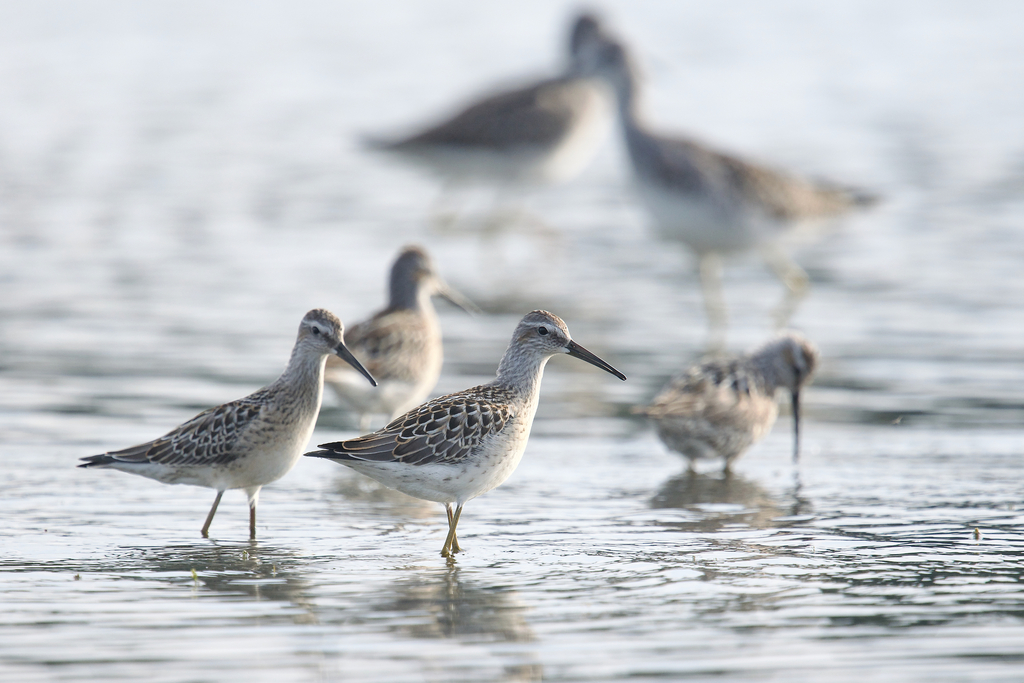
(c) Owen Strickland, some rights reserved (CC BY) · licence
Family: Scolopacidae · Class: Aves · Order: Charadriiformes
Calidris himantopus (Stilt Sandpiper) is a California animal in the Scolopacidae family.
The Stilt Sandpiper is a medium-sized shorebird measuring 19 to 23 cm (7.5 to 9.1 inches) in length with a wingspan of 42 to 46 cm (16.5 to 18.1 inches). Adults weigh between 55 to 100 grams. The species exhibits distinct seasonal plumages. Breeding adults display heavily barred underparts with rufous-chestnut patches on the cheeks and ear coverts, while the upperparts are mottled brown and gray. The bill is long, straight, and dark, measuring 35 to 40 mm, with a slight droop at the tip. The legs are distinctively long and greenish-yellow, giving the species its common name. Non-breeding adults are pale gray above with white underparts and a prominent white supercilium. Juveniles show buff-colored feather edges on the upperparts and lack the heavy barring of breeding adults. Stilt Sandpipers breed in the Arctic tundra of Alaska and northern Canada. During migration and winter, they occur throughout much of North America, including California. In California, the species is primarily a transient visitor during spring and fall migration periods, typically appearing from mid-April through May and again from July through September. Small numbers occasionally overwinter in suitable habitat, particularly in the Central Valley and coastal areas. The species has been recorded in all California counties with appropriate wetland habitat. The species inhabits shallow freshwater and brackish wetlands, including flooded agricultural fields, sewage ponds, managed wetlands, and mudflats. Stilt Sandpipers prefer water depths of 5 to 25 cm (2 to 10 inches) where they can wade while foraging. They show strong preference for areas with soft substrates and emergent vegetation. During migration, they utilize temporary wetlands created by seasonal flooding and irrigation. Stilt Sandpipers are tactile feeders, probing deeply into mud and soft substrates with their sensitive bills. Their diet consists primarily of aquatic invertebrates, including chironomid larvae, amphipods, oligochaetes, and small mollusks. They also consume plant seeds and algae. The species often feeds in mixed flocks with other sandpipers, particularly Least Sandpipers and Dunlin. Breeding occurs on Arctic tundra from late May through July, with females laying 4 buff-colored eggs with brown markings in a ground scrape lined with vegetation. The incubation period is 19 to 21 days, and chicks fledge after 17 to 18 days. Stilt Sandpipers are not federally or state listed in California and are considered secure globally by the International Union for Conservation of Nature. However, like many shorebird species, they face threats from habitat loss due to wetland drainage and conversion. Climate change poses additional challenges through altered precipitation patterns affecting breeding habitat in the Arctic and stopover sites along migration routes. In California, the species benefits from managed wetlands in wildlife refuges and waterfowl management areas. Population monitoring through Christmas Bird Counts and breeding bird surveys indicates stable populations, though long-term trends require continued assessment given the species' dependence on increasingly threatened wetland ecosystems.
Classification
Class: Aves · Order: Charadriiformes · Family: Scolopacidae
Frequently asked questions
How is Calidris himantopus classified?
Calidris himantopus belongs to class Aves, order Charadriiformes, family Scolopacidae.
What family does Calidris himantopus belong to?
Calidris himantopus is in the Scolopacidae family.
What is Calidris himantopus?
The Stilt Sandpiper is a medium-sized shorebird measuring 19 to 23 cm (7.5 to 9.1 inches) in length with a wingspan of 42 to 46 cm (16.5 to 18.1 inches).
Is Calidris himantopus found in California?
Yes. Calidris himantopus is recorded in California in The California Species Project's catalogue.
Related species
Other California species in the same genus, family, or bioregion.
Data from The California Species Project — 14,000+ California species with verified data from CNPS, CDFW, USFWS, and more.