Calidris mauri
Western Sandpiper
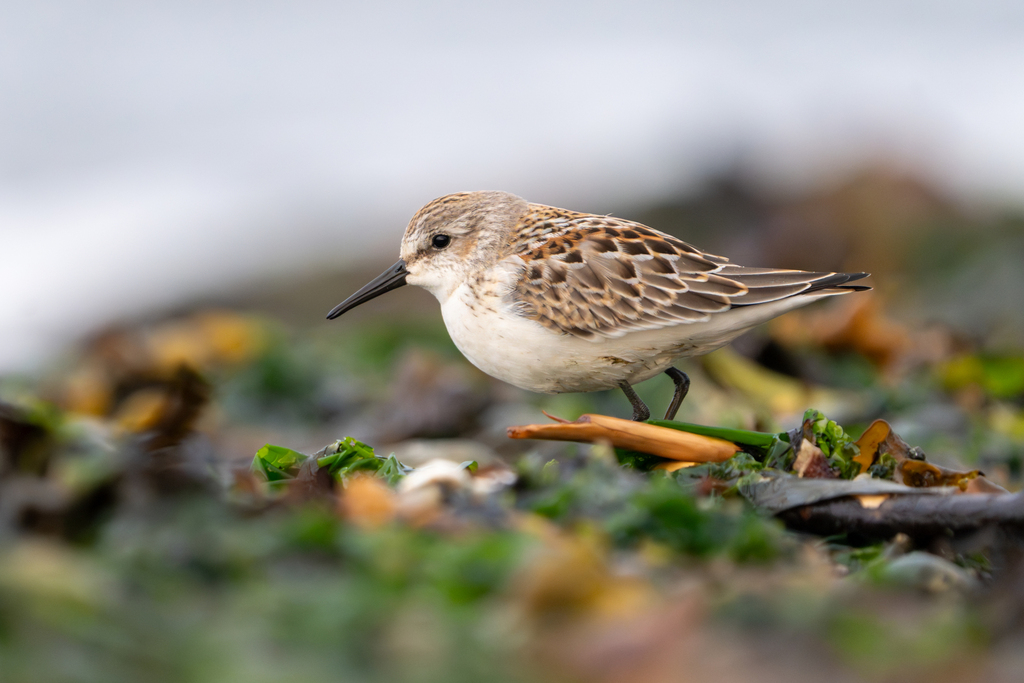
(c) Pete Lypkie, some rights reserved (CC BY) · licence
Family: Scolopacidae · Class: Aves · Order: Charadriiformes
Calidris mauri (Western Sandpiper) is a California animal in the Scolopacidae family.
The Western Sandpiper is a small shorebird measuring 14-17 cm (5.5-6.7 inches) in length with a wingspan of 35-40 cm (13.8-15.7 inches) and weighing 20-35 grams. During breeding season, adults display rufous streaking on the crown and ear coverts, with dark spots and chevrons across the breast and flanks. The bill is relatively long for a peep sandpiper, measuring 19-25 mm, with a slight downward curve at the tip. Non-breeding adults are pale gray above and white below, with minimal streaking. Juveniles show distinctive rufous and buff scaling on the upperparts with fine streaking on the breast. The Western Sandpiper breeds in coastal tundra regions of Alaska and extreme northwestern Canada, with the largest populations nesting on the Yukon-Kuskokwim Delta. During migration and winter, the species ranges along the Pacific Coast from southern Alaska to Peru, with significant populations wintering in California. According to eBird data, California hosts substantial numbers during migration periods, particularly at major stopover sites including San Francisco Bay, Monterey Bay, and the Salton Sea. The species also occurs along the Atlantic Coast during migration, though in smaller numbers. Western Sandpipers inhabit mudflats, sandy beaches, salt marshes, and shallow coastal lagoons during migration and winter. They prefer areas with soft substrates that support invertebrate prey populations. During breeding season, they occupy wet tundra with scattered vegetation near Arctic coastlines. The species shows strong site fidelity to traditional stopover locations, where they may remain for several weeks to replenish energy reserves. The diet consists primarily of small invertebrates including polychaete worms, small crustaceans, insects, and larvae. Birds employ tactile feeding, probing soft sediments with their sensitive bill tips. Western Sandpipers are highly gregarious outside the breeding season, often forming mixed flocks with other sandpiper species. Breeding occurs from late May through July, with females laying 3-4 eggs in ground scrapes lined with vegetation. Incubation lasts 20-22 days, and chicks fledge after 17-21 days. The Western Sandpiper is not federally listed under the Endangered Species Act and maintains stable population trends according to the North American Breeding Bird Survey. However, the species faces ongoing threats from habitat loss at key stopover sites due to coastal development and sea level rise. Climate change poses additional risks through altered prey availability and shifting habitat conditions. Shorebird populations depend heavily on a network of intact coastal habitats, making coordinated conservation efforts across international boundaries essential. The Western Sandpiper benefits from protected areas including national wildlife refuges and state parks that preserve critical feeding and roosting habitat along the Pacific Flyway.
Classification
Class: Aves · Order: Charadriiformes · Family: Scolopacidae
Frequently asked questions
How is Calidris mauri classified?
Calidris mauri belongs to class Aves, order Charadriiformes, family Scolopacidae.
What family does Calidris mauri belong to?
Calidris mauri is in the Scolopacidae family.
What is Calidris mauri?
The Western Sandpiper is a small shorebird measuring 14-17 cm (5.5-6.7 inches) in length with a wingspan of 35-40 cm (13.8-15.7 inches) and weighing 20-35 grams.
Is Calidris mauri found in California?
Yes. Calidris mauri is recorded in California in The California Species Project's catalogue.
Related species
Other California species in the same genus, family, or bioregion.
Data from The California Species Project — 14,000+ California species with verified data from CNPS, CDFW, USFWS, and more.