Calidris melanotos
Pectoral Sandpiper
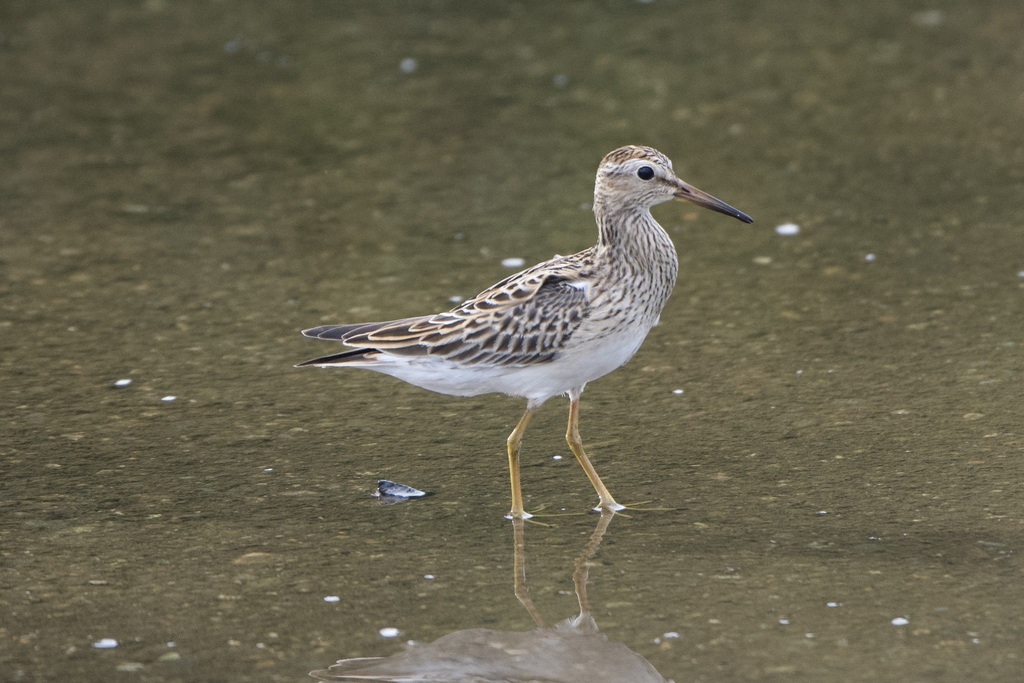
no rights reserved · CC0
Family: Scolopacidae · Class: Aves · Order: Charadriiformes
Calidris melanotos (Pectoral Sandpiper) is a California animal in the Scolopacidae family.
The Pectoral Sandpiper is a medium-sized shorebird measuring 19 to 23 centimeters (7.5 to 9.1 inches) in length with a wingspan of 38 to 44 centimeters (15 to 17.3 inches). Adults weigh between 45 and 100 grams (1.6 to 3.5 ounces), with males typically larger than females. The species exhibits a distinctive streaked breast pattern that ends abruptly at a clean white belly, creating a sharp contrast. The upperparts are mottled brown and black with rusty edges on the feathers. The bill is straight, dark, and medium-length, while the legs are yellowish to greenish-yellow. During breeding season, males develop an inflatable throat sac used in courtship displays. Pectoral Sandpipers breed in the Arctic tundra of Alaska and northern Canada, with the vast majority nesting on the North Slope of Alaska. During migration, they traverse much of North America, with the Pacific Flyway population passing through California. In California, the species occurs primarily as a transient migrant from late July through October during southbound migration and from April through May during northbound migration. They are uncommon but regular visitors to suitable habitat throughout the state, from coastal areas to inland valleys. The species inhabits shallow wetlands, flooded agricultural fields, sewage ponds, mudflats, and the edges of lakes and reservoirs. Pectoral Sandpipers prefer areas with emergent vegetation and muddy substrates rich in invertebrates. During migration, they frequent rice fields, managed wetlands, and seasonal pools. The species typically forages in water depths of 2 to 10 centimeters, using a deliberate picking and probing technique. Pectoral Sandpipers are omnivorous, feeding primarily on invertebrates including chironomid larvae, beetles, flies, and small crustaceans. During the breeding season, they also consume plant material and berries. The species exhibits a promiscuous mating system, with males establishing territories and performing elaborate aerial displays to attract females. Females construct ground nests lined with grass and moss, typically laying four eggs. Incubation lasts 21 to 23 days, and chicks are precocial, leaving the nest within hours of hatching. The species undertakes one of the longest migrations of any shorebird, with some individuals traveling over 30,000 kilometers (18,600 miles) annually between Arctic breeding grounds and wintering areas in South America. Males may migrate earlier than females and juveniles, a pattern known as differential migration. The Pectoral Sandpiper is not federally or state listed in California and maintains stable global populations. According to the North American Bird Conservation Initiative, the species has a continental population estimated at 400,000 to 2 million individuals. However, like many shorebirds, Pectoral Sandpipers face threats from habitat loss due to wetland drainage, climate change affecting Arctic breeding habitats, and disturbance at stopover sites during migration. Conservation efforts focus on protecting and restoring wetland habitats along migration routes and maintaining water levels in managed wetlands during critical migration periods.
Classification
Class: Aves · Order: Charadriiformes · Family: Scolopacidae
Frequently asked questions
How is Calidris melanotos classified?
Calidris melanotos belongs to class Aves, order Charadriiformes, family Scolopacidae.
What family does Calidris melanotos belong to?
Calidris melanotos is in the Scolopacidae family.
What is Calidris melanotos?
The Pectoral Sandpiper is a medium-sized shorebird measuring 19 to 23 centimeters (7.5 to 9.1 inches) in length with a wingspan of 38 to 44 centimeters (15 to 17.3 inches).
Is Calidris melanotos found in California?
Yes. Calidris melanotos is recorded in California in The California Species Project's catalogue.
Related species
Other California species in the same genus, family, or bioregion.
Data from The California Species Project — 14,000+ California species with verified data from CNPS, CDFW, USFWS, and more.