Calidris minuta
Little Stint
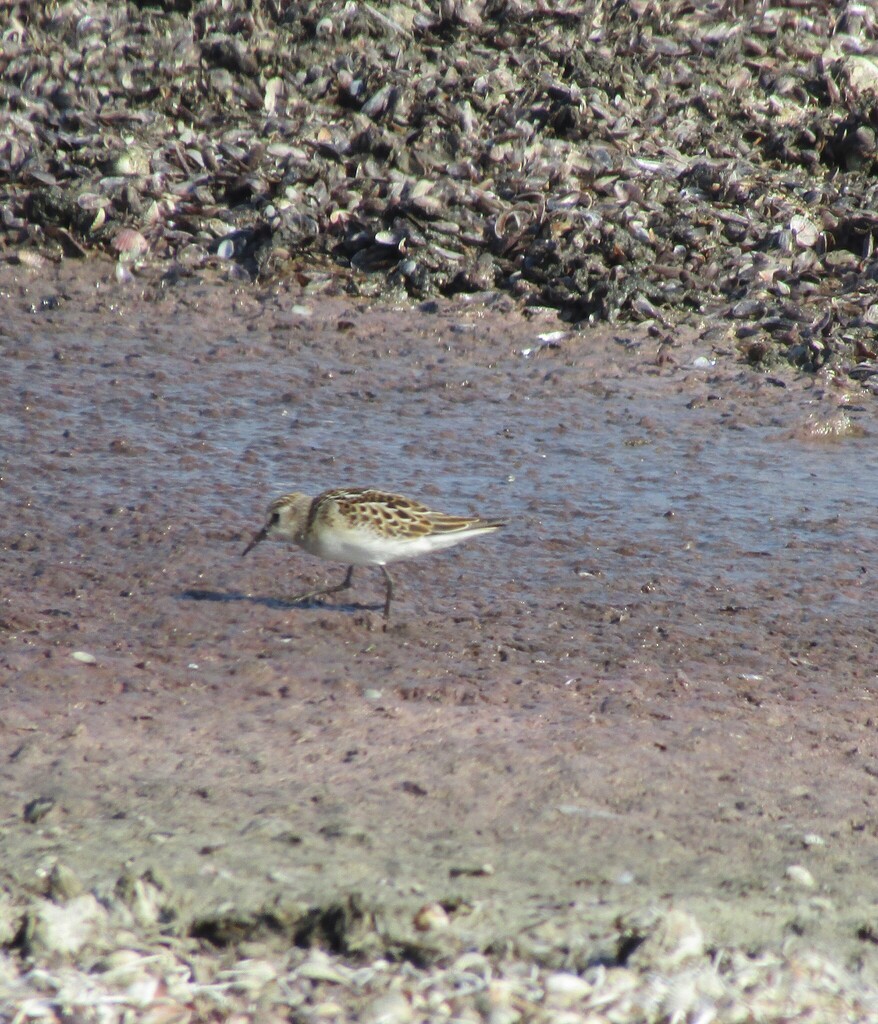
(c) SteveM4560, some rights reserved (CC BY) · licence
Family: Scolopacidae · Class: Aves · Order: Charadriiformes
Calidris minuta (Little Stint) is a California animal in the Scolopacidae family.
The Little Stint is a small shorebird measuring 12-14 cm (4.7-5.5 inches) in length with a wingspan of 27-30 cm (10.6-11.8 inches). Adults weigh 20-30 grams (0.7-1.1 ounces). During breeding season, the upperparts are rufous-brown with dark feather centers and pale edges, creating a scaly appearance. The underparts are white with dark streaking on the breast. In non-breeding plumage, the bird appears gray-brown above with clean white underparts. The bill is short, straight, and black, measuring 16-20 mm in length. Legs are dark gray to black. Juveniles display more distinct rufous and buff tones with prominent white mantle stripes. The Little Stint breeds across the arctic tundra of northern Europe and Asia, from northern Scandinavia east to the Chukchi Peninsula. The species winters primarily in Africa, southern Asia, and Australia. In North America, the Little Stint is considered a rare vagrant, with most records occurring along the Pacific Coast. California records are extremely limited, with fewer than 20 documented occurrences since the first confirmed sighting in 1975. Most California observations have been from coastal locations including Point Reyes, Monterey Bay, and the Salton Sea, typically during fall migration from August through October. During migration and winter, Little Stints inhabit mudflats, shallow lagoons, salt ponds, sewage treatment facilities, and other wetland margins. They prefer areas with soft substrates where they can probe for invertebrates. On breeding grounds, they occupy wet tundra with scattered vegetation, often near small ponds or streams. The species shows a preference for alkaline and saline water bodies during migration. Little Stints are active foragers, using rapid pecking motions and shallow probing to capture small invertebrates including chironomid larvae, amphipods, oligochaetes, and small mollusks. They often feed in mixed flocks with other small sandpipers, particularly Least Sandpipers and Semipalmated Sandpipers. Breeding occurs from late May through July on arctic tundra. Males establish territories and perform aerial displays involving trilling calls and flutter flights. Females lay 3-4 eggs in a shallow scrape lined with grass and leaves. Incubation lasts 19-21 days, with both parents sharing duties. Chicks are precocial and fledge after 17-18 days. The Little Stint is not federally listed in the United States, as it is not a regular breeding or wintering species in North American territories. The global population is considered stable, with an estimated 1.5-2.5 million individuals. Climate change poses potential threats to arctic breeding habitat through warming temperatures and altered precipitation patterns. In California, the species remains an exceptional vagrant, with birders considering any sighting noteworthy. The rarity of California records reflects the species' normal migration routes, which follow the East Atlantic and Central Asian flyways rather than Pacific routes.
Classification
Class: Aves · Order: Charadriiformes · Family: Scolopacidae
Frequently asked questions
How is Calidris minuta classified?
Calidris minuta belongs to class Aves, order Charadriiformes, family Scolopacidae.
What family does Calidris minuta belong to?
Calidris minuta is in the Scolopacidae family.
What is Calidris minuta?
The Little Stint is a small shorebird measuring 12-14 cm (4.7-5.5 inches) in length with a wingspan of 27-30 cm (10.6-11.8 inches).
Is Calidris minuta found in California?
Yes. Calidris minuta is recorded in California in The California Species Project's catalogue.
Related species
Other California species in the same genus, family, or bioregion.
Data from The California Species Project — 14,000+ California species with verified data from CNPS, CDFW, USFWS, and more.