Calidris minutilla
Least Sandpiper
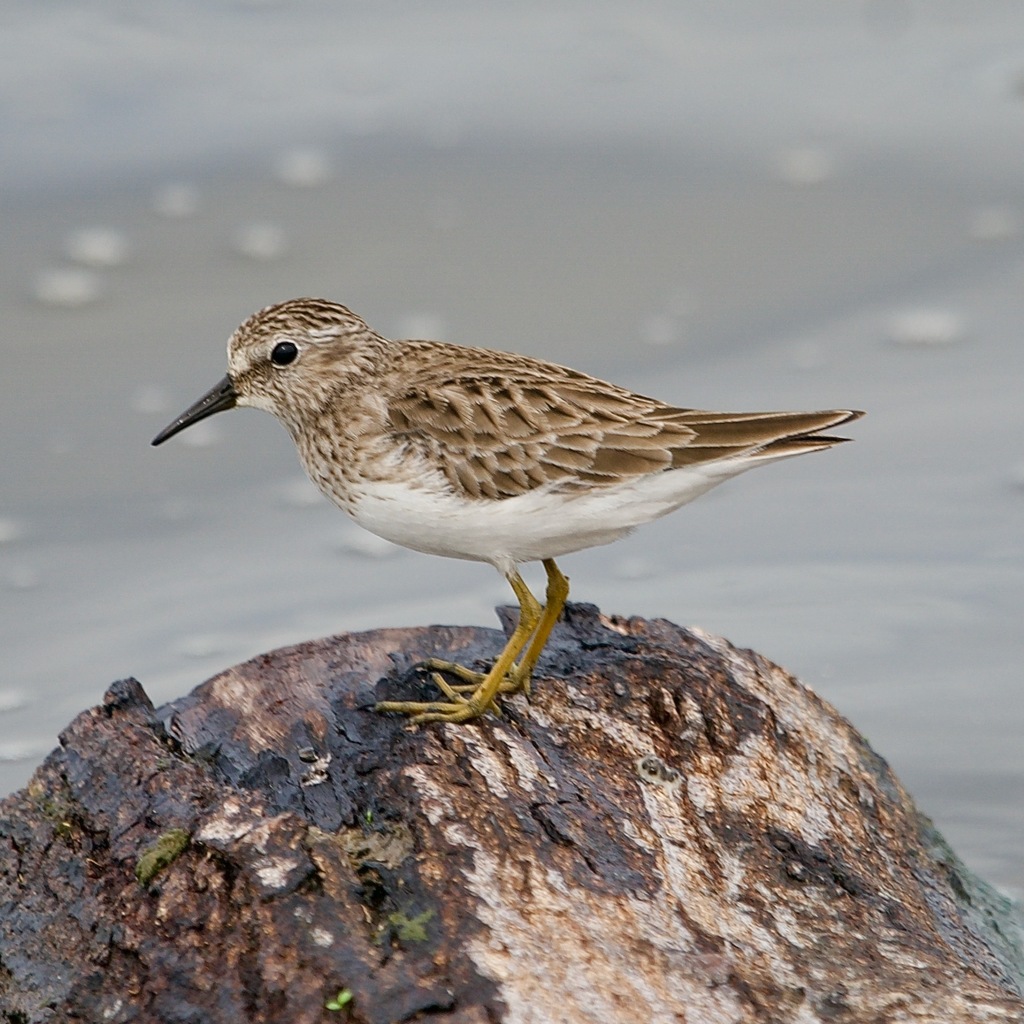
(c) Bill Levine, some rights reserved (CC BY) · licence
Family: Scolopacidae · Class: Aves · Order: Charadriiformes
Calidris minutilla (Least Sandpiper) is a California animal in the Scolopacidae family.
The Least Sandpiper is the smallest shorebird in North America, measuring 13 to 15 centimeters (5.1 to 5.9 inches) in length with a wingspan of 27 to 30 centimeters (10.6 to 11.8 inches). Adults weigh 19 to 30 grams (0.7 to 1.1 ounces). The species displays distinct seasonal plumage variations. During breeding season, adults exhibit brown and rufous upperparts with dark streaking, white underparts with brown streaking on the breast and flanks, and a distinctive yellowish-green to olive coloration on the legs and feet. Non-breeding adults appear grayer above with less distinct streaking. The bill is dark, slightly decurved, and relatively short compared to other sandpipers. Juveniles show bright rufous and buff edges on back feathers, creating a scaly appearance. Least Sandpipers breed across the subarctic and boreal regions of Alaska and northern Canada, from the Aleutian Islands east to Newfoundland. The species winters along both coasts of North America, from southern British Columbia to Peru on the Pacific coast, and from New Jersey to northern South America on the Atlantic coast. In California, Least Sandpipers are common migrants and winter residents along the entire coastline, in San Francisco Bay, and at inland wetlands throughout the Central Valley. They occur from sea level to approximately 1,500 meters (4,900 feet) elevation at mountain lakes during migration. This species inhabits diverse wetland environments including mudflats, salt marshes, shallow ponds, sewage treatment facilities, flooded agricultural fields, and the edges of freshwater and brackish water bodies. Least Sandpipers prefer areas with exposed mud or shallow water less than 5 centimeters (2 inches) deep. During breeding, they utilize wet tundra, sedge meadows, and boggy areas with scattered pools. The species shows greater tolerance for freshwater habitats compared to many other small sandpipers. Least Sandpipers are opportunistic foragers, using both visual and tactile feeding methods. They probe soft substrates and pick prey from surfaces, consuming marine worms, crustaceans, insects, larvae, and occasionally small mollusks and seeds. The species often feeds in mixed flocks with other small sandpipers. Breeding occurs from May to July on the tundra, where females lay 3 to 4 eggs in a shallow scrape lined with leaves and moss. Incubation lasts 19 to 23 days, with both parents sharing duties. Chicks are precocial and fledge after 18 to 20 days. The Least Sandpiper is not federally or state listed and maintains stable populations across most of its range. The species is classified as Least Concern by the International Union for Conservation of Nature. However, like many shorebirds, it faces threats from habitat loss due to coastal development, wetland drainage, and sea-level rise. Climate change may affect breeding habitat in the Arctic and alter timing of food availability along migration routes. Conservation efforts focus on protecting key stopover sites and wintering areas, particularly through the Western Hemisphere Shorebird Reserve Network.
Classification
Class: Aves · Order: Charadriiformes · Family: Scolopacidae
Frequently asked questions
How is Calidris minutilla classified?
Calidris minutilla belongs to class Aves, order Charadriiformes, family Scolopacidae.
What family does Calidris minutilla belong to?
Calidris minutilla is in the Scolopacidae family.
What is Calidris minutilla?
The Least Sandpiper is the smallest shorebird in North America, measuring 13 to 15 centimeters (5.1 to 5.9 inches) in length with a wingspan of 27 to 30 centimeters (10.6 to 11.8 inches).
Is Calidris minutilla found in California?
Yes. Calidris minutilla is recorded in California in The California Species Project's catalogue.
Related species
Other California species in the same genus, family, or bioregion.
Data from The California Species Project — 14,000+ California species with verified data from CNPS, CDFW, USFWS, and more.