Calidris ruficollis
Red-necked Stint
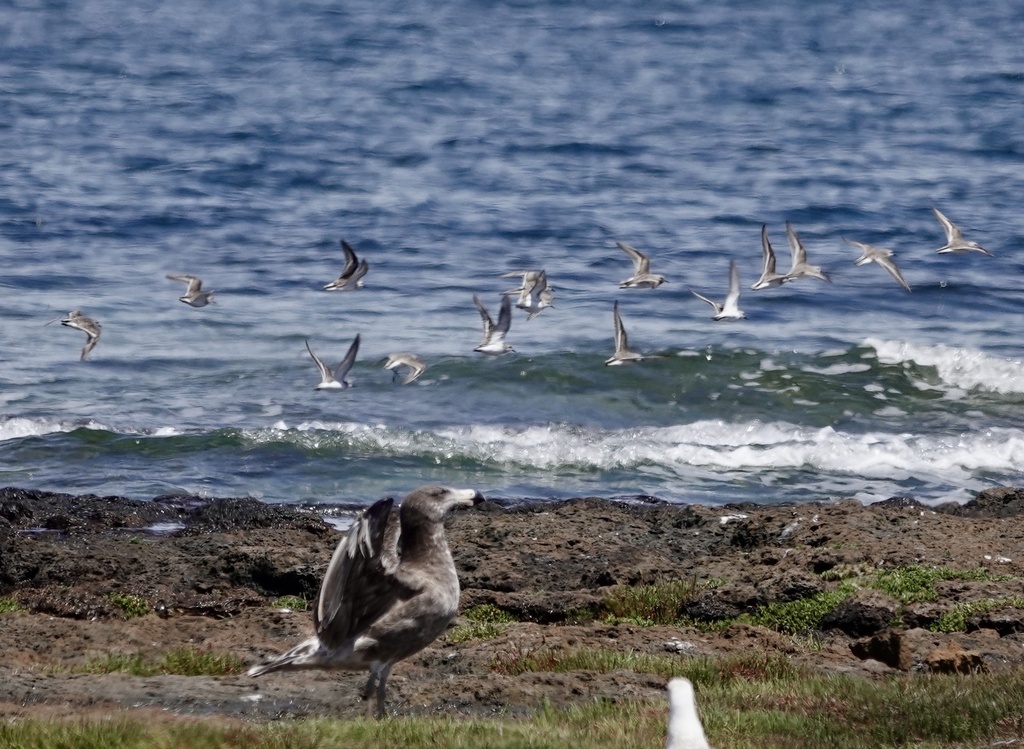
no rights reserved · CC0
Family: Scolopacidae · Class: Aves · Order: Charadriiformes
Calidris ruficollis (Red-necked Stint) is a California animal in the Scolopacidae family.
The Red-necked Stint is a small shorebird measuring 13-16 cm (5.1-6.3 inches) in length with a wingspan of 28-32 cm (11-12.6 inches) and weighing 20-40 grams (0.7-1.4 ounces). During breeding season, adults display distinctive rufous coloration on the head, neck, and upper breast, contrasting with white underparts. The back and wings show brownish-gray plumage with darker feather centers creating a scaled appearance. Non-breeding adults are pale gray-brown above with white underparts, while juveniles exhibit rufous-tinged upperparts with buff breast markings. The bill is straight, black, and approximately 18-20 mm long, adapted for probing soft substrates. Legs are black or dark olive-green. The Red-necked Stint breeds across northern Russia and Alaska, with the primary breeding range extending from the Chukchi Peninsula through northern Siberia. In California, this species occurs as an uncommon to rare visitor primarily along the coast during migration and winter months. According to eBird data, the species has been recorded at locations including San Francisco Bay, Monterey Bay, and coastal areas from Humboldt County to San Diego County. Peak occurrence in California typically falls between August and October during southbound migration, with smaller numbers present through winter and during spring migration from March to May. This species inhabits mudflats, salt ponds, shallow lagoons, and sandy beaches during its California visits. Red-necked Stints prefer areas with soft, muddy substrates rich in invertebrate prey. They frequent both natural estuarine environments and managed salt ponds, often associating with mixed flocks of other small sandpipers including Least Sandpipers, Western Sandpipers, and Dunlin. The species typically forages in water depths of 1-5 cm or on exposed mudflats. Red-necked Stints are highly active foragers, employing rapid pecking motions while walking steadily across suitable substrate. Their diet consists primarily of small invertebrates including polychaete worms, small crustaceans, insects, and larvae. During migration, individuals may form loose flocks of 10-50 birds, though they often integrate with larger mixed-species assemblages. The species exhibits strong site fidelity to productive foraging areas during extended stopovers. Breeding occurs on Arctic tundra, where females lay 4 eggs in ground scrapes lined with vegetation, with incubation lasting 21-22 days. The Red-necked Stint is not federally listed under the Endangered Species Act and lacks formal state listing status in California. The International Union for Conservation of Nature classifies the species as Least Concern globally, with an estimated worldwide population of 3.5-4 million individuals. However, like many Arctic-breeding shorebirds, Red-necked Stints face potential threats from climate change affecting breeding habitat, coastal development impacting migration stopover sites, and sea-level rise threatening wintering areas. In California, habitat loss from salt pond conversion and urban development along the coast may affect the species' limited wintering population. Conservation efforts focus on protecting key stopover sites and monitoring population trends through coordinated shorebird surveys.
Classification
Class: Aves · Order: Charadriiformes · Family: Scolopacidae
Frequently asked questions
How is Calidris ruficollis classified?
Calidris ruficollis belongs to class Aves, order Charadriiformes, family Scolopacidae.
What family does Calidris ruficollis belong to?
Calidris ruficollis is in the Scolopacidae family.
What is Calidris ruficollis?
The Red-necked Stint is a small shorebird measuring 13-16 cm (5.1-6.3 inches) in length with a wingspan of 28-32 cm (11-12.6 inches) and weighing 20-40 grams (0.7-1.4 ounces).
Is Calidris ruficollis found in California?
Yes. Calidris ruficollis is recorded in California in The California Species Project's catalogue.
Related species
Other California species in the same genus, family, or bioregion.
Data from The California Species Project — 14,000+ California species with verified data from CNPS, CDFW, USFWS, and more.