Calidris subminuta
Long-toed Stint
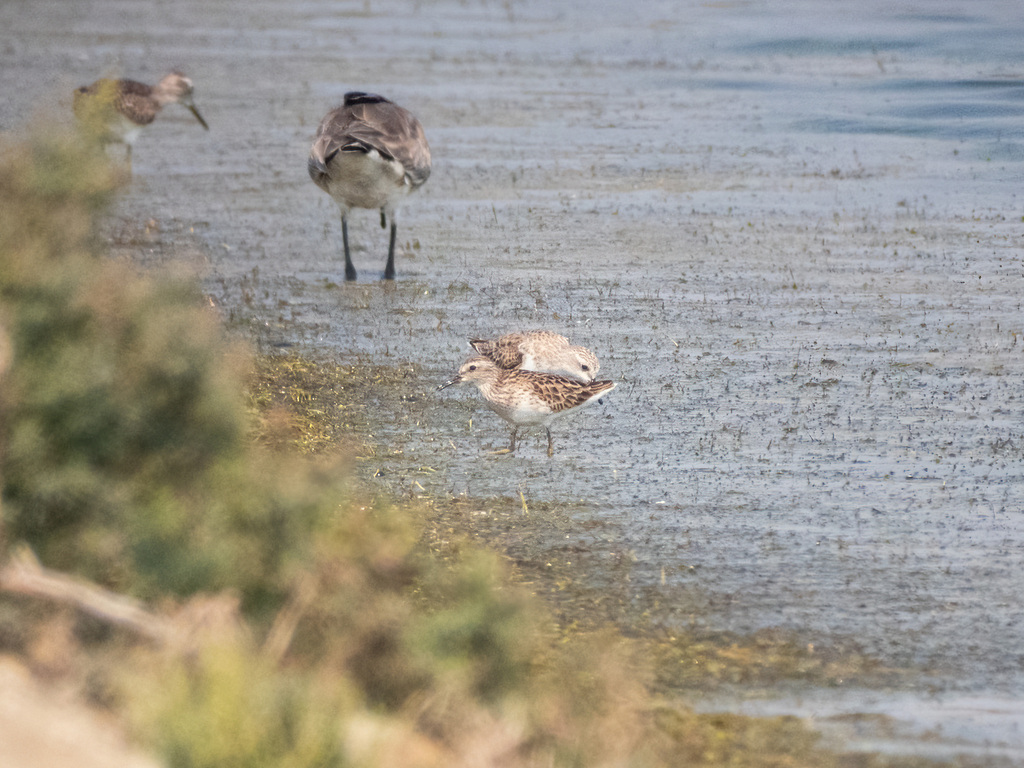
(c) Jason Alexander, some rights reserved (CC BY) · licence
Family: Scolopacidae · Class: Aves · Order: Charadriiformes
Calidris subminuta (Long-toed Stint) is a California animal in the Scolopacidae family.
The Long-toed Stint is a small shorebird measuring 13-16 cm (5.1-6.3 inches) in length with a wingspan of 28-31 cm (11-12.2 inches). Adults weigh 19-37 grams (0.7-1.3 ounces). During breeding season, the upperparts are rufous-brown with dark streaks and pale feather edges, while the underparts are white with a rufous-buff wash on the breast and neck. The species exhibits a distinctive white supercilium extending behind the eye and dark lores creating a striking facial pattern. Non-breeding adults display gray-brown upperparts with less contrasting plumage. As the name suggests, the middle toe is notably elongated compared to other small sandpipers, and the legs are yellowish to greenish-yellow. The bill is straight, thin, and dark with a yellowish base. The Long-toed Stint breeds across northern Siberia from the Yamal Peninsula east to Chukotka and south to Kamchatka. During migration and winter, the species occurs throughout much of Asia, from India and Southeast Asia to eastern China and Japan. In North America, this species is considered a rare vagrant, with most records from Alaska's western islands and mainland coast. California records are extremely rare, with fewer than 20 documented occurrences as of December 2025, primarily from coastal locations during fall migration between August and October. Breeding habitat consists of wet tundra with sedge meadows, moss-covered areas near ponds and lakes, and coastal tundra zones. During migration and winter, Long-toed Stints utilize mudflats, shallow wetlands, rice paddies, salt ponds, and the edges of freshwater and brackish marshes. The species shows preference for soft substrates where it can effectively probe for invertebrates. Long-toed Stints are primarily insectivorous, feeding on chironomid larvae, beetles, flies, and other small invertebrates found in mud and shallow water. The elongated middle toe aids in walking across soft substrates and may provide additional surface area for foraging in aquatic environments. Breeding occurs from June to July, with females laying 3-4 eggs in a shallow scrape lined with grass and leaves. The species is highly gregarious during migration and winter, often forming mixed flocks with other small sandpipers including Least Sandpipers and Semipalmated Sandpipers. The Long-toed Stint is not federally or state listed in the United States, reflecting its status as a vagrant rather than a regular component of North American avifauna. The global population is considered stable, though specific population estimates are not well documented. In California, the species remains one of the rarest shorebird vagrants, with records concentrated at premier birding locations such as Point Reyes, Bolsa Chica, and the Salton Sea. Climate change and habitat loss in Asian wintering grounds may affect future vagrant occurrences, though the species' primary conservation concerns lie outside North American jurisdiction.
Classification
Class: Aves · Order: Charadriiformes · Family: Scolopacidae
Frequently asked questions
How is Calidris subminuta classified?
Calidris subminuta belongs to class Aves, order Charadriiformes, family Scolopacidae.
What family does Calidris subminuta belong to?
Calidris subminuta is in the Scolopacidae family.
What is Calidris subminuta?
The Long-toed Stint is a small shorebird measuring 13-16 cm (5.1-6.3 inches) in length with a wingspan of 28-31 cm (11-12.2 inches).
Is Calidris subminuta found in California?
Yes. Calidris subminuta is recorded in California in The California Species Project's catalogue.
Related species
Other California species in the same genus, family, or bioregion.
Data from The California Species Project — 14,000+ California species with verified data from CNPS, CDFW, USFWS, and more.