Calidris subruficollis
Buff-breasted Sandpiper
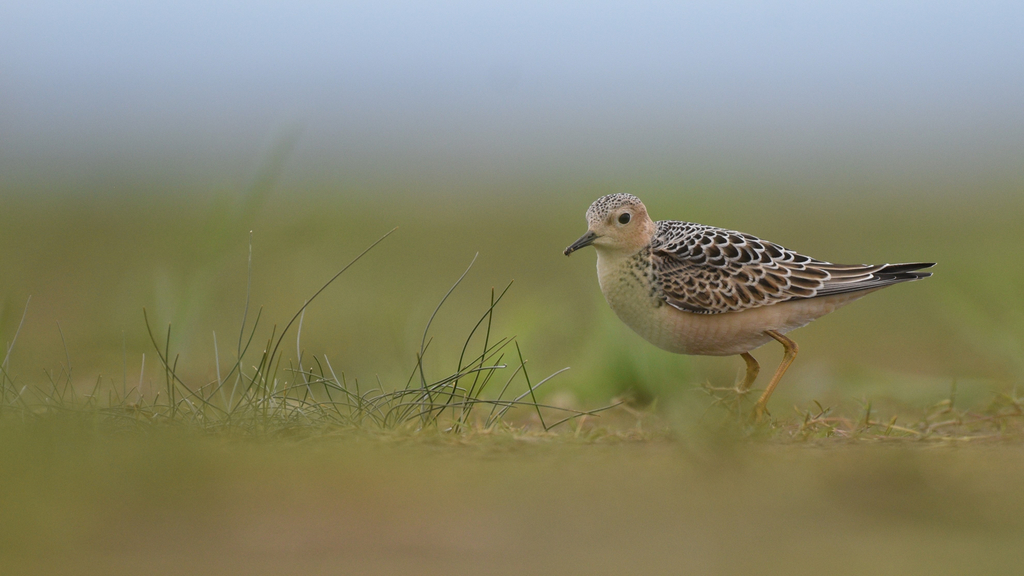
(c) Jacob Crawford, some rights reserved (CC BY) · licence
Family: Scolopacidae · Class: Aves · Order: Charadriiformes
Calidris subruficollis (Buff-breasted Sandpiper) is a California animal in the Scolopacidae family.
The Buff-breasted Sandpiper is a medium-sized shorebird measuring 18 to 20 cm (7.1 to 7.9 inches) in length with a wingspan of 43 to 47 cm (17 to 18.5 inches). Adults weigh 45 to 85 grams (1.6 to 3.0 ounces). The species is characterized by its distinctive buffy-orange underparts that extend from the throat to the undertail coverts, contrasting with a darker brown back and crown. The legs are bright yellow-orange, and the bill is straight, dark, and relatively short for a sandpiper. In flight, the underwing shows prominent white patches with dark trailing edges, a key field mark for identification. The Buff-breasted Sandpiper breeds in the high Arctic tundra of Alaska and northern Canada, with nesting areas extending from northern Alaska across to the Canadian Arctic archipelago. During migration, the species travels through the Great Plains of North America, with California serving as an uncommon but regular stopover location along the Pacific Flyway. In California, Buff-breasted Sandpipers are most frequently observed during fall migration from late August through October, with occasional spring records from April to May. Primary California observation areas include the Central Valley, coastal mudflats, and agricultural fields in the Sacramento and San Joaquin valleys. This species occupies short-grass prairie, agricultural fields, and recently mowed areas during migration. Unlike most sandpipers, Buff-breasted Sandpipers rarely use traditional mudflat or shoreline habitats, instead preferring dry upland areas with sparse vegetation. During the breeding season, they inhabit well-drained tundra ridges and slopes with low vegetation. In California, they are typically found in flooded rice fields after harvest, short-grass pastures, and occasionally on golf courses and airports. Buff-breasted Sandpipers are primarily insectivorous, feeding on flies, beetles, larvae, and other small invertebrates. They employ a distinctive foraging behavior, picking prey from vegetation and the ground surface rather than probing like most sandpipers. Males perform elaborate courtship displays during breeding season, raising their wings to show the white underwing patches while circling potential mates. The species nests on the ground in a simple scrape lined with grass and leaves. Females typically lay 4 eggs, which are incubated for 21 to 23 days. Males may mate with multiple females and do not participate in chick care. The Buff-breasted Sandpiper is not federally listed but is considered a species of conservation concern due to significant population declines. According to the North American Bird Conservation Initiative, continental populations have declined by approximately 50% since 1970. The species faces threats from habitat loss in both breeding and migration areas, particularly the conversion of native grasslands to agriculture. Climate change poses additional risks through altered precipitation patterns affecting Arctic breeding grounds and timing of insect emergence. In California, the species benefits from flooded rice agriculture, though pesticide use and changes in farming practices present ongoing challenges.
Classification
Class: Aves · Order: Charadriiformes · Family: Scolopacidae
Frequently asked questions
How is Calidris subruficollis classified?
Calidris subruficollis belongs to class Aves, order Charadriiformes, family Scolopacidae.
What family does Calidris subruficollis belong to?
Calidris subruficollis is in the Scolopacidae family.
What is Calidris subruficollis?
The Buff-breasted Sandpiper is a medium-sized shorebird measuring 18 to 20 cm (7.1 to 7.9 inches) in length with a wingspan of 43 to 47 cm (17 to 18.5 inches).
Is Calidris subruficollis found in California?
Yes. Calidris subruficollis is recorded in California in The California Species Project's catalogue.
Related species
Other California species in the same genus, family, or bioregion.
Data from The California Species Project — 14,000+ California species with verified data from CNPS, CDFW, USFWS, and more.