Calidris virgata
Surfbird
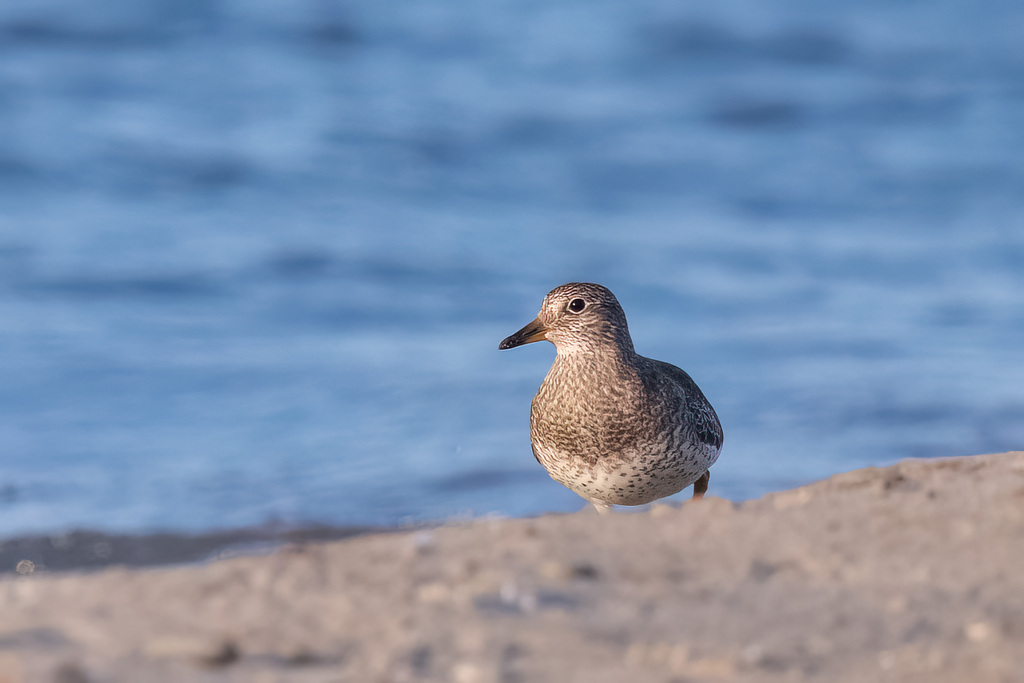
(c) Kalvin Chan, some rights reserved (CC BY) · licence
Family: Scolopacidae · Class: Aves · Order: Charadriiformes
Calidris virgata (Surfbird) is a California animal in the Scolopacidae family.
The Surfbird is a medium-sized shorebird measuring 23 to 26 cm (9.1 to 10.2 inches) in length with a wingspan of 50 to 55 cm (19.7 to 21.7 inches). Adults weigh between 150 to 220 grams. In breeding plumage, the species displays a mottled brown and black back with heavy dark streaking on white underparts. The head and neck show rufous tones with dark streaking. Non-breeding adults are uniformly gray above with lighter gray underparts and minimal streaking. The bill is short, straight, and yellow-orange at the base with a dark tip. The legs are bright yellow-orange. In flight, the species shows a distinctive white wing stripe and white rump patch contrasting with a dark tail band. The Surfbird breeds in alpine tundra regions of Alaska and northwestern Canada, primarily above 1,000 meters elevation. During migration and winter, the species occurs along rocky coastlines from Alaska to Chile. In California, Surfbirds are present year-round along the entire coast, with populations varying seasonally. Peak abundance occurs during spring migration from April to May and fall migration from July through September. Winter populations are maintained along suitable rocky shore habitats throughout the state. Surfbirds inhabit rocky intertidal zones, preferring areas with extensive wave-washed rocks, jetties, and breakwaters. The species shows strong fidelity to rocky substrates and is rarely observed on sandy beaches or mudflats. During breeding season, they occupy barren alpine tundra with scattered rocks and low vegetation at elevations between 1,000 to 2,000 meters. Wintering birds concentrate on rocky shores with abundant invertebrate prey exposed by tidal action. Surfbirds feed primarily on marine invertebrates during the non-breeding season, including mollusks, crustaceans, and marine worms. They use their bills to pry limpets and barnacles from rocks and probe crevices for prey. The species exhibits specialized foraging behavior, often feeding in areas with heavy wave action where other shorebirds cannot access food resources. Breeding occurs from May through July in arctic and subarctic regions. Females typically lay four eggs in a shallow scrape lined with lichens and moss. The incubation period lasts 23 to 24 days, with both sexes sharing duties. Chicks are precocial and leave the nest within hours of hatching. The Surfbird is not federally listed and appears stable across its range. The species benefits from its specialized rocky shore habitat, which has experienced less human modification compared to other coastal environments. However, climate change may affect prey availability and breeding habitat conditions in arctic regions. Oil spills pose a significant threat to wintering populations concentrated along the Pacific Coast. According to eBird data, California supports substantial wintering populations, with consistent observations reported from Mendocino County south to San Diego County. The species' strong site fidelity and specialized habitat requirements make monitoring relatively straightforward at established survey locations.
Classification
Class: Aves · Order: Charadriiformes · Family: Scolopacidae
Frequently asked questions
How is Calidris virgata classified?
Calidris virgata belongs to class Aves, order Charadriiformes, family Scolopacidae.
What family does Calidris virgata belong to?
Calidris virgata is in the Scolopacidae family.
What is Calidris virgata?
The Surfbird is a medium-sized shorebird measuring 23 to 26 cm (9.1 to 10.2 inches) in length with a wingspan of 50 to 55 cm (19.7 to 21.7 inches).
Is Calidris virgata found in California?
Yes. Calidris virgata is recorded in California in The California Species Project's catalogue.
Related species
Other California species in the same genus, family, or bioregion.
Data from The California Species Project — 14,000+ California species with verified data from CNPS, CDFW, USFWS, and more.