Calineuria californica
Western Stonefly
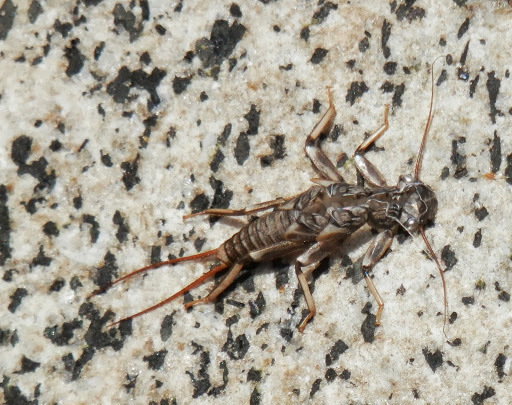
(c) 101595408250610106310, some rights reserved (CC BY) · licence
Family: Perlidae · Class: Insecta · Order: Plecoptera
Calineuria californica (Western Stonefly) is a California animal in the Perlidae family.
The western stonefly is a large aquatic insect belonging to the order Plecoptera and family Perlidae. Adults are robust, brownish stoneflies with well-developed wings that fold flat over the abdomen when at rest. The species exhibits typical perlid characteristics including prominent cerci (tail filaments) and strong legs adapted for clinging to rocks in swift water. Nymphs are distinctive, featuring a wavy, irregular row of small spines at the back of the head, basal segments of cerci with fringes of long hair, small spines on the abdominal tergites, and complete fringes of long hair on the margins of abdominal sterna (BugGuide). Calineuria californica occurs throughout a broad range extending from California northward along the Pacific Coast to southern British Columbia and eastward into the Canadian Rockies (Stewart and Oswood 2006). Within this range, the species inhabits various mountainous regions including the Cascade Range, Sierra Nevada, and coastal mountain systems. The genus Calineuria contains only one Nearctic species, californica, making identification relatively straightforward within North America (BugGuide). The species inhabits cool, well-oxygenated mountain streams and rivers with rocky substrates. Nymphs are typically found under submerged rocks along stream margins, where they cling to the undersides of stones in areas with moderate to swift current flow. The rocky substrate provides both shelter and feeding opportunities for the developing nymphs. Adults are most commonly observed near their natal streams during emergence and mating periods. Western stonefly nymphs are predatory, feeding on smaller aquatic invertebrates including midge larvae, mayfly nymphs, and other soft-bodied prey. They are active hunters, using their strong mandibles to capture and consume prey items. The species exhibits a univoltine life cycle, requiring approximately one year to complete development from egg to adult. Nymphs overwinter in the stream, continuing to grow and develop until emergence occurs during warmer months. Adults are relatively short-lived, focusing primarily on mating and egg-laying activities near water sources. The conservation status of Calineuria californica has not been formally assessed at federal or state levels. As an aquatic species dependent on clean, cold mountain streams, western stoneflies may be vulnerable to habitat degradation from water diversions, pollution, sedimentation, and climate change effects that increase water temperatures. Stream modifications and urbanization within watersheds can alter flow regimes and water quality, potentially impacting population stability. However, the species' broad geographic range and presence in relatively pristine mountain environments likely provides some protection from localized threats. Long-term monitoring of aquatic insect communities would be valuable for assessing population trends and identifying conservation needs for this and other stream-dependent species.
Classification
Class: Insecta · Order: Plecoptera · Family: Perlidae
Frequently asked questions
How is Calineuria californica classified?
Calineuria californica belongs to class Insecta, order Plecoptera, family Perlidae.
What family does Calineuria californica belong to?
Calineuria californica is in the Perlidae family.
What is Calineuria californica?
The western stonefly is a large aquatic insect belonging to the order Plecoptera and family Perlidae.
Is Calineuria californica found in California?
Yes. Calineuria californica is recorded in California in The California Species Project's catalogue.
More California species
This species has no close relatives in our California data — here are other species to explore.
Data from The California Species Project — 14,000+ California species with verified data from CNPS, CDFW, USFWS, and more.