Callipepla gambelii
Gambel's Quail
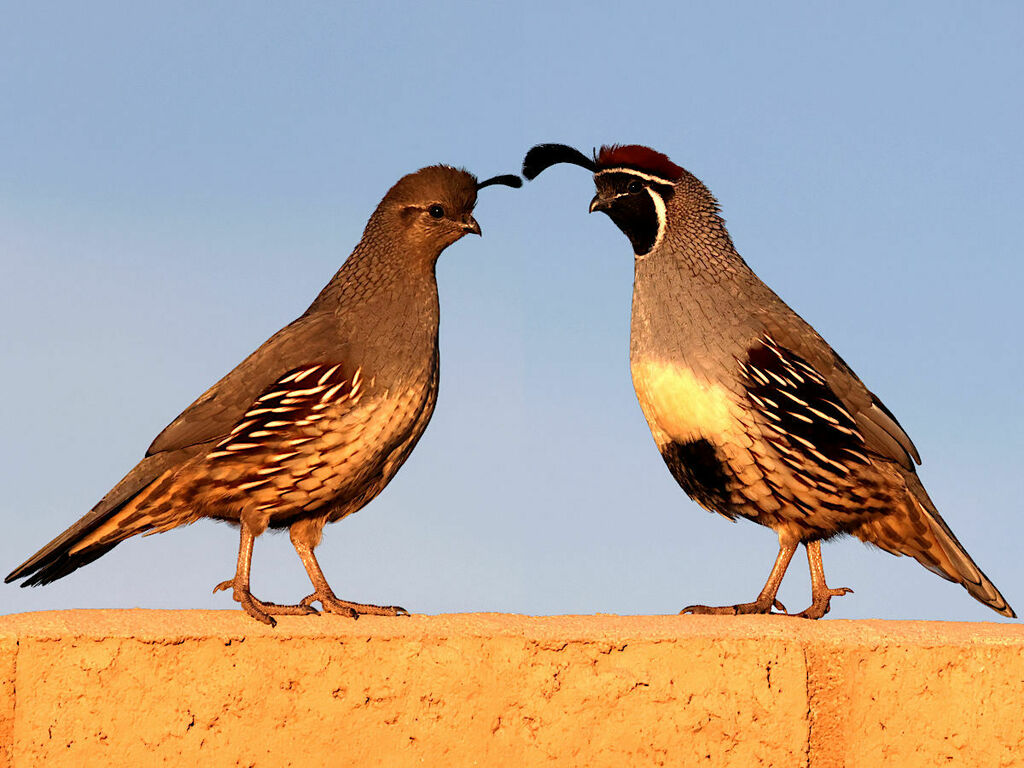
(c) Peter Chen 2.0, some rights reserved (CC BY) · licence
Family: Odontophoridae · Class: Aves · Order: Galliformes
Callipepla gambelii (Gambel's Quail) is a California animal in the Odontophoridae family.
Gambel's quail is a medium-sized ground-dwelling bird measuring 24 to 27 cm (9.4 to 10.6 inches) in length with a distinctive forward-curving black plume extending from the crown. Males display a black face bordered by white stripes, a chestnut crown cap, and a black throat patch outlined in white. The breast is grayish-blue with a prominent black belly patch, while the flanks show distinctive white streaking on rufous-chestnut sides. Females are more subdued in coloration, lacking the male's bold head pattern and belly patch, with brownish-gray plumage and scaled underparts. Both sexes have short, rounded wings and relatively long, square-tipped tails. Gambel's quail inhabits the southwestern United States and northwestern Mexico, with California populations occurring primarily in the southeastern desert regions. The species is found in the Colorado River valley, extending through Imperial County and southeastern Riverside County, with scattered populations in eastern San Bernardino County. The range includes areas along the Colorado River from Needles south to the Mexican border, typically below 1,200 meters (4,000 feet) elevation. This species occupies desert scrub habitats dominated by mesquite, palo verde, ironwood, and catclaw acacia. Gambel's quail requires dense shrub cover for nesting and roosting, with nearby open areas for foraging. The birds frequent desert washes, riparian corridors, and areas with scattered trees that provide elevated perching and roosting sites. Water sources are critical, as the species must drink daily during hot weather, unlike some desert-adapted birds. Gambel's quail are highly social outside the breeding season, forming coveys of 20 to 100 individuals. The diet consists primarily of seeds, green vegetation, fruits, and occasionally insects. Breeding occurs from April through July, with peak nesting in May and June. Females construct ground nests in dense shrub cover, laying 10 to 12 cream-colored eggs with brown markings. Incubation lasts 21 to 24 days, and precocial chicks leave the nest within hours of hatching. Both parents tend the young, which can fly short distances at 10 days of age. Gambel's quail is not federally or state listed and maintains stable populations throughout most of its range as of December 2025. The species has adapted well to some human modifications of desert habitats, including agricultural edges and suburban developments that provide water and cover. However, habitat loss from urban development, agriculture, and invasive plant species poses localized threats. Overgrazing by livestock can reduce ground cover essential for nesting, while water diversions may eliminate crucial water sources. Climate change may affect the species through increased temperatures and altered precipitation patterns in desert ecosystems.
Classification
Class: Aves · Order: Galliformes · Family: Odontophoridae
Frequently asked questions
How is Callipepla gambelii classified?
Callipepla gambelii belongs to class Aves, order Galliformes, family Odontophoridae.
What family does Callipepla gambelii belong to?
Callipepla gambelii is in the Odontophoridae family.
What is Callipepla gambelii?
Gambel's quail is a medium-sized ground-dwelling bird measuring 24 to 27 cm (9.4 to 10.6 inches) in length with a distinctive forward-curving black plume extending from the crown.
Is Callipepla gambelii found in California?
Yes. Callipepla gambelii is recorded in California in The California Species Project's catalogue.
Related species
Other California species in the same genus, family, or bioregion.
Data from The California Species Project — 14,000+ California species with verified data from CNPS, CDFW, USFWS, and more.