Callisaurus draconoides
Zebra-Tailed Lizard
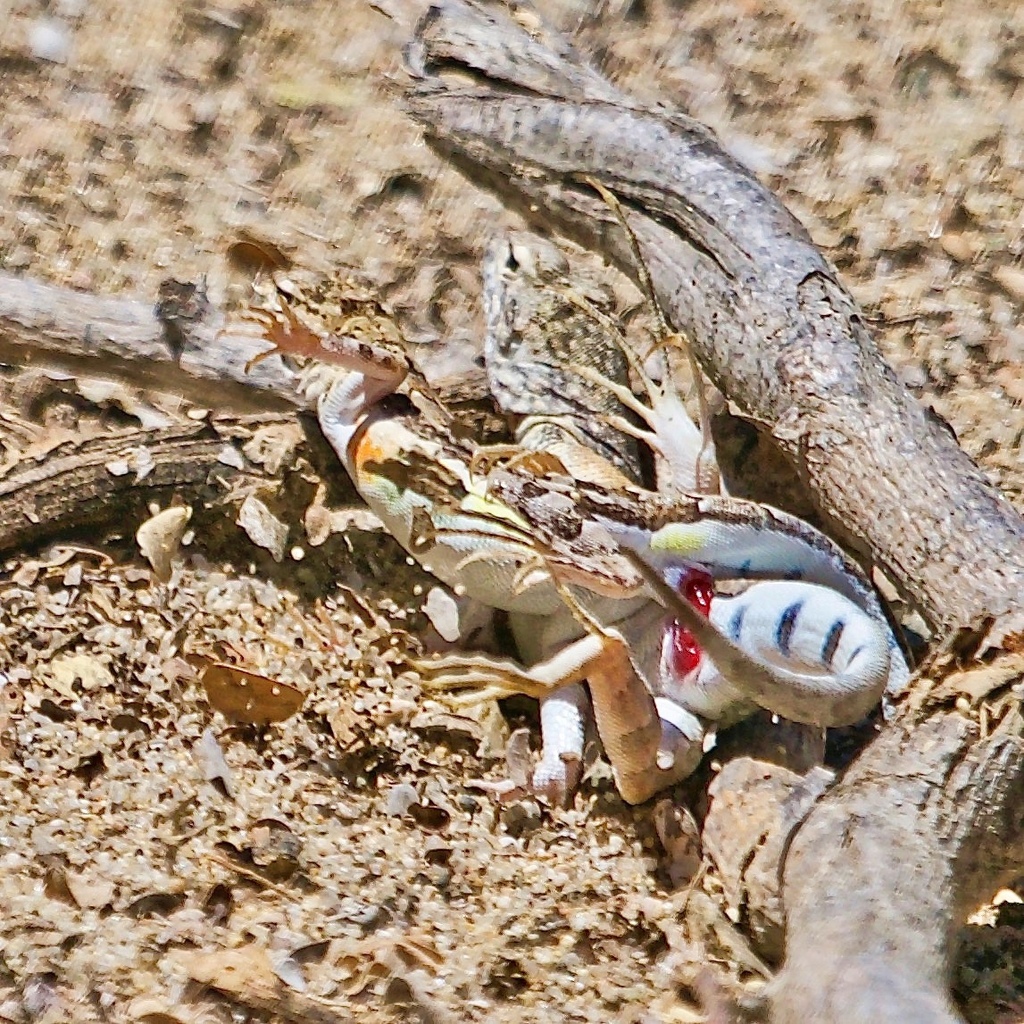
(c) Bill Levine, some rights reserved (CC BY) · licence
Family: Phrynosomatidae · Class: Reptilia · Order: Squamata
Callisaurus draconoides (Zebra-Tailed Lizard) is a California animal in the Phrynosomatidae family.
The zebra-tailed lizard is a medium-sized lizard measuring 152 to 229 mm (6 to 9 inches) in total length, with the tail comprising approximately 60% of the body length. The dorsal coloration is typically gray to brown with distinct crossbands of darker pigmentation across the back and sides. The ventral surface is white or cream-colored. The species is most readily identified by its distinctive tail pattern, featuring alternating black and white bands that create a zebra-like appearance. When threatened, individuals curl the tail over the back, displaying the conspicuous banding pattern as a warning signal. Males develop bright blue patches on the belly and throat during breeding season, while females lack this coloration. Zebra-tailed lizards occur throughout the southwestern United States and northwestern Mexico. In California, the species is found primarily in the southeastern desert regions, including the Mojave and Sonoran deserts. Their range extends from Inyo County south through San Bernardino, Riverside, and Imperial counties. The species inhabits elevations from below sea level in the Salton Basin to approximately 1,500 meters (4,920 feet) in desert mountain ranges. This species occupies open desert habitats characterized by hard-packed soils, sparse vegetation, and scattered rocks or debris for shelter. Zebra-tailed lizards prefer areas with creosote bush scrub, desert pavement, washes, and flats with minimal shrub cover. They require open spaces for rapid locomotion and typically avoid areas with dense vegetation. Suitable habitat includes both sandy and rocky substrates, though they show preference for firmer surfaces that facilitate their high-speed running behavior. Zebra-tailed lizards are diurnal and highly active during warm weather, exhibiting high-speed locomotion when escaping predators. They can reach speeds of up to 24 kilometers per hour (15 miles per hour) and often run bipedally on their hind legs. The species is primarily insectivorous, feeding on beetles, ants, flies, moths, and other arthropods. Breeding occurs from April through July, with females laying clutches of 2 to 8 eggs in sandy soil or beneath rocks. Eggs incubate for approximately 60 to 75 days, with hatchlings emerging in late summer or early fall. During winter months and extreme heat, individuals seek shelter in burrows, rock crevices, or beneath shrubs. Currently, the zebra-tailed lizard is not listed under federal or state endangered species acts and appears to maintain stable populations throughout most of its range in California. The species demonstrates adaptability to human-modified landscapes and can persist in areas with moderate development. However, habitat loss from urban expansion, renewable energy projects, and off-road vehicle use may pose localized threats in some areas. Climate change could potentially affect the species through altered precipitation patterns and increased temperatures, though the species' broad thermal tolerance and desert adaptations may provide resilience to such changes.
Classification
Class: Reptilia · Order: Squamata · Family: Phrynosomatidae
Frequently asked questions
How is Callisaurus draconoides classified?
Callisaurus draconoides belongs to class Reptilia, order Squamata, family Phrynosomatidae.
What family does Callisaurus draconoides belong to?
Callisaurus draconoides is in the Phrynosomatidae family.
What is Callisaurus draconoides?
The zebra-tailed lizard is a medium-sized lizard measuring 152 to 229 mm (6 to 9 inches) in total length, with the tail comprising approximately 60% of the body length.
Is Callisaurus draconoides found in California?
Yes. Callisaurus draconoides is recorded in California in The California Species Project's catalogue.
Related species
Other California species in the same genus, family, or bioregion.
Data from The California Species Project — 14,000+ California species with verified data from CNPS, CDFW, USFWS, and more.