Callophrys affinis
Western Green Hairstreak
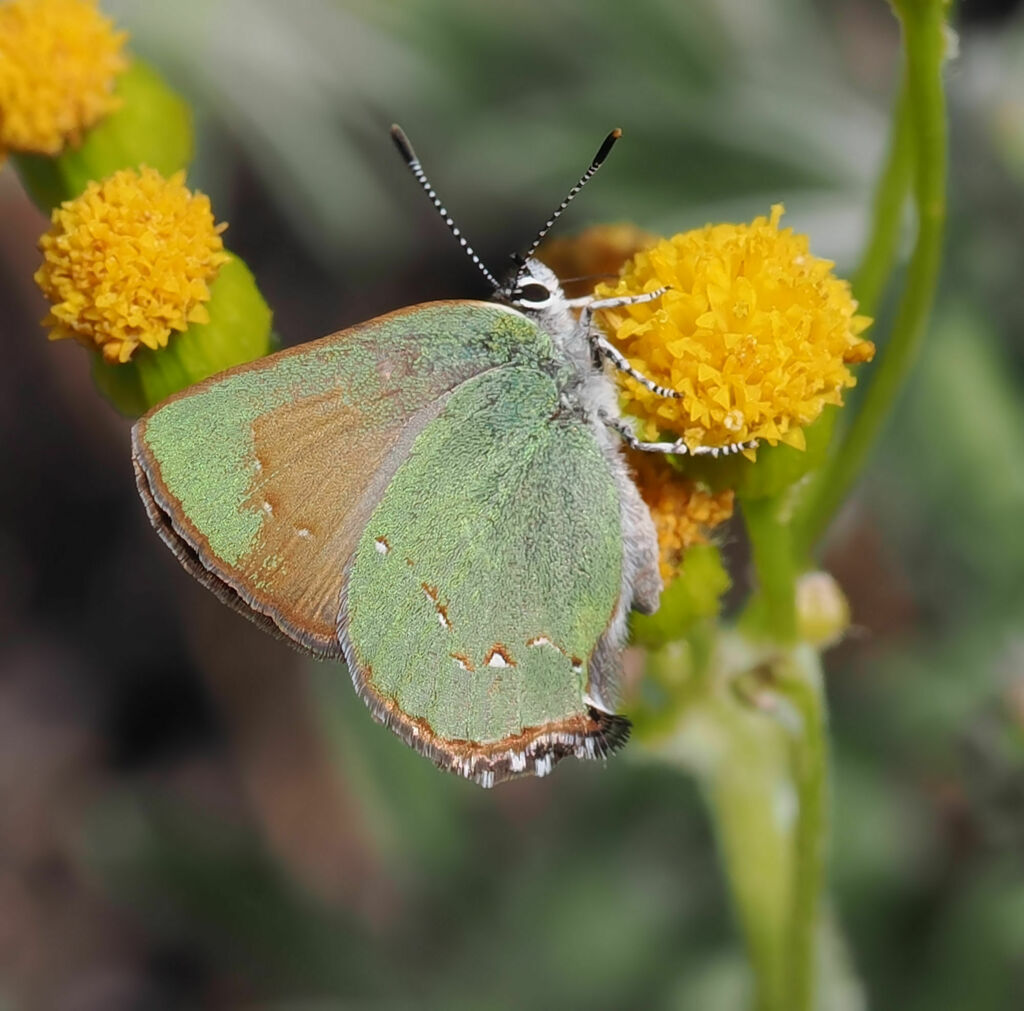
(c) Wendy McCrady, some rights reserved (CC BY) · licence
Family: Lycaenidae · Class: Insecta · Order: Lepidoptera
Callophrys affinis (Western Green Hairstreak) is a California animal in the Lycaenidae family.
The Western Green Hairstreak is a small butterfly with distinctive metallic green underwings that provide effective camouflage when the wings are folded. Adults measure 22-28 mm (0.9-1.1 inches) in wingspan. The dorsal wing surfaces are brown to gray-brown in males and females, while the ventral surfaces display iridescent green scaling with small white spots arranged in irregular lines across both forewings and hindwings. The hindwings feature short, thread-like tails typical of hairstreak butterflies. Males possess scent patches on their forewings used during courtship displays. The species ranges from southern British Columbia and Washington south through California into northern Baja California, extending eastward to central Montana, Wyoming, Colorado, and New Mexico. In California, populations occur throughout the state from sea level to approximately 2,500 meters (8,200 feet) elevation, inhabiting diverse geographic regions including the Coast Ranges, Sierra Nevada, and desert mountains. The distribution follows the availability of suitable host plants and open habitat conditions. Western Green Hairstreaks occupy a variety of open habitats including chaparral, oak woodlands, grasslands, desert scrub, and forest clearings. The species thrives in areas with scattered shrubs and abundant flowering plants, particularly where host plants grow in sunny, well-drained locations. Elevation preferences vary regionally, with coastal populations occurring near sea level and montane populations found at higher elevations where suitable microhabitats exist. Adults are active from March through August, with peak flight periods varying by elevation and latitude. Males establish territories on hilltops and ridges, engaging in perching behavior to locate females. Females deposit single eggs on flower buds or young leaves of host plants, which include various species of Eriogonum (wild buckwheat), Lotus (bird's-foot trefoil), and Ceanothus (California lilac). Larvae feed within flower heads and developing seed pods, completing development in 3-4 weeks. The species overwinters as pupae attached to host plant stems or nearby vegetation. Adults nectar on diverse flowering plants including dogbane, yerba santa, and various composites, often visiting flowers of their larval host plants. The Western Green Hairstreak is not federally or state-listed and appears to maintain stable populations across much of its range. However, local populations may face pressure from habitat conversion, particularly in rapidly developing areas of California. Urban expansion and agricultural intensification have reduced available habitat in some regions. The species' dependence on native host plants makes it vulnerable to invasive plant species that alter natural plant communities. Fire suppression practices that eliminate natural disturbance cycles may also impact habitat quality in some areas. Conservation efforts focus on maintaining diverse native plant communities and preserving open space corridors that support both host plants and nectar sources essential for population persistence.
Classification
Class: Insecta · Order: Lepidoptera · Family: Lycaenidae
Frequently asked questions
How is Callophrys affinis classified?
Callophrys affinis belongs to class Insecta, order Lepidoptera, family Lycaenidae.
What family does Callophrys affinis belong to?
Callophrys affinis is in the Lycaenidae family.
What is Callophrys affinis?
The Western Green Hairstreak is a small butterfly with distinctive metallic green underwings that provide effective camouflage when the wings are folded.
Is Callophrys affinis found in California?
Yes. Callophrys affinis is recorded in California in The California Species Project's catalogue.
Related species
Other California species in the same genus, family, or bioregion.
Data from The California Species Project — 14,000+ California species with verified data from CNPS, CDFW, USFWS, and more.