Callophrys augustinus
Brown Elfin
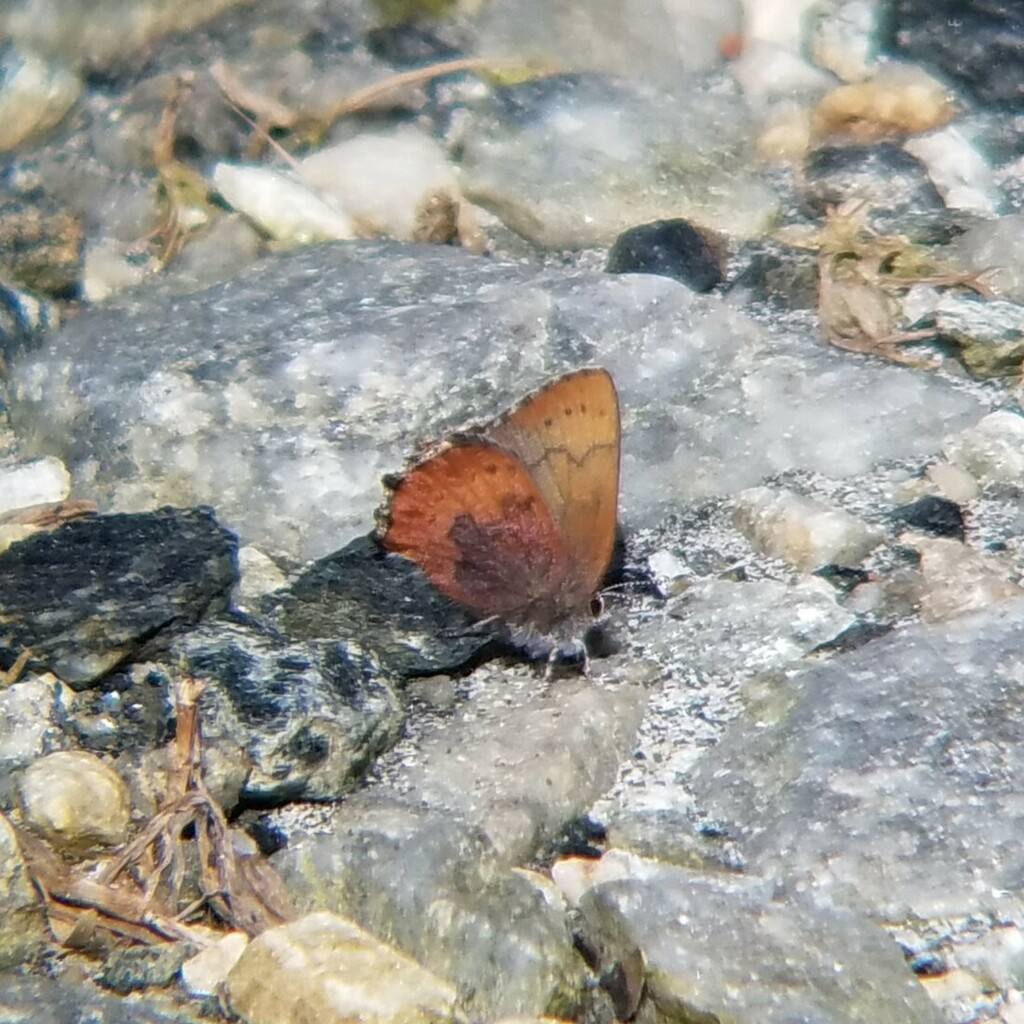
(c) Leila Dasher, some rights reserved (CC BY) · licence
Family: Lycaenidae · Class: Insecta · Order: Lepidoptera
Callophrys augustinus (Brown Elfin) is a California animal in the Lycaenidae family.
The Brown Elfin is a small butterfly with a wingspan ranging from 22 to 28 mm (0.9 to 1.1 inches). The dorsal wing surfaces are brown with a subtle purplish sheen in males, while females display darker brown coloration. The ventral hindwings are characterized by a distinctive reddish-brown base color with an irregular white-edged postmedian line. The forewings show orange patches near the wing bases, and the hindwings lack tails, distinguishing this species from related elfins. Fresh specimens display a frosted appearance on the wing undersides due to fine scaling. The Brown Elfin has one of the most extensive distributions among North American lycaenids, ranging from Newfoundland north and west through northern United States and the prairie provinces to Alaska. The species extends south in the Appalachian Mountains to northern Georgia and northern Alabama, and through western mountains to northern Baja California. Notably, it does not occur on the Great Plains or in the Midwest. In California, populations are found primarily in mountainous regions of the Sierra Nevada, Cascade Range, and Coast Ranges, typically at elevations between 300 and 3,000 meters. Brown Elfins inhabit diverse ecosystems depending on geographic location, including boreal forests, montane woodlands, chaparral, and heath communities. In eastern populations, the species occurs in acidic soils supporting heath family vegetation, while western populations utilize a broader range of plant communities. The butterflies require proximity to host plants and are often found in forest clearings, woodland edges, and areas with partial canopy cover. Host plant associations vary dramatically across the species' range. Eastern populations utilize members of the heath family (Ericaceae), including sugar huckleberry (Vaccinium vacillans) and Labrador tea (Ledum groenlandicum). Western populations demonstrate extensive host plant diversity, utilizing madrone (Arbutus), dodder (Cuscuta), and various other plant families. This broad host range contributes to the species' extensive distribution. Adults fly from March through June, with peak emergence varying by elevation and latitude. Males exhibit territorial behavior, perching on shrubs and patrolling for females. Mating occurs in spring, with females laying single eggs on host plant buds or young leaves. Larvae feed on flowers and developing fruits, pupating in leaf litter or soil. The species typically produces one generation annually, overwintering as pupae. The Brown Elfin currently holds no federal or state conservation listing status and appears to maintain stable populations across most of its range. However, localized threats include habitat loss from development, logging, and fire suppression altering natural burn cycles. Climate change may affect montane populations through shifting temperature and precipitation patterns. The species' broad host plant usage and extensive range provide some resilience against environmental changes, though specific subspecies or isolated populations may face greater vulnerability.
Classification
Class: Insecta · Order: Lepidoptera · Family: Lycaenidae
Frequently asked questions
How is Callophrys augustinus classified?
Callophrys augustinus belongs to class Insecta, order Lepidoptera, family Lycaenidae.
What family does Callophrys augustinus belong to?
Callophrys augustinus is in the Lycaenidae family.
What is Callophrys augustinus?
The Brown Elfin is a small butterfly with a wingspan ranging from 22 to 28 mm (0.9 to 1.1 inches).
Is Callophrys augustinus found in California?
Yes. Callophrys augustinus is recorded in California in The California Species Project's catalogue.
Related species
Other California species in the same genus, family, or bioregion.
Data from The California Species Project — 14,000+ California species with verified data from CNPS, CDFW, USFWS, and more.