Callophrys eryphon
Western Pine Elfin
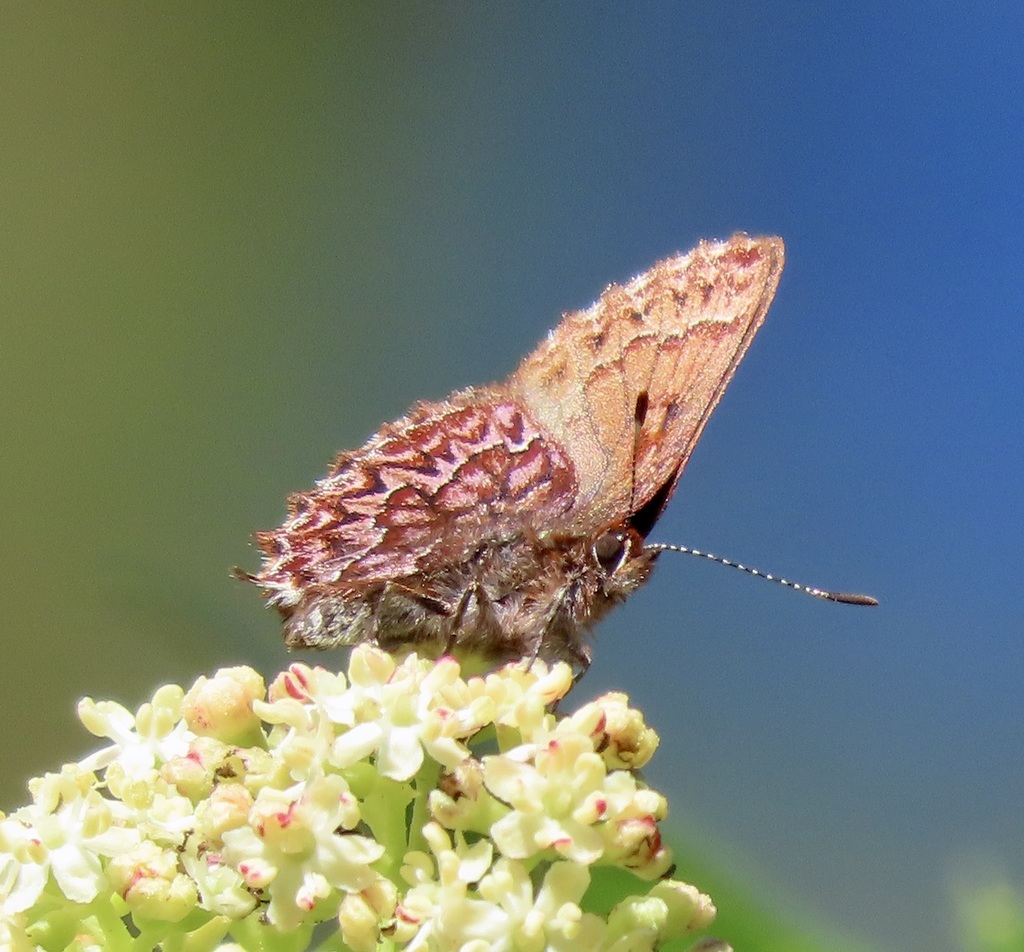
(c) John Hibbard, some rights reserved (CC BY) · licence
Family: Lycaenidae · Class: Insecta · Order: Lepidoptera
Callophrys eryphon (Western Pine Elfin) is a California animal in the Lycaenidae family.
The Western Pine Elfin is a small butterfly in the copper family (Lycaenidae) with a wingspan ranging from 22 to 28 mm (0.9 to 1.1 inches). The dorsal wing surfaces are brown to grayish-brown, while the ventral surfaces display a complex pattern of brown, gray, and white markings with distinctive irregular white postmedian bands. The hindwings feature characteristic short tails and small orange-capped eyespots near the tail. Males tend to be smaller and darker than females, with more pronounced scent patches on the forewings used during courtship. This species has a broad North American distribution, ranging from British Columbia east to Maine and extending south to southern California, Arizona, and New Mexico. In California, Western Pine Elfin populations occur primarily in montane regions where suitable host plants are present, including the Sierra Nevada, Cascade Range, and scattered mountain ranges throughout the state. The species demonstrates considerable geographic variation across its range, with several recognized subspecies adapted to different regional conditions. Western Pine Elfin inhabits coniferous forests and woodlands dominated by hard pines, typically at elevations ranging from 1,200 to 3,400 meters (4,000 to 11,200 feet). The species shows strong fidelity to areas with healthy pine stands, particularly favoring forest edges, clearings, and openings where host plants receive adequate sunlight. Adults are commonly observed in areas with mixed-age pine forests that provide both larval food sources and adult nectar resources. Larvae feed exclusively on young needles of hard pine species, including lodgepole pine (Pinus contorta), limber pine (P. flexilis), and ponderosa pine (P. ponderosa), with some populations possibly utilizing black spruce. The species is univoltine, producing one generation per year. Adults typically emerge in late spring to early summer, with flight periods varying by elevation and latitude but generally occurring from May through July. Females deposit single eggs on new growth of host pines, and larvae develop through the summer, overwintering as pupae. Adults feed on nectar from various flowering plants, including wildflowers and shrubs within their forest habitat. Males exhibit territorial behavior, perching on prominent locations such as treetops or exposed branches to intercept passing females. Courtship involves aerial displays and the release of chemical attractants from specialized wing scales. Western Pine Elfin is not federally listed and appears to maintain stable populations across much of its range. However, the species faces potential threats from forest management practices, wildfire suppression that alters natural forest dynamics, and climate change impacts on montane ecosystems. Pine beetle outbreaks and associated tree mortality can temporarily reduce suitable habitat, though the species' broad host plant range and wide distribution provide some resilience. Long-term monitoring is important given the species' dependence on healthy pine forest ecosystems, which face increasing pressure from various environmental stressors.
Classification
Class: Insecta · Order: Lepidoptera · Family: Lycaenidae
Frequently asked questions
How is Callophrys eryphon classified?
Callophrys eryphon belongs to class Insecta, order Lepidoptera, family Lycaenidae.
What family does Callophrys eryphon belong to?
Callophrys eryphon is in the Lycaenidae family.
What is Callophrys eryphon?
The Western Pine Elfin is a small butterfly in the copper family (Lycaenidae) with a wingspan ranging from 22 to 28 mm (0.9 to 1.1 inches).
Is Callophrys eryphon found in California?
Yes. Callophrys eryphon is recorded in California in The California Species Project's catalogue.
Related species
Other California species in the same genus, family, or bioregion.
Data from The California Species Project — 14,000+ California species with verified data from CNPS, CDFW, USFWS, and more.