Callophrys fotis
Desert Elfin
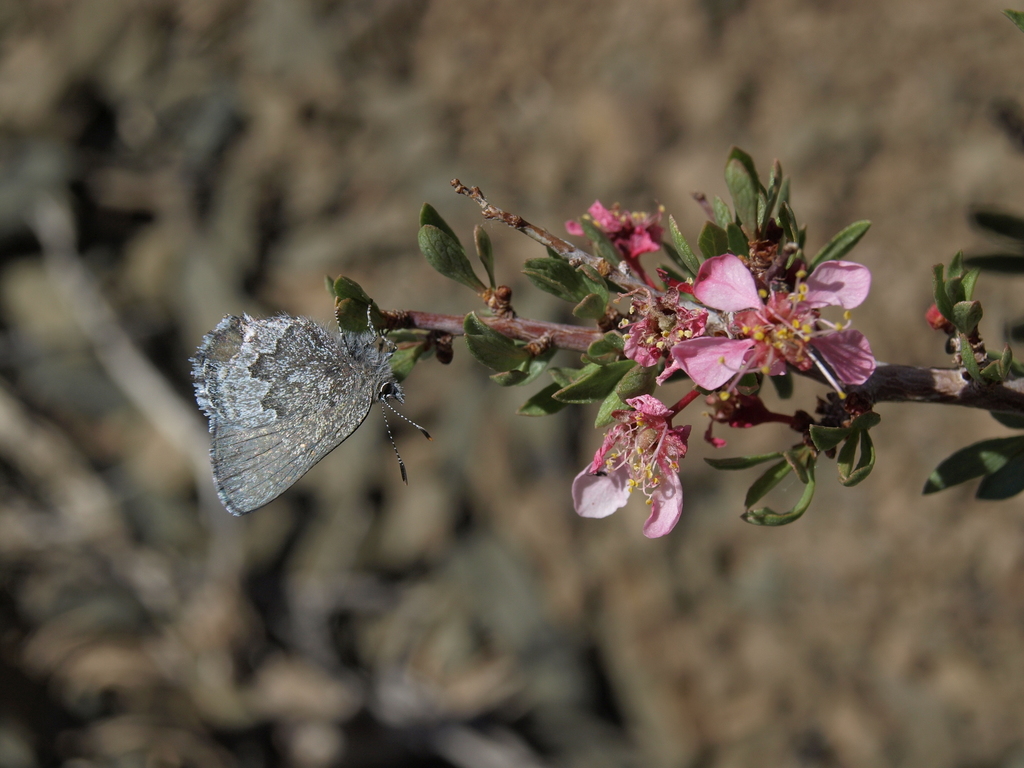
(c) Jim Morefield, some rights reserved (CC BY) · licence
Family: Lycaenidae · Class: Insecta · Order: Lepidoptera
Callophrys fotis (Desert Elfin) is a California animal in the Lycaenidae family.
The Desert Elfin is a small butterfly in the hairstreak family Lycaenidae, distinguished by its compact size and distinctive wing patterns. Adults have a wingspan of approximately 22 to 28 millimeters (0.9 to 1.1 inches). The dorsal wing surfaces are brownish-gray to dark brown, while the ventral surfaces display a complex pattern of brown, gray, and white markings with subtle metallic scaling. Males typically exhibit more pronounced coloration than females. Like other elfins, this species lacks the hair-like tails on the hindwings that characterize many lycaenids. The Desert Elfin occurs across the southwestern United States, with its range encompassing southeastern California, southern Nevada, central Utah, southwest Colorado, northern Arizona, and northwestern New Mexico. In California, populations are documented from the Mojave Desert region, particularly in areas of suitable habitat containing the host plant. The species occupies a relatively narrow elevational range, typically between 1,200 and 2,400 meters (4,000 to 8,000 feet). This butterfly inhabits arid and semi-arid environments characterized by pinyon-juniper woodland, sagebrush scrub, and desert mountain slopes. The species demonstrates strict host plant specificity, with larvae feeding exclusively on cliff rose (Cowania mexicana var. stansburiana) in the rose family. Adults are most commonly observed in areas where cliff rose forms dense stands or scattered populations on rocky slopes, canyon walls, and mesa edges. The habitat typically features well-drained soils and exposed rock formations. Desert Elfin exhibits a single annual generation, with adults emerging in spring, typically from March through May, depending on elevation and local climate conditions. Flight period coincides with the flowering of cliff rose, when nectar sources are abundant. Males establish territories near host plants and engage in perching behavior to locate females. After mating, females deposit eggs singly on flower buds or young leaves of cliff rose. Larvae develop through four instars, feeding on flowers, young leaves, and developing seed pods. The species overwinters in the pupal stage, with pupae often concealed in leaf litter or soil cracks near the base of host plants. Adults are opportunistic nectar feeders, visiting various spring-blooming wildflowers including buckwheat species, lupines, and penstemon when available. The butterfly's flight pattern is typically rapid and erratic, making field observation challenging. Males are more frequently encountered than females, as they actively patrol territories and engage in territorial disputes. While not federally or state listed, Desert Elfin populations face potential threats from habitat degradation, urban development, and climate change impacts on both the butterfly and its specialized host plant. The species' dependence on cliff rose makes it vulnerable to changes in precipitation patterns and temperature regimes that could affect host plant distribution and phenology. Grazing pressure and invasive plant species may also impact habitat quality in some areas.
Classification
Class: Insecta · Order: Lepidoptera · Family: Lycaenidae
Frequently asked questions
How is Callophrys fotis classified?
Callophrys fotis belongs to class Insecta, order Lepidoptera, family Lycaenidae.
What family does Callophrys fotis belong to?
Callophrys fotis is in the Lycaenidae family.
What is Callophrys fotis?
The Desert Elfin is a small butterfly in the hairstreak family Lycaenidae, distinguished by its compact size and distinctive wing patterns.
Is Callophrys fotis found in California?
Yes. Callophrys fotis is recorded in California in The California Species Project's catalogue.
Related species
Other California species in the same genus, family, or bioregion.
Data from The California Species Project — 14,000+ California species with verified data from CNPS, CDFW, USFWS, and more.