Callophrys gryneus
Juniper Hairstreak
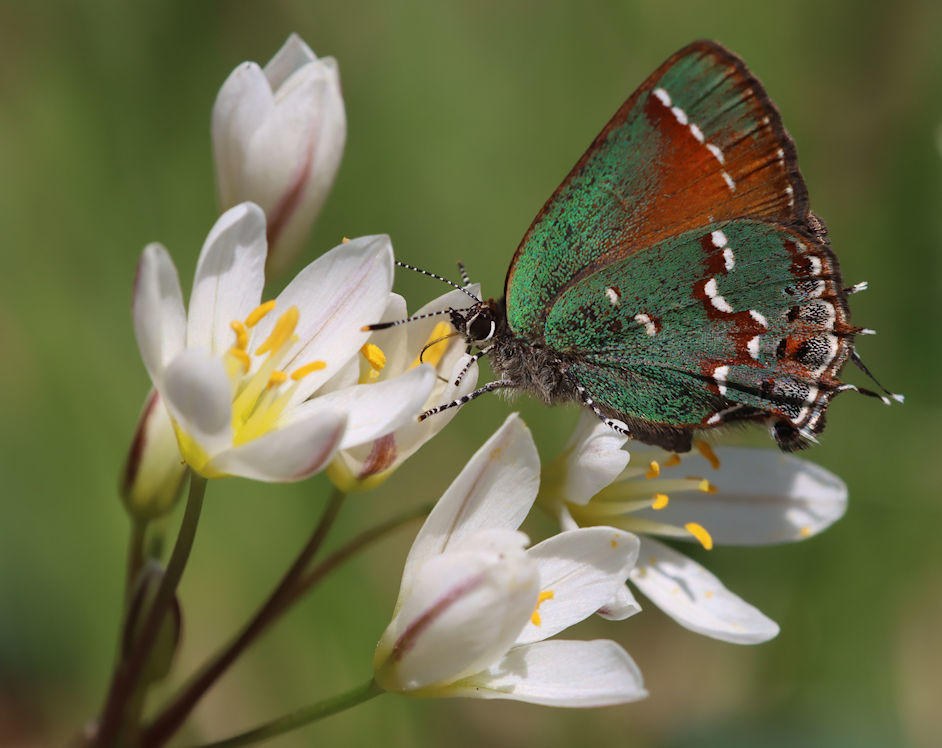
(c) hr_dragonfly, some rights reserved (CC BY) · licence
Family: Lycaenidae · Class: Insecta · Order: Lepidoptera
Callophrys gryneus (Juniper Hairstreak) is a California animal in the Lycaenidae family.
The Juniper Hairstreak (Callophrys gryneus) is a small butterfly in the family Lycaenidae, characterized by its compact size and cryptic coloration. Adults typically measure 22 to 30 mm (0.9 to 1.2 inches) in wingspan. The dorsal wing surfaces are brown with subtle iridescent blue-green highlights, particularly visible in males. The ventral surfaces display the distinctive hairstreak pattern: pale green to gray-green ground color with irregular white lines edged in darker green or brown. A prominent orange eyespot with a black center appears near the hindwing tail, and thin hairlike projections extend from the hindwing tips. These tail-like extensions and eyespots likely function to misdirect predator attacks away from the head. The Juniper Hairstreak ranges from eastern Texas westward through Montana, North Dakota, and Nebraska, extending south through California, Arizona, New Mexico, and into Baja California. In California, the species occurs in suitable habitat throughout much of the state where host plants are present, from the Coast Ranges to the Sierra Nevada foothills and desert regions. The distribution closely follows that of native juniper species across western North America. This species inhabits areas dominated by juniper woodlands, ranging from sea level to elevations exceeding 2,400 meters (8,000 feet). Preferred habitats include open juniper stands, juniper-oak woodlands, pinyon-juniper communities, and chaparral areas where junipers occur as scattered individuals. Adults are often found on hillsides, canyon slopes, and ridge tops where air currents facilitate their flight patterns. The species shows strong fidelity to areas containing its specific host plants. Juniper Hairstreaks are obligate specialists on juniper species (Juniperus spp.), with larvae feeding exclusively on these plants. Documented host plants include Rocky Mountain juniper (Juniperus scopulorum), California juniper (J. californica), Utah juniper (J. osteosperma), and likely other juniper species within the range. Females deposit single eggs on young juniper shoots, typically on new growth. Larvae are green with pale stripes and feed internally on juniper foliage, developing through four instars. The species overwinters as a chrysalis attached to the host plant or nearby vegetation. Adults are active from March through September, with peak flight periods varying by elevation and latitude. Males establish territories on hilltops and prominent perches, engaging in rapid, erratic flights to investigate potential mates or intruders. Adults nectar on various flowers including buckwheat, rabbitbrush, and other low-growing plants in juniper habitat. The Juniper Hairstreak is not federally or state-listed and appears to maintain stable populations throughout most of its range. However, habitat loss from urban development, particularly in California's foothill regions, has reduced available habitat in some areas. Juniper woodland management, including prescribed burning and mechanical treatments, can impact local populations if not carefully planned to maintain host plant availability.
Classification
Class: Insecta · Order: Lepidoptera · Family: Lycaenidae
Frequently asked questions
How is Callophrys gryneus classified?
Callophrys gryneus belongs to class Insecta, order Lepidoptera, family Lycaenidae.
What family does Callophrys gryneus belong to?
Callophrys gryneus is in the Lycaenidae family.
What is Callophrys gryneus?
The Juniper Hairstreak (Callophrys gryneus) is a small butterfly in the family Lycaenidae, characterized by its compact size and cryptic coloration.
Is Callophrys gryneus found in California?
Yes. Callophrys gryneus is recorded in California in The California Species Project's catalogue.
Related species
Other California species in the same genus, family, or bioregion.
Data from The California Species Project — 14,000+ California species with verified data from CNPS, CDFW, USFWS, and more.