Callophrys johnsoni
Johnson's Hairstreak
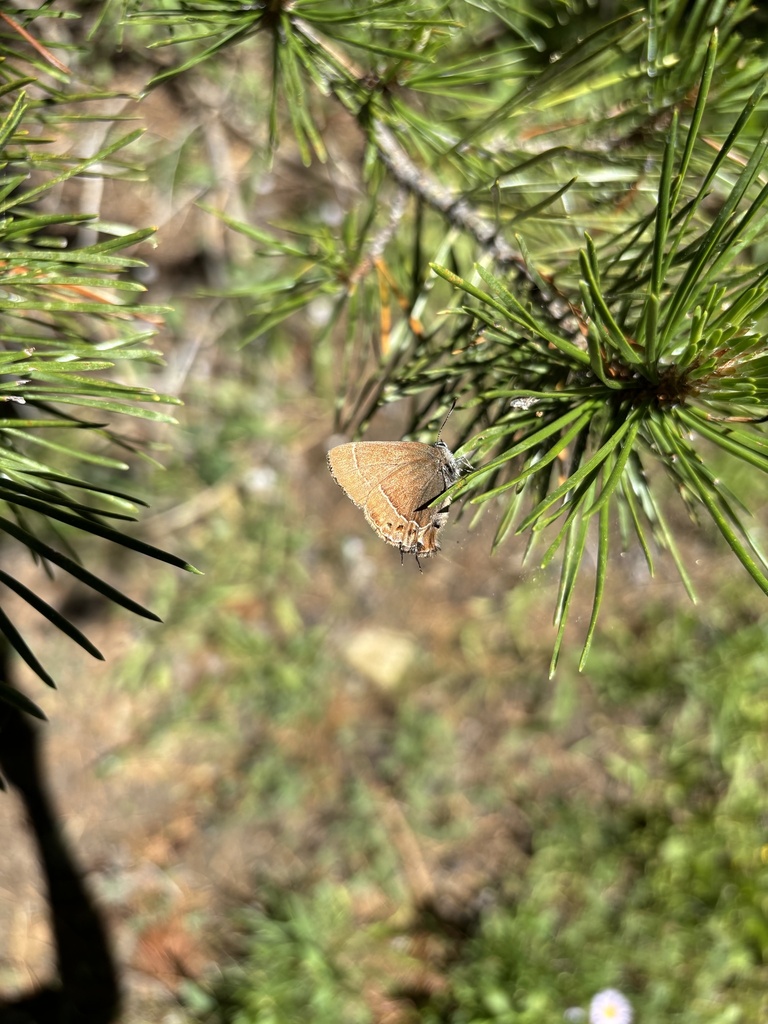
(c) graham_coop, some rights reserved (CC BY) · licence
Family: Lycaenidae · Class: Insecta · Order: Lepidoptera
Callophrys johnsoni (Johnson's Hairstreak) is a California animal in the Lycaenidae family.
Johnson's hairstreak (Callophrys johnsoni) is a small butterfly in the family Lycaenidae, distinguished by its specialized ecological requirements and limited distribution. Adults have a wingspan of approximately 22-28 mm (0.9-1.1 inches). The dorsal wing surfaces are typically brown to gray-brown, while the ventral surfaces display the characteristic green coloration common to many Callophrys species, often with subtle white postmedial lines and orange-capped tails on the hindwings. Males and females are similar in appearance, though females may be slightly larger. Johnson's hairstreak occurs along the Pacific Slope mountains from British Columbia south to central California, but populations are very local and scarce throughout this range. In California, the species has been documented in the Sierra Nevada, Cascade Range, and northern Coast Range mountains. The distribution closely follows that of its obligate host plant, pine dwarf mistletoe (Arceuthobium campylopodum), which limits the butterfly's occurrence to specific forest types and elevations. The species inhabits coniferous forests where pine dwarf mistletoe infects host trees, typically at elevations ranging from 900 to 2,400 meters (3,000 to 8,000 feet). Pine dwarf mistletoe parasitizes various conifer species including ponderosa pine, lodgepole pine, Douglas-fir, and true firs. Johnson's hairstreak larvae develop exclusively within the swollen branches and stems created by mistletoe infections, known as witches' brooms. These microhabitats provide both food and shelter throughout the larval development period. Adults typically fly from May through July, with peak emergence varying by elevation and local climate conditions. Males establish territories near mistletoe-infected trees and engage in patrolling behavior to locate females. Mating occurs on or near host plants, and females deposit eggs directly on young mistletoe shoots. The larvae are specialized feeders, consuming mistletoe tissue and potentially the fungal associates within the parasitic plant. Development likely requires one year to complete, with larvae overwintering in mistletoe growths. The species exhibits a close synchronization with mistletoe phenology, as adults must emerge when suitable egg-laying sites are available. Johnson's hairstreak faces conservation challenges due to its highly specialized ecological requirements and naturally fragmented distribution. The species depends entirely on the presence of pine dwarf mistletoe, which itself has a patchy distribution within suitable forest types. Forest management practices that remove diseased trees or entire infected stands can eliminate local populations. Climate change may affect the distribution and abundance of both the butterfly and its host plant, particularly at the margins of their ranges. Fire suppression policies that alter natural forest dynamics could impact mistletoe abundance and distribution patterns. The species' rarity and specialized habitat requirements make it vulnerable to local extinctions, though it currently lacks formal conservation status designation at state or federal levels. Long-term monitoring of populations and their associated mistletoe communities would help assess conservation needs for this ecologically specialized butterfly.
Classification
Class: Insecta · Order: Lepidoptera · Family: Lycaenidae
Frequently asked questions
How is Callophrys johnsoni classified?
Callophrys johnsoni belongs to class Insecta, order Lepidoptera, family Lycaenidae.
What family does Callophrys johnsoni belong to?
Callophrys johnsoni is in the Lycaenidae family.
What is Callophrys johnsoni?
Johnson's hairstreak (Callophrys johnsoni) is a small butterfly in the family Lycaenidae, distinguished by its specialized ecological requirements and limited distribution.
Is Callophrys johnsoni found in California?
Yes. Callophrys johnsoni is recorded in California in The California Species Project's catalogue.
Related species
Other California species in the same genus, family, or bioregion.
Data from The California Species Project — 14,000+ California species with verified data from CNPS, CDFW, USFWS, and more.