Callophrys mossii
Moss' Elfin
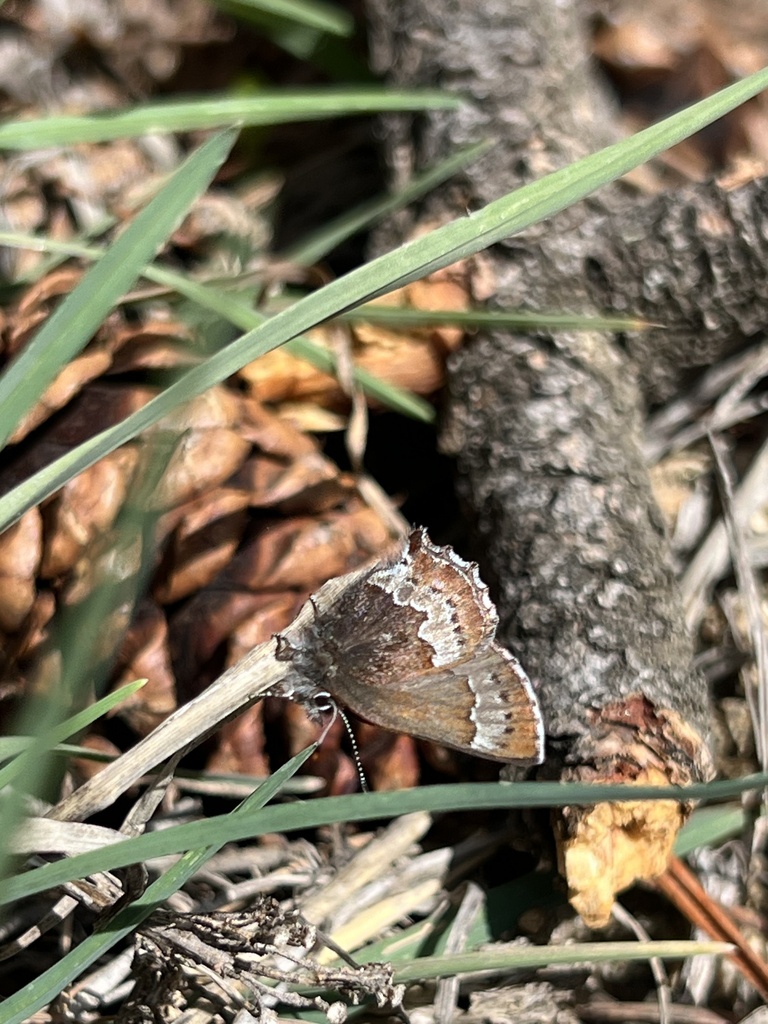
(c) Jared Shorma, some rights reserved (CC BY) · licence
Family: Lycaenidae · Class: Insecta · Order: Lepidoptera
Callophrys mossii (Moss' Elfin) is a California animal in the Lycaenidae family.
Moss' Elfin is a small butterfly in the hairstreak family Lycaenidae with a wingspan ranging from 19 to 25 mm (0.75 to 1.0 inches). Adults display cryptic coloration with brown upperside wing surfaces marked by darker brown bands and spots. The underside forewings are grayish-brown with white-edged dark lines, while the hindwings feature a distinctive row of white-outlined dark spots along the outer margin. Males typically show slightly brighter coloration than females, and both sexes lack the tail-like projections common in many hairstreak species. Moss' Elfin occurs in patchy, isolated populations from British Columbia south to southern California, extending eastward to Wyoming and Colorado. Within California, populations are documented in the Coast Ranges, Sierra Nevada, and desert mountain ranges. The species' fragmented distribution reflects its specialized habitat requirements and limited dispersal ability. Historical records indicate the butterfly once occupied a broader range, but habitat loss has contributed to population isolation. The species inhabits rocky outcrops, cliff faces, and steep slopes where host plants grow in thin soils and crevices. Elevations range from near sea level in coastal areas to approximately 2,400 meters (7,875 feet) in montane environments. Moss' Elfin requires areas with exposed rock surfaces that support sparse vegetation dominated by succulent host plants. Suitable habitat often occurs on south-facing slopes with excellent drainage and minimal canopy cover. Moss' Elfin larvae feed exclusively on stonecrop species in the Crassulaceae family, including Sedum, Sedella, Dudleya, and Parvisedum. Adults typically fly from March through June, with flight timing varying by elevation and latitude. Females deposit eggs singly on host plant buds or young leaves. Larvae develop through four instars, feeding on flowers, fruits, and occasionally leaves of their host plants. The species overwinters as chrysalids attached to rock surfaces or plant debris near the host plants. Adults are strong fliers despite their small size and males establish territories around host plant patches where they actively patrol for mates. Moss' Elfin faces conservation challenges primarily from habitat destruction and fragmentation. Urban development, quarrying operations, and recreational activities threaten many populations, particularly those at lower elevations. Climate change poses additional risks through altered precipitation patterns that may affect host plant survival in already marginal habitats. The butterfly's specialized host plant requirements and limited dispersal ability make populations vulnerable to local extirpations. Some populations occur within protected areas, but many sites lack formal conservation status. Monitoring efforts are limited, making population trend assessment difficult. Conservation strategies should focus on protecting known breeding sites and maintaining connectivity between isolated populations through habitat corridor preservation.
Classification
Class: Insecta · Order: Lepidoptera · Family: Lycaenidae
Frequently asked questions
How is Callophrys mossii classified?
Callophrys mossii belongs to class Insecta, order Lepidoptera, family Lycaenidae.
What family does Callophrys mossii belong to?
Callophrys mossii is in the Lycaenidae family.
What is Callophrys mossii?
Moss' Elfin is a small butterfly in the hairstreak family Lycaenidae with a wingspan ranging from 19 to 25 mm (0.75 to 1.0 inches).
Is Callophrys mossii found in California?
Yes. Callophrys mossii is recorded in California in The California Species Project's catalogue.
Related species
Other California species in the same genus, family, or bioregion.
Data from The California Species Project — 14,000+ California species with verified data from CNPS, CDFW, USFWS, and more.