Callophrys mossii bayensis
San Bruno elfin butterfly
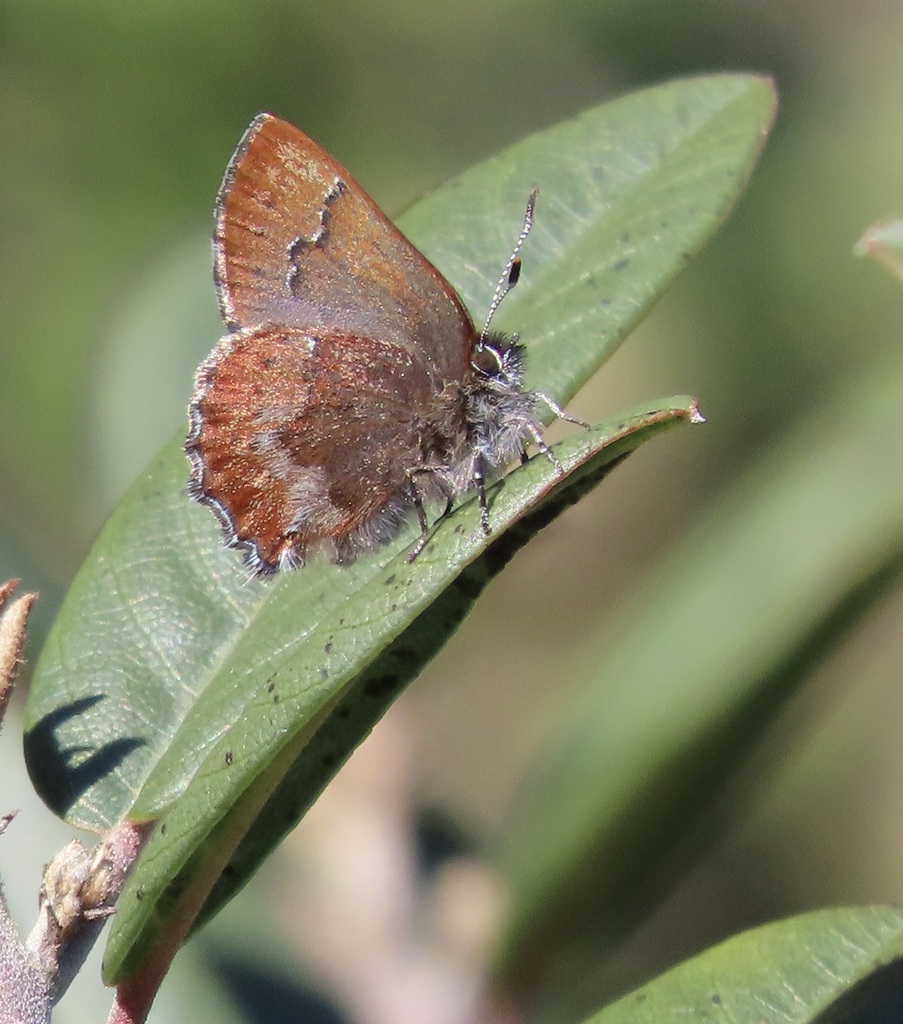
(c) John Hibbard, some rights reserved (CC BY) · licence
Family: Lycaenidae · Class: Insecta · Order: Lepidoptera
Conservation status: Endangered · G4T2 S2
Callophrys mossii bayensis (San Bruno elfin butterfly) is a California animal in the Lycaenidae family.
The San Bruno elfin butterfly (Callophrys mossii bayensis) is a small lycaenid butterfly endemic to the San Francisco Peninsula in California. Adults have a wingspan of approximately 22 to 28 millimeters (0.9 to 1.1 inches). The dorsal wing surfaces are brown with subtle darker markings, while the ventral hindwings display a distinctive pattern of white and brown bands with irregular white postmedian lines. Males typically exhibit slightly more vibrant coloration than females. The species lacks tails on the hindwings, distinguishing it from related hairstreak butterflies. According to the California Department of Fish and Wildlife, this subspecies is synonymous with Incisalia fotis bayensis and Callophrys fotis bayensis. The San Bruno elfin butterfly is restricted to San Mateo County, California, with its range centered on San Bruno Mountain and nearby areas of the San Francisco Peninsula. Historically, the subspecies likely occurred more widely across suitable habitat in the region, but development has significantly reduced its distribution. Current populations are known from fewer than 10 locations, all within a very limited geographic area of approximately 8 square kilometers. This butterfly inhabits coastal scrub and grassland communities on steep, rocky slopes and ridges. The species is closely associated with areas containing its host plant, Sedum spathulifolium (broadleaf stonecrop), which grows on rocky outcrops and thin soils. Elevations range from approximately 180 to 400 meters (590 to 1,310 feet) above sea level. The habitat is characterized by fog influence from the Pacific Ocean, creating cool, moist conditions during summer months. Associated plant species include coyote brush, poison oak, and various native grasses. San Bruno elfin butterflies are univoltine, producing one generation per year. Adults emerge from late February through April, with peak flight activity typically occurring in March. Females deposit eggs singly on or near the host plant, Sedum spathulifolium. Larvae feed exclusively on this succulent plant, developing through five instars before pupating. The species overwinters in the pupal stage, with pupae attached to the host plant or nearby vegetation. Adults are active during warm, sunny periods and males establish territories on hilltops and ridges where they engage in patrolling behavior to locate females. The U.S. Fish and Wildlife Service listed the San Bruno elfin butterfly as endangered in 1976, making it one of the first butterfly subspecies to receive federal protection. The primary threat is habitat loss and fragmentation due to urban development on the San Francisco Peninsula. Additional threats include invasive plant species that compete with the host plant, recreational activities that disturb habitat, and climate change effects on fog patterns. Conservation efforts include habitat restoration, invasive species control, and protection of remaining habitat through land acquisition and management agreements. The species' extremely limited range and small population size make it particularly vulnerable to extinction from stochastic events or continued habitat degradation.
Classification
Class: Insecta · Order: Lepidoptera · Family: Lycaenidae
Conservation status
Endangered · G4T2 S2
Frequently asked questions
How is Callophrys mossii bayensis classified?
Callophrys mossii bayensis belongs to class Insecta, order Lepidoptera, family Lycaenidae.
What family does Callophrys mossii bayensis belong to?
Callophrys mossii bayensis is in the Lycaenidae family.
Is Callophrys mossii bayensis protected or of conservation concern?
Callophrys mossii bayensis carries the following status: Endangered · G4T2 S2.
What is Callophrys mossii bayensis?
The San Bruno elfin butterfly (Callophrys mossii bayensis) is a small lycaenid butterfly endemic to the San Francisco Peninsula in California.
Is Callophrys mossii bayensis found in California?
Yes. Callophrys mossii bayensis is recorded in California in The California Species Project's catalogue.
Related species
Other California species in the same genus, family, or bioregion.
Data from The California Species Project — 14,000+ California species with verified data from CNPS, CDFW, USFWS, and more.