Callophrys mossii marinensis
Marin Elfin Butterfly
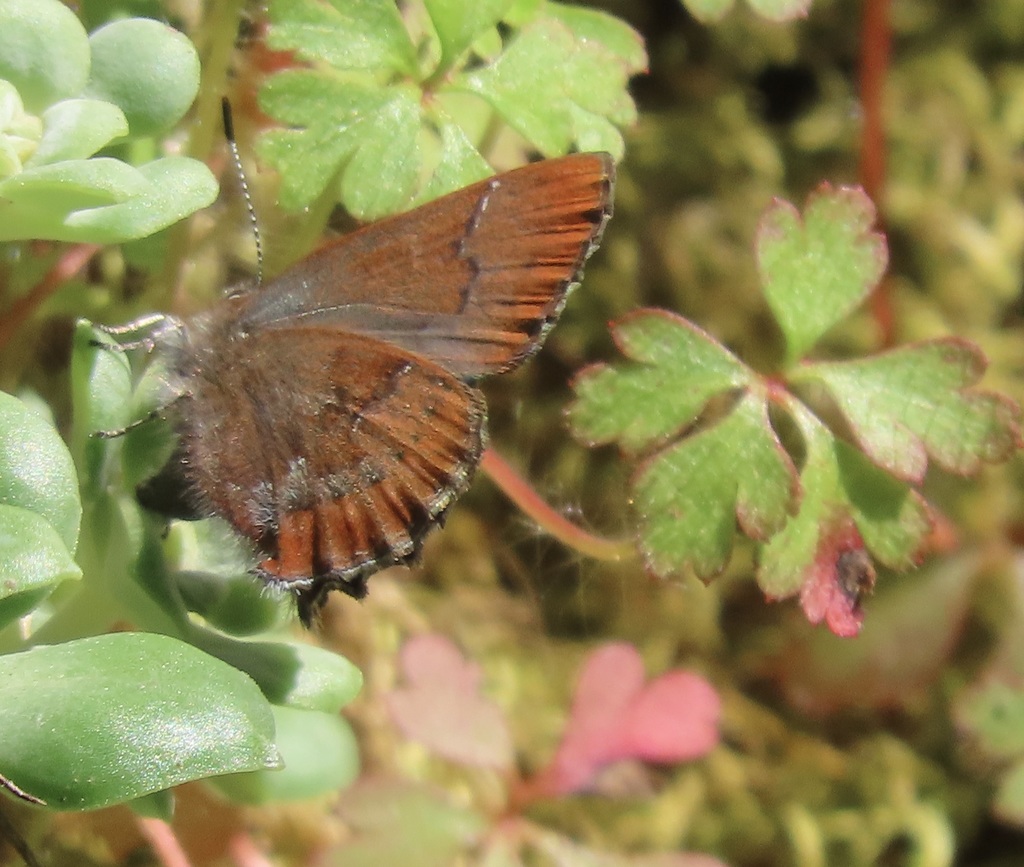
(c) John Hibbard, some rights reserved (CC BY) · licence
Family: Lycaenidae · Class: Insecta · Order: Lepidoptera
Conservation status: G4T1 S2
Callophrys mossii marinensis (Marin Elfin Butterfly) is a California animal in the Lycaenidae family.
The Marin Elfin Butterfly (Callophrys mossii marinensis) is a small lycaenid butterfly endemic to a highly restricted area of coastal California. Adults have a wingspan of approximately 22-28 mm (0.9-1.1 inches), with males displaying iridescent green-bronze dorsal wing surfaces and females appearing more subdued brown. The ventral hindwings exhibit the characteristic elfin pattern of irregular white-edged lines and spots against a mottled brown and gray background. Both sexes possess the distinctive short tails on the hindwings typical of elfin butterflies, though these may be reduced or absent in some individuals. This subspecies occurs only in Marin County, California, representing one of the most geographically restricted butterfly taxa in North America. The entire known range encompasses fewer than 20 square kilometers in the coastal hills and ridges of the Marin Headlands and adjacent areas. Historical records suggest the subspecies may have occurred more broadly across suitable habitat in western Marin County, but current populations are confined to scattered sites between approximately 60-400 meters (200-1,300 feet) elevation. Marin Elfin inhabits coastal scrub and chaparral communities dominated by its sole larval host plant, Sedum spathulifolium (broadleaf stonecrop). This succulent grows on rocky outcrops, cliff faces, and thin-soiled slopes where fog and marine moisture provide necessary humidity. The butterfly shows strong fidelity to sites with abundant stonecrop populations, typically on north- and west-facing exposures that receive regular fog influence. Adults emerge from late February through early May, with peak flight activity occurring in March and early April. Males establish territories near host plant colonies and engage in patrol flights to locate females. After mating, females deposit single eggs on or near stonecrop plants. Larvae feed exclusively on Sedum spathulifolium flowers and developing seed capsules, completing development over approximately 30 days. The species overwinters as pupae in silk-lined cells constructed among rocks or plant debris near the host plant. The Marin Elfin's conservation status reflects its extremely limited range and small population size. The subspecies receives a Global/State Rank of G4T1 S2, indicating it is critically imperiled as a subspecies. Primary threats include habitat loss from urban development, recreational activities, and invasive plant species. The butterfly's dependence on fog-influenced microhabitats makes it particularly vulnerable to climate change, as shifting fog patterns could alter the moisture regimes essential for both the butterfly and its host plant. Additionally, the small, isolated populations face increased extinction risk from stochastic events and reduced genetic diversity. Conservation efforts focus on habitat protection and management, invasive species control, and monitoring of known populations to track population trends and detect new threats.
Classification
Class: Insecta · Order: Lepidoptera · Family: Lycaenidae
Conservation status
G4T1 S2
Frequently asked questions
How is Callophrys mossii marinensis classified?
Callophrys mossii marinensis belongs to class Insecta, order Lepidoptera, family Lycaenidae.
What family does Callophrys mossii marinensis belong to?
Callophrys mossii marinensis is in the Lycaenidae family.
Is Callophrys mossii marinensis protected or of conservation concern?
Callophrys mossii marinensis carries the following status: G4T1 S2.
What is Callophrys mossii marinensis?
The Marin Elfin Butterfly (Callophrys mossii marinensis) is a small lycaenid butterfly endemic to a highly restricted area of coastal California.
Is Callophrys mossii marinensis found in California?
Yes. Callophrys mossii marinensis is recorded in California in The California Species Project's catalogue.
Related species
Other California species in the same genus, family, or bioregion.
Data from The California Species Project — 14,000+ California species with verified data from CNPS, CDFW, USFWS, and more.