Callophrys muiri
Muir's Hairstreak
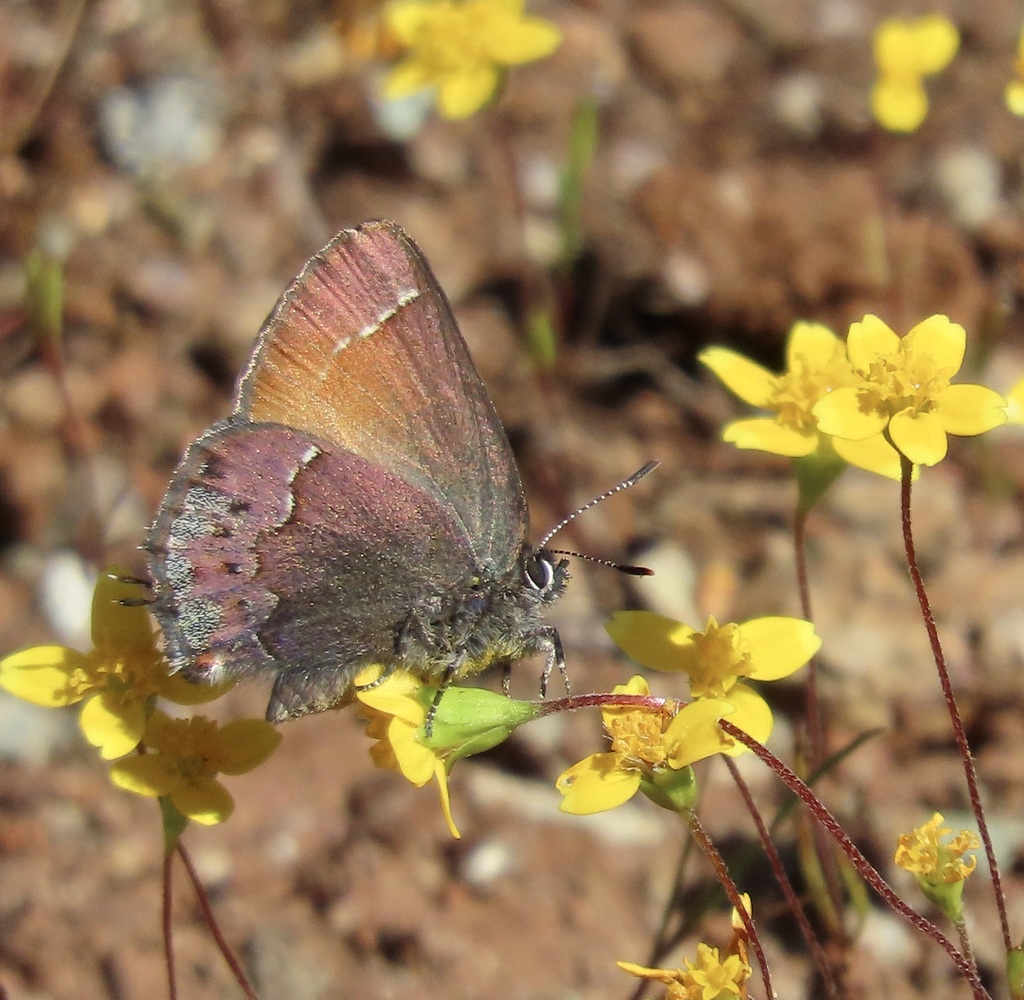
(c) John Hibbard, some rights reserved (CC BY) · licence
Family: Lycaenidae · Class: Insecta · Order: Lepidoptera
Callophrys muiri (Muir's Hairstreak) is a California animal in the Lycaenidae family.
Muir's hairstreak is a small butterfly endemic to California's Coast Ranges and Baja California, Mexico. Adults have a wingspan of approximately 22 to 28 mm (0.9 to 1.1 inches). The dorsal wing surfaces are brown with a subtle copper sheen in males, while females display more muted brown coloration. The ventral hindwings feature distinctive white-edged postmedian lines and small orange spots near the tail extensions. Both sexes possess the characteristic short tails on the hindwings typical of hairstreak butterflies, along with eyespots that may help deflect predator attacks away from vital body parts. Muir's hairstreak occurs in California's Coast Ranges from San Luis Obispo County north to Mendocino County, with an additional population on Guadalupe Island, Mexico. The species inhabits scattered locations throughout this range, typically associated with cypress woodlands and chaparral communities. In California, populations are documented in areas including the Santa Lucia Mountains, the Diablo Range, and portions of the North Coast Ranges where suitable host plants occur. The species occupies dry, rocky slopes and ridges in chaparral and mixed evergreen forest communities, typically at elevations ranging from near sea level to approximately 1,500 meters (4,900 feet). Habitat requirements center on the presence of native cypress trees, particularly in areas with well-drained soils and exposure to full or partial sunlight. Adults are most commonly observed in clearings and edges adjacent to cypress stands, where they engage in territorial behavior and mate-seeking activities. Muir's hairstreak is strictly associated with cypress trees as larval hosts, especially Sargent cypress and MacNab's cypress. Females deposit eggs singly on young cypress foliage, typically on new growth or terminal buds. Larvae feed on cypress needles and developing cones, with their green coloration providing camouflage against the host plant. The species is univoltine, producing one generation per year with adult flight period occurring from late March through June, peaking in April and May. Adults are active during warm, sunny conditions and exhibit typical lycaenid behavior, including rapid, erratic flight patterns and frequent perching on low vegetation or bare ground. Currently, Muir's hairstreak does not hold federal or state listing status in California. However, the species faces conservation challenges due to its narrow host plant requirements and fragmented distribution. Native cypress woodlands have experienced habitat loss from development, fire suppression leading to vegetation changes, and altered fire regimes. Climate change poses additional threats through potential shifts in suitable habitat zones and increased wildfire frequency. The species' dependence on specific cypress species makes it vulnerable to factors affecting these host plants, including drought stress, disease, and direct habitat conversion. Conservation of remaining cypress woodland habitats and monitoring of known populations remain important for maintaining stable Muir's hairstreak populations throughout its limited California range.
Classification
Class: Insecta · Order: Lepidoptera · Family: Lycaenidae
Frequently asked questions
How is Callophrys muiri classified?
Callophrys muiri belongs to class Insecta, order Lepidoptera, family Lycaenidae.
What family does Callophrys muiri belong to?
Callophrys muiri is in the Lycaenidae family.
What is Callophrys muiri?
Muir's hairstreak is a small butterfly endemic to California's Coast Ranges and Baja California, Mexico.
Is Callophrys muiri found in California?
Yes. Callophrys muiri is recorded in California in The California Species Project's catalogue.
Related species
Other California species in the same genus, family, or bioregion.
Data from The California Species Project — 14,000+ California species with verified data from CNPS, CDFW, USFWS, and more.