Callophrys nelsoni
Nelson's Hairstreak
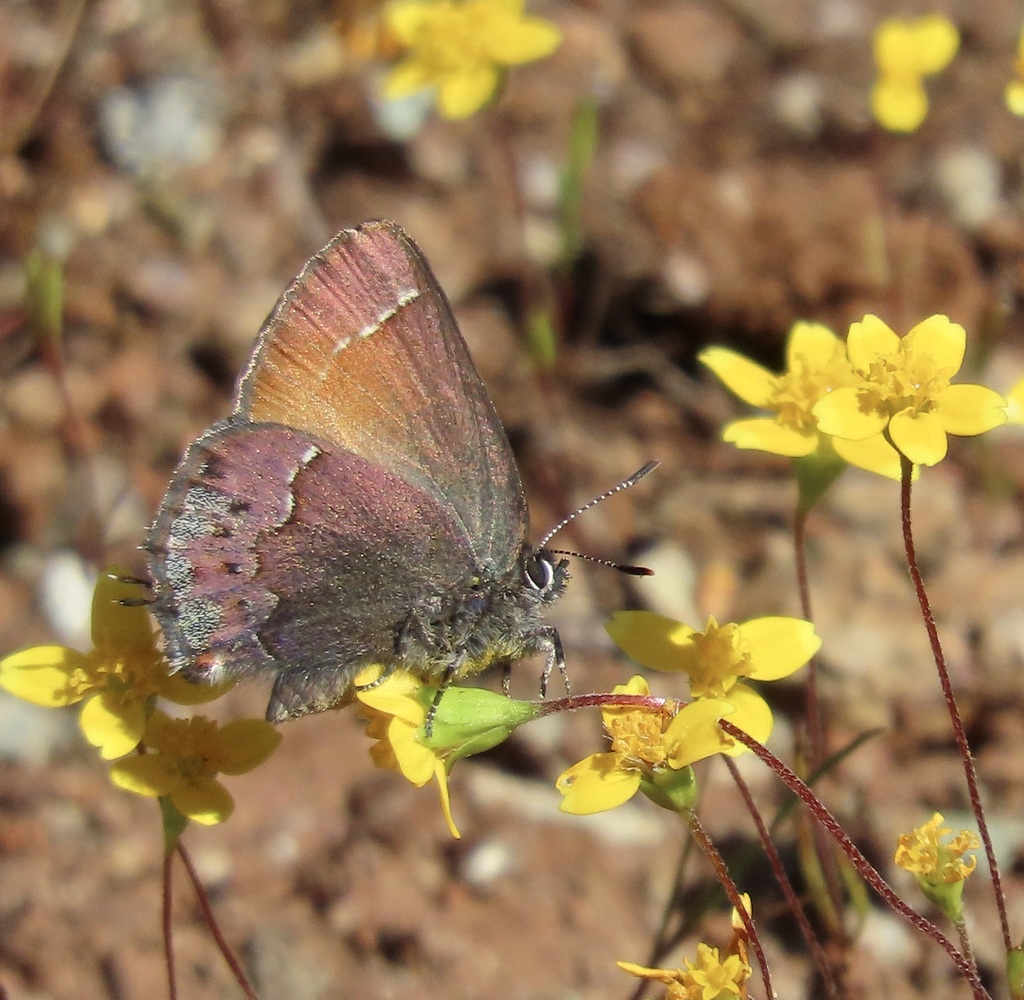
(c) John Hibbard, some rights reserved (CC BY) · licence
Family: Lycaenidae · Class: Insecta · Order: Lepidoptera
Callophrys nelsoni (Nelson's Hairstreak) is a California animal in the Lycaenidae family.
Nelson's hairstreak is a small butterfly in the copper family (Lycaenidae) with distinctive wing patterns and specialized habitat requirements. Adults have a wingspan of approximately 22-28 mm (0.9-1.1 inches). The dorsal wing surfaces are dark brown to blackish with minimal markings, while the ventral surfaces display a complex pattern of white, gray, and brown bands with small orange spots near the hindwing margins. Males and females are similar in size and coloration, though females may appear slightly larger. The hindwings feature small tail-like projections typical of hairstreak butterflies, along with prominent eyespots that may serve to deflect predator attacks away from vital body parts. Nelson's hairstreak ranges from southern British Columbia and northwest Montana south through Washington, Oregon, Idaho, and Nevada to the high-altitude mountains of southern California and Baja California Norte. In California, populations occur primarily in montane regions of the Sierra Nevada, Cascade Range, and scattered locations in the Coast Ranges. The species typically inhabits areas between 1,200 and 2,400 meters (4,000-8,000 feet) elevation, though it may occur at lower elevations in northern portions of its range. This species is closely associated with coniferous forests containing its host plants: incense cedar (Calocedrus decurrens) and western red-cedar (Thuja plicata). Nelson's hairstreak requires mature forest stands where these conifers form significant components of the canopy. Adults are most commonly observed in forest openings, along ridgelines, and near creek drainages where host trees are present. The species shows strong fidelity to specific microsites within suitable habitat, often returning to the same territories year after year. Adults typically emerge in late spring to early summer, with flight periods varying by elevation and latitude. Peak activity occurs from May through July in most locations. Males establish territories on prominent perches such as tree tops or exposed rocks, from which they investigate passing objects and engage in aerial pursuits of potential mates. Females seek out suitable host plants for oviposition, depositing single eggs on young foliage or bark crevices of incense cedar or western red-cedar. Larvae feed on the host plant's foliage and likely overwinter as pupae, emerging as adults the following spring. The conservation status of Nelson's hairstreak has not been formally assessed at federal or state levels, though the species is considered secure throughout most of its range. Local populations may face pressures from forest management practices, wildfire, and climate change effects on montane ecosystems. The species' dependence on mature coniferous forests makes it potentially vulnerable to habitat fragmentation and loss of old-growth forest stands. Maintaining connectivity between suitable habitat patches and preserving mature forest ecosystems are important considerations for long-term population viability.
Classification
Class: Insecta · Order: Lepidoptera · Family: Lycaenidae
Frequently asked questions
How is Callophrys nelsoni classified?
Callophrys nelsoni belongs to class Insecta, order Lepidoptera, family Lycaenidae.
What family does Callophrys nelsoni belong to?
Callophrys nelsoni is in the Lycaenidae family.
What is Callophrys nelsoni?
Nelson's hairstreak is a small butterfly in the copper family (Lycaenidae) with distinctive wing patterns and specialized habitat requirements.
Is Callophrys nelsoni found in California?
Yes. Callophrys nelsoni is recorded in California in The California Species Project's catalogue.
Related species
Other California species in the same genus, family, or bioregion.
Data from The California Species Project — 14,000+ California species with verified data from CNPS, CDFW, USFWS, and more.