Callophrys perplexa
Perplexing hairstreak
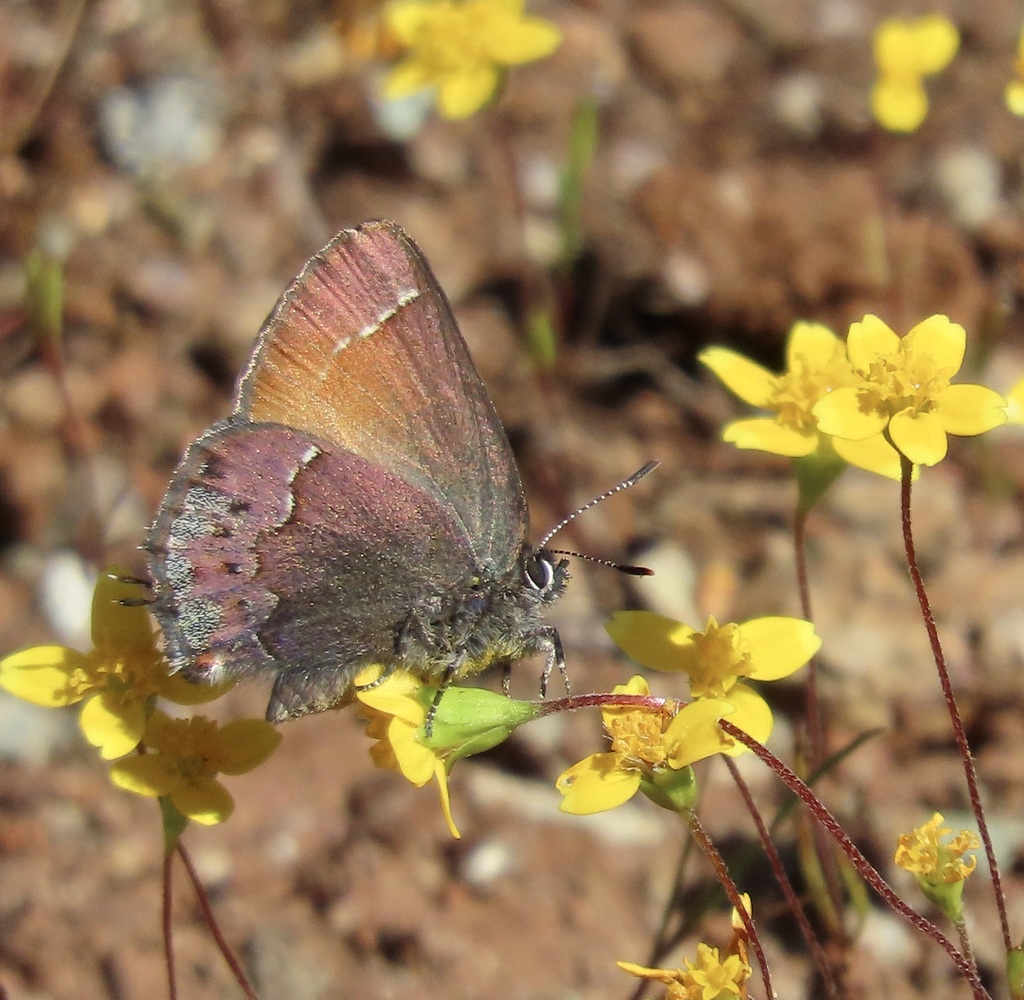
(c) John Hibbard, some rights reserved (CC BY) · licence
Family: Lycaenidae · Class: Insecta · Order: Lepidoptera
Callophrys perplexa (Perplexing hairstreak) is a California animal in the Lycaenidae family.
The perplexing hairstreak is a small butterfly in the family Lycaenidae, characterized by the hairlike projections extending from the hindwings that are typical of this group. Adults have a wingspan of approximately 22 to 28 millimeters (0.9 to 1.1 inches). The dorsal wing surfaces are brown with subtle variations in shading, while the ventral surfaces display a more complex pattern of browns and grays with distinctive white postmedian lines edged in darker brown. Males and females show minimal sexual dimorphism in wing coloration and pattern. The hindwings bear short tails and small eyespots near the wing margins, features that help deflect predator attacks away from vital body parts. Callophrys perplexa is endemic to Southern California, where its distribution includes portions of the Transverse and Peninsular mountain ranges. The species occurs in areas of suitable habitat from sea level to approximately 1,500 meters (4,900 feet) elevation. Historical records document populations in Los Angeles, Orange, Riverside, and San Diego counties, though current distribution may be more fragmented due to habitat loss. This hairstreak inhabits chaparral, coastal sage scrub, and oak woodland communities where its larval host plants occur. Adults are most commonly observed in areas with patchy vegetation that provide both nectar sources and egg-laying sites. The species shows a preference for south-facing slopes and canyon bottoms where host plants are abundant. Deerweed (Acmispon glaber) serves as the primary larval host plant, though larvae also utilize various buckwheat species (Eriogonum spp.) and potentially other members of the pea and buckwheat families. Adult perplexing hairstreaks are active during daylight hours and exhibit rapid, erratic flight patterns typical of lycaenids. Males engage in territorial behavior, perching on prominent vegetation to watch for females and competing males. Mating occurs during the flight period, which typically extends from March through June, with peak activity in April and May. Females deposit eggs singly on host plant buds or young leaves. Larvae feed within developing seed pods or flower heads, completing development through four instars before pupating. The species appears to be univoltine in most locations, producing one generation per year. The perplexing hairstreak lacks formal state or federal conservation status but faces ongoing threats from habitat loss and fragmentation throughout its range. Urban development, fire suppression altering natural fire cycles, and invasive plant species pose primary challenges to population persistence. Climate change may affect the species through altered precipitation patterns and increased temperatures that could shift the distribution of host plants. Many populations occur on private lands where development pressure remains high. Conservation efforts focus on habitat preservation and restoration of native plant communities, particularly maintaining diverse shrubland ecosystems that support both adult nectar sources and larval host plants.
Classification
Class: Insecta · Order: Lepidoptera · Family: Lycaenidae
Frequently asked questions
How is Callophrys perplexa classified?
Callophrys perplexa belongs to class Insecta, order Lepidoptera, family Lycaenidae.
What family does Callophrys perplexa belong to?
Callophrys perplexa is in the Lycaenidae family.
What is Callophrys perplexa?
The perplexing hairstreak is a small butterfly in the family Lycaenidae, characterized by the hairlike projections extending from the hindwings that are typical of this group.
Is Callophrys perplexa found in California?
Yes. Callophrys perplexa is recorded in California in The California Species Project's catalogue.
Related species
Other California species in the same genus, family, or bioregion.
Data from The California Species Project — 14,000+ California species with verified data from CNPS, CDFW, USFWS, and more.