Callophrys polios
Hoary Elfin
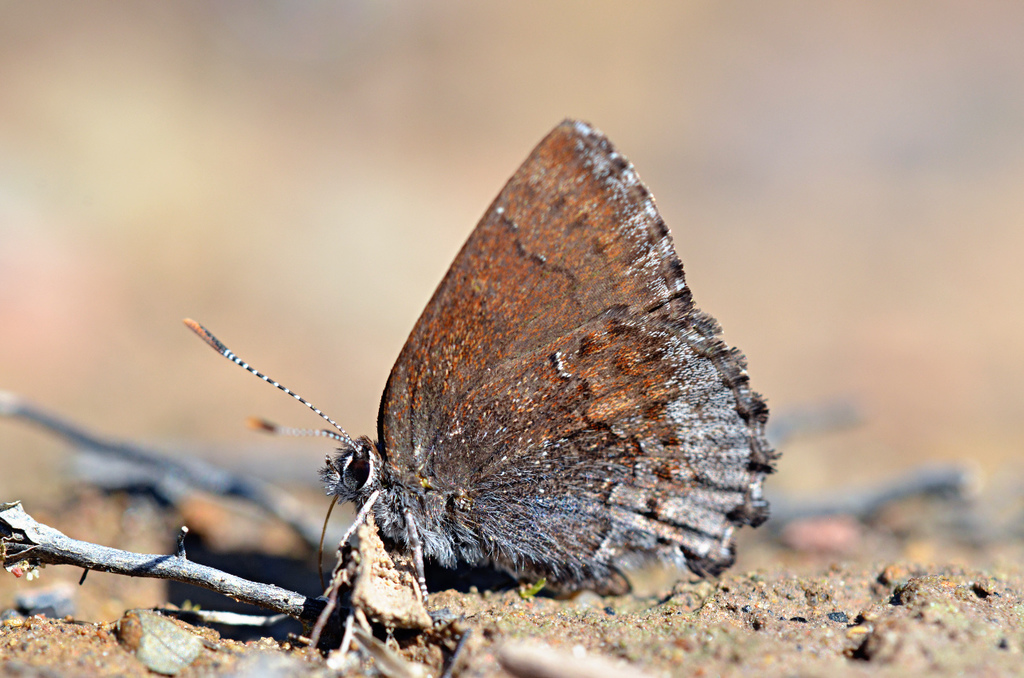
(c) Jimmy Dee, some rights reserved (CC BY-SA) · licence
Family: Lycaenidae · Class: Insecta · Order: Lepidoptera
Callophrys polios (Hoary Elfin) is a California animal in the Lycaenidae family.
The Hoary Elfin is a small butterfly in the copper and hairstreak family Lycaenidae. Adults measure 20 to 25 mm (0.8 to 1.0 inches) in wingspan, making them one of the smaller North American elfins. The dorsal wing surfaces are brown with a grayish cast, while the ventral surfaces display the characteristic pattern that gives the species its common name. The underwing is marked with irregular white and gray scaling that creates a frosted or hoary appearance, particularly prominent on the hindwings. Males typically show more pronounced gray scaling than females. Both sexes lack the tail-like projections found on many related lycaenid species. The Hoary Elfin exhibits a transcontinental but highly localized distribution pattern. The species ranges from Maine south to New Jersey, extending south through the Appalachian Mountains to Virginia. The range continues west across the Great Lakes states and southern prairie provinces of Canada, extending north to Alaska. Along the Pacific Coast, populations occur south to northern California, while in the Rocky Mountain region, the species extends south to northern New Mexico. Despite this broad range, populations are typically small and isolated, occurring only where suitable host plants are present. This species inhabits areas where its primary host plants grow, including sandy barrens, rocky outcrops, and open woodland edges. Bearberry (Arctostaphylos uva-ursi) serves as the primary larval host plant throughout most of the range, with trailing arbutus (Epigaea repens) likely serving as an alternative host in some regions. Both host plants are members of the heath family (Ericaceae) and typically grow in acidic, well-drained soils. Hoary Elfin habitat often occurs on exposed sites with thin soil layers over bedrock or sand, creating the specialized conditions required by the host plants. Hoary Elfins are univoltine, producing one generation per year. Adults typically emerge in early to mid-spring, with flight periods varying by latitude and elevation. In most regions, peak activity occurs from April through May. Males exhibit territorial behavior, perching on elevated spots near host plant patches and investigating passing insects. Females deposit eggs singly on host plant leaves or stems. Larvae feed on the host plant foliage, developing through multiple instars before pupating. The species overwinters in the pupal stage, with adults emerging the following spring when host plants begin active growth. The Hoary Elfin lacks formal federal or state conservation listing status, but faces threats common to specialized butterflies with restricted habitat requirements. Habitat loss and fragmentation pose the primary conservation challenges, as development and vegetation succession can eliminate the open, sandy conditions required by host plants. Fire suppression may contribute to habitat degradation in some regions, as periodic disturbance historically maintained suitable conditions. Climate change may affect the species' northern populations and high-elevation sites. The small size and isolation of many populations make them particularly vulnerable to local extirpation from environmental stochasticity or habitat changes.
Classification
Class: Insecta · Order: Lepidoptera · Family: Lycaenidae
Frequently asked questions
How is Callophrys polios classified?
Callophrys polios belongs to class Insecta, order Lepidoptera, family Lycaenidae.
What family does Callophrys polios belong to?
Callophrys polios is in the Lycaenidae family.
What is Callophrys polios?
The Hoary Elfin is a small butterfly in the copper and hairstreak family Lycaenidae.
Is Callophrys polios found in California?
Yes. Callophrys polios is recorded in California in The California Species Project's catalogue.
Related species
Other California species in the same genus, family, or bioregion.
Data from The California Species Project — 14,000+ California species with verified data from CNPS, CDFW, USFWS, and more.