Callophrys sheridanii
Sheridan's Green Hairstreak
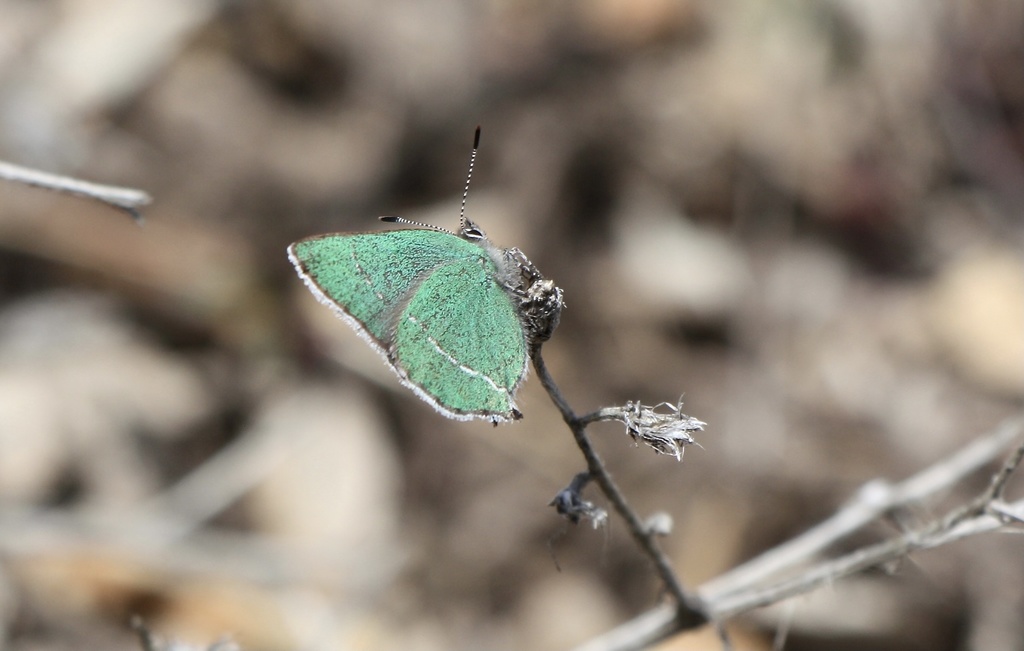
no rights reserved · CC0
Family: Lycaenidae · Class: Insecta · Order: Lepidoptera
Callophrys sheridanii (Sheridan's Green Hairstreak) is a California animal in the Lycaenidae family.
Sheridan's Green Hairstreak is a small butterfly in the family Lycaenidae, with adults measuring 22 to 28 mm (0.9 to 1.1 inches) in wingspan. The dorsal wing surfaces are brown to gray-brown, while the ventral surfaces display the characteristic iridescent green coloration that gives this species its common name. Males typically exhibit brighter green iridescence than females. The hindwings bear short, thread-like tails and small orange spots near the wing margins. Fresh specimens show distinctive white postmedian lines on the undersides of both forewings and hindwings. Sheridan's Green Hairstreak ranges from southern British Columbia east to Alberta, extending south through eastern Washington to the Sierra Nevada of California, and southeast along the Rocky Mountains to New Mexico. In California, populations occur primarily in the eastern Sierra Nevada and adjacent mountain ranges, typically at elevations between 1,200 and 3,000 meters (4,000 to 10,000 feet). The species inhabits montane and subalpine environments where suitable host plants are present. This species occupies dry, rocky slopes, sagebrush flats, and open areas within coniferous forests. Adults are closely associated with various species of wild buckwheat (Eriogonum), which serve as the primary host plants for larval development. Habitat requirements include areas with scattered buckwheat populations, often in association with granite outcrops, scree slopes, or disturbed ground where these plants establish. The species shows preference for south-facing exposures that receive full sun exposure. Sheridan's Green Hairstreak exhibits a univoltine life cycle, producing one generation per year. Adults typically emerge in late May through July, depending on elevation and local climate conditions. Males establish territories near host plants and engage in perching behavior to locate females. Mating occurs shortly after emergence, with females depositing single eggs on flower buds or young leaves of Eriogonum species. Larvae feed on flowers, developing seeds, and occasionally leaves of the host plant. The species overwinters in the pupal stage, with chrysalids attached to plant stems or hidden among leaf litter near the base of host plants. Adults are strong fliers but tend to remain within localized areas containing suitable breeding habitat. Sheridan's Green Hairstreak is not currently listed under federal or California state endangered species legislation. The species appears stable across much of its range, though local populations may face threats from habitat modification, grazing pressure that affects host plant abundance, and potential climate-related shifts in suitable habitat zones. Fire suppression activities that alter natural disturbance patterns may impact habitat quality in some areas, as wild buckwheat species often benefit from periodic disturbance. Conservation of this species depends primarily on maintaining intact montane ecosystems and preserving the diverse Eriogonum communities that support both adult and larval life stages.
Classification
Class: Insecta · Order: Lepidoptera · Family: Lycaenidae
Frequently asked questions
How is Callophrys sheridanii classified?
Callophrys sheridanii belongs to class Insecta, order Lepidoptera, family Lycaenidae.
What family does Callophrys sheridanii belong to?
Callophrys sheridanii is in the Lycaenidae family.
What is Callophrys sheridanii?
Sheridan's Green Hairstreak is a small butterfly in the family Lycaenidae, with adults measuring 22 to 28 mm (0.9 to 1.1 inches) in wingspan.
Is Callophrys sheridanii found in California?
Yes. Callophrys sheridanii is recorded in California in The California Species Project's catalogue.
Related species
Other California species in the same genus, family, or bioregion.
Data from The California Species Project — 14,000+ California species with verified data from CNPS, CDFW, USFWS, and more.