Callophrys sheridanii comstocki
Desert Green Hairstreak
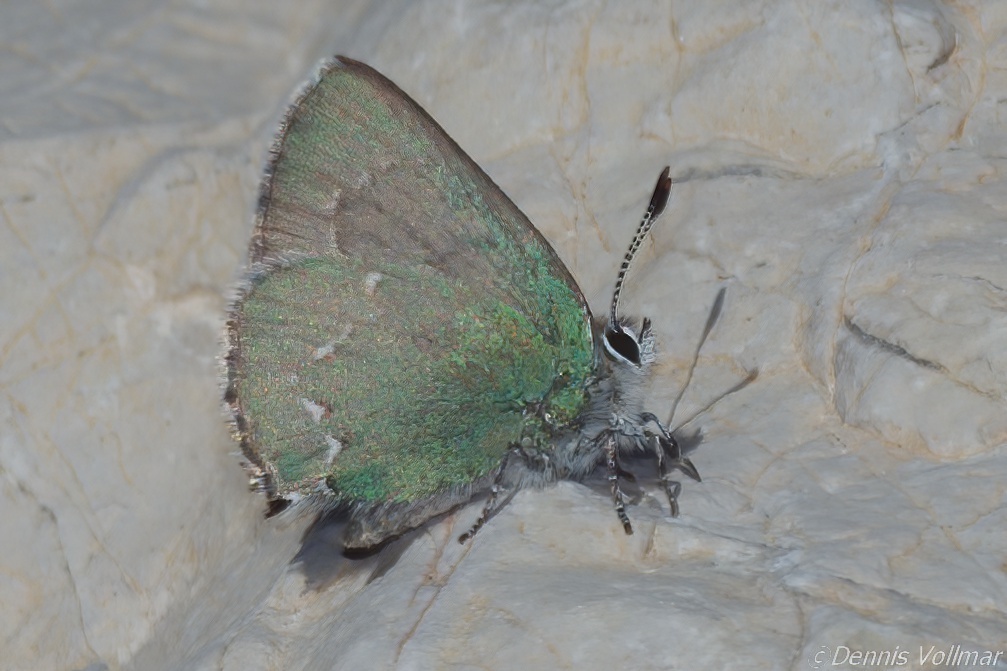
(c) Dennis Vollmar, some rights reserved (CC BY) · licence
Family: Lycaenidae · Class: Insecta · Order: Lepidoptera
Conservation status: G5T3T4 S1S2
Callophrys sheridanii comstocki (Desert Green Hairstreak) is a California animal in the Lycaenidae family.
The Desert Green Hairstreak (Callophrys sheridanii comstocki) is a small butterfly subspecies in the copper family Lycaenidae. Adults display the characteristic hairstreak wing pattern with a wingspan typically measuring 22 to 28 mm (0.9 to 1.1 inches). The dorsal wing surfaces are brown to gray-brown, while the ventral surfaces show the distinctive green coloration that gives this subspecies its common name. Males possess specialized scent patches on their forewings used in courtship displays. The hindwings feature small tail-like projections typical of hairstreak butterflies, along with eyespots near the wing margins that may confuse predators. This subspecies occurs in the Great Basin and arid inter-mountain West, ranging from northern Nevada and eastern California eastward to southern Utah and western Colorado. In California, populations are restricted to the eastern Sierra Nevada region and adjacent desert areas. The subspecies represents the westernmost populations of the Sheridan's Green Hairstreak complex, with geographic isolation contributing to its taxonomic distinctiveness. Desert Green Hairstreaks inhabit arid shrubland and desert environments at elevations typically ranging from 1,200 to 2,400 meters (4,000 to 8,000 feet). These butterflies are closely associated with areas supporting their host plants, particularly wild buckwheat species (Eriogonum). The habitat consists of open, rocky slopes and flats with scattered shrub vegetation, often in pinyon-juniper woodland transitions or sagebrush communities. Adults prefer areas with morning sun exposure and some shelter from strong winds. Adults are active from late spring through early summer, typically flying from May through July depending on elevation and local conditions. Males engage in territorial behavior, perching on prominent rocks or shrubs to await females. Mating occurs after elaborate courtship flights involving pheromone release and aerial displays. Females deposit eggs singly on flower buds or young leaves of various wild buckwheat species, with Wright's buckwheat (Eriogonum wrightii) and racemose buckwheat (Eriogonum racemosum) serving as primary hosts. Larvae feed within the flower heads and developing seed structures, completing development over several weeks. The species overwinters in the pupal stage, with pupae forming in soil debris or rock crevices near host plants. The Desert Green Hairstreak holds no federal listing status but is ranked G5T3T4 globally and S1S2 in California, indicating the subspecies is vulnerable to extirpation within the state. California populations are considered critically imperiled to imperiled, with fewer than 20 known occurrences. Primary conservation concerns include habitat degradation from livestock grazing, off-road vehicle use, and urban development in desert areas. Climate change poses additional threats through altered precipitation patterns and increased temperatures that may affect host plant phenology and butterfly emergence timing. The subspecies' limited California range and specialized habitat requirements make it particularly susceptible to local population extinctions.
Classification
Class: Insecta · Order: Lepidoptera · Family: Lycaenidae
Conservation status
G5T3T4 S1S2
Frequently asked questions
How is Callophrys sheridanii comstocki classified?
Callophrys sheridanii comstocki belongs to class Insecta, order Lepidoptera, family Lycaenidae.
What family does Callophrys sheridanii comstocki belong to?
Callophrys sheridanii comstocki is in the Lycaenidae family.
Is Callophrys sheridanii comstocki protected or of conservation concern?
Callophrys sheridanii comstocki carries the following status: G5T3T4 S1S2.
What is Callophrys sheridanii comstocki?
The Desert Green Hairstreak (Callophrys sheridanii comstocki) is a small butterfly subspecies in the copper family Lycaenidae.
Is Callophrys sheridanii comstocki found in California?
Yes. Callophrys sheridanii comstocki is recorded in California in The California Species Project's catalogue.
Related species
Other California species in the same genus, family, or bioregion.
Data from The California Species Project — 14,000+ California species with verified data from CNPS, CDFW, USFWS, and more.