Callophrys spinetorum
Thicket Hairstreak
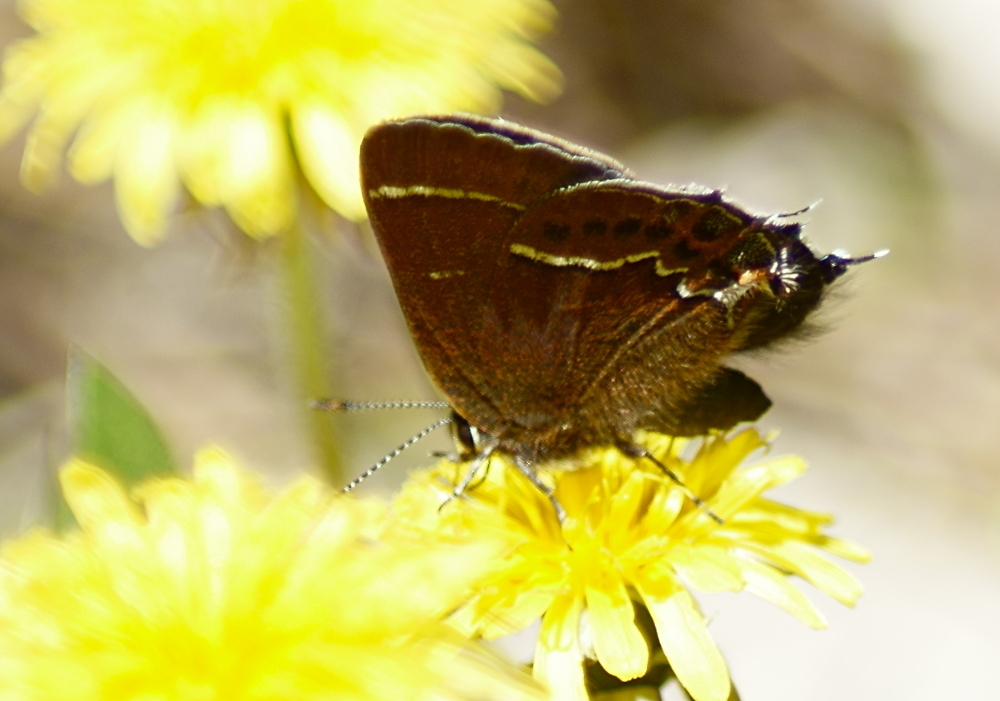
(c) psweet, some rights reserved (CC BY-SA) · licence
Family: Lycaenidae · Class: Insecta · Order: Lepidoptera
Callophrys spinetorum (Thicket Hairstreak) is a California animal in the Lycaenidae family.
The Thicket Hairstreak is a small butterfly in the family Lycaenidae, characterized by its compact size and distinctive wing patterns. Adults typically measure 22 to 28 mm (0.9 to 1.1 inches) in wingspan. The dorsal wing surfaces are brown to gray-brown, while the ventral surfaces display a complex pattern of white, gray, and brown markings with characteristic hairstreak tail projections on the hindwings. Males and females show similar coloration, though females may be slightly larger. The species can be distinguished from related hairstreaks by its association with mistletoe-infested trees and specific flight patterns around host plants. The Thicket Hairstreak ranges from British Columbia southeast through the Rocky Mountains to New Mexico and into Mexico, extending south through California into Baja California. Within this range, the species is usually local and rare, with populations scattered across suitable habitat. In California, the butterfly occurs primarily in montane and foothill regions where appropriate host plants are present on coniferous trees. This species inhabits areas where dwarf mistletoes (Arceuthobium species) grow as parasites on juniper, pine, and fir trees. These parasitic plants in the Santalaceae family create the specific microhabitat requirements for the Thicket Hairstreak. The butterfly is typically found in open woodlands, forest edges, and clearings where infested trees provide both larval food sources and adult nectar resources. Elevations range from foothill zones to mid-montane forests, generally between 1,000 and 2,500 meters (3,300 to 8,200 feet). The Thicket Hairstreak exhibits a specialized life cycle closely tied to its mistletoe hosts. Females deposit eggs directly on dwarf mistletoe clumps, where larvae develop by feeding on the parasitic plant tissue. The species is univoltine, producing one generation per year, with adults typically active from late spring through early summer. Flight period varies with elevation and latitude but generally occurs from May through July. Adults feed on nectar from various flowering plants in their habitat, including wildflowers and shrub blossoms. Males establish territories near mistletoe-infested trees and engage in perching behavior to locate females. The conservation status of the Thicket Hairstreak is not formally assessed at federal or state levels, but the species faces challenges due to its specialized habitat requirements. Populations depend entirely on the presence of dwarf mistletoes, which are themselves dependent on specific host tree species. Forest management practices, including removal of mistletoe-infested trees, can eliminate local breeding habitat. Climate change may affect the distribution of both the butterfly and its obligate host plants. Fire suppression and altered forest dynamics could impact the open woodland conditions preferred by this species. The naturally patchy distribution and apparent rarity of populations suggest that monitoring and habitat protection may be important for long-term persistence, particularly given the specialized nature of the butterfly's ecological requirements.
Classification
Class: Insecta · Order: Lepidoptera · Family: Lycaenidae
Frequently asked questions
How is Callophrys spinetorum classified?
Callophrys spinetorum belongs to class Insecta, order Lepidoptera, family Lycaenidae.
What family does Callophrys spinetorum belong to?
Callophrys spinetorum is in the Lycaenidae family.
What is Callophrys spinetorum?
The Thicket Hairstreak is a small butterfly in the family Lycaenidae, characterized by its compact size and distinctive wing patterns.
Is Callophrys spinetorum found in California?
Yes. Callophrys spinetorum is recorded in California in The California Species Project's catalogue.
Related species
Other California species in the same genus, family, or bioregion.
Data from The California Species Project — 14,000+ California species with verified data from CNPS, CDFW, USFWS, and more.