Callophrys thornei
Thorne's Hairstreak
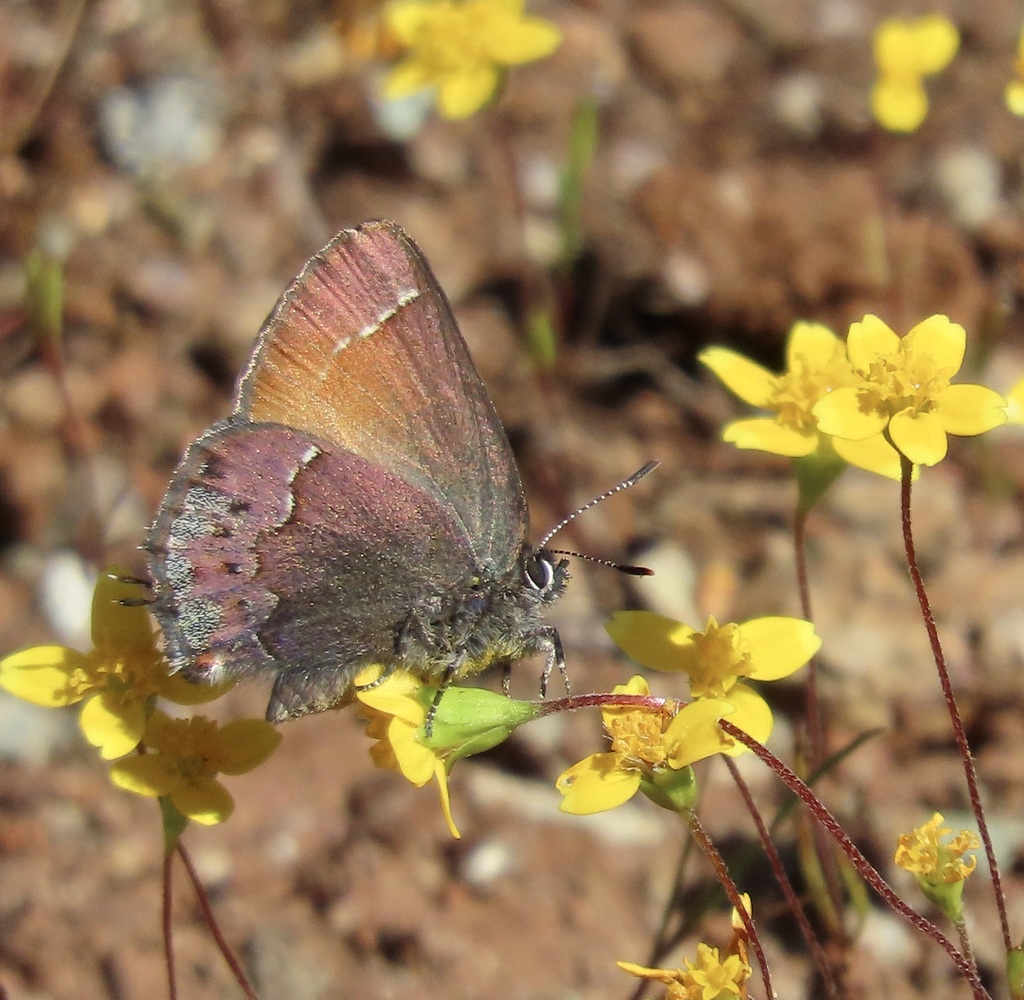
(c) John Hibbard, some rights reserved (CC BY) · licence
Family: Lycaenidae · Class: Insecta · Order: Lepidoptera
Conservation status: G3G4T2 S2
Callophrys thornei (Thorne's Hairstreak) is a California animal in the Lycaenidae family.
Thorne's hairstreak is a small butterfly subspecies in the family Lycaenidae, taxonomically classified as Callophrys loki thornei according to current nomenclature (iNaturalist). This subspecies represents one of several regional variants within the Callophrys loki complex, distinguished by its specific host plant associations and limited geographic distribution. Like other members of the hairstreak family, adults are small butterflies with delicate wings that typically display subtle coloration patterns. The dorsal wing surfaces generally exhibit muted browns and grays, while the ventral surfaces often show more complex patterns of spots and lines characteristic of the genus Callophrys. Males and females may show slight dimorphism in coloration and wing patterns, though specific morphological details for this subspecies have not been extensively documented in available literature. Thorne's hairstreak occurs in a restricted range within San Diego County, California, representing one of the most geographically limited butterfly subspecies in the state. This narrow distribution reflects the species' specialized habitat requirements and dependence on its specific host plant. The subspecies appears to be endemic to particular areas where suitable habitat conditions and host plants converge. The species exhibits obligate dependence on Tecate cypress (Cupressus species, also known as Hesperocyparis forbesii) as its primary host plant. Larvae feed exclusively on the foliage of this cypress species, which itself has a limited distribution in southern California and northern Baja California. This host plant relationship restricts the butterfly's habitat to areas where Tecate cypress populations occur, typically in chaparral and woodland environments at moderate elevations. The cypress trees provide both larval food sources and adult nectar resources, creating essential habitat patches for population persistence. Adult flight periods and reproductive behavior follow patterns typical of hairstreak butterflies, with males likely establishing territories near host plants and females seeking appropriate oviposition sites on cypress foliage. Eggs are probably laid singly on young growth or buds of the host plant. Development from egg to adult likely requires one full season, with pupae overwintering and adults emerging in spring or early summer, though specific phenological data for this subspecies remains limited in published sources. Thorne's hairstreak receives a global rank of G3G4T2 S2, indicating that the subspecies faces significant conservation challenges at both global and state levels. The T2 ranking specifically denotes this subspecies as imperiled, with few occurrences and steep declines or other factors making it vulnerable to extirpation. Most known occurrences are located on federal Bureau of Land Management properties, providing some protection from development pressures (NatureServe Explorer). However, the subspecies remains vulnerable to habitat loss, fragmentation of cypress stands, altered fire regimes, and climate change impacts on its specialized habitat requirements. The extremely limited range in San Diego County makes any local habitat disturbances potentially significant for population viability.
Classification
Class: Insecta · Order: Lepidoptera · Family: Lycaenidae
Conservation status
G3G4T2 S2
Frequently asked questions
How is Callophrys thornei classified?
Callophrys thornei belongs to class Insecta, order Lepidoptera, family Lycaenidae.
What family does Callophrys thornei belong to?
Callophrys thornei is in the Lycaenidae family.
Is Callophrys thornei protected or of conservation concern?
Callophrys thornei carries the following status: G3G4T2 S2.
What is Callophrys thornei?
Thorne's hairstreak is a small butterfly subspecies in the family Lycaenidae, taxonomically classified as Callophrys loki thornei according to current nomenclature (iNaturalist).
Is Callophrys thornei found in California?
Yes. Callophrys thornei is recorded in California in The California Species Project's catalogue.
Related species
Other California species in the same genus, family, or bioregion.
Data from The California Species Project — 14,000+ California species with verified data from CNPS, CDFW, USFWS, and more.