Callophrys viridis
Coastal Green Hairstreak
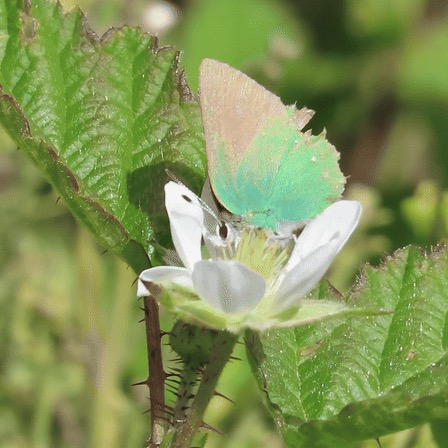
(c) Linzy L., some rights reserved (CC BY-SA) · licence
Family: Lycaenidae · Class: Insecta · Order: Lepidoptera
Callophrys viridis (Coastal Green Hairstreak) is a California animal in the Lycaenidae family.
The Coastal Green Hairstreak is a small butterfly in the family Lycaenidae, formerly classified as Callophrys dumetorum. Adults measure 22 to 28 mm (0.87 to 1.1 inches) in wingspan. The dorsal wing surfaces are dark brown to black, while the ventral surfaces display the characteristic green coloration that gives the species its common name. This metallic green is created by structural coloration from microscopic scales. Males possess scent patches on the forewings and exhibit territorial behavior around host plants. The species can be distinguished from similar hairstreaks by its consistent green ventral coloration and coastal distribution pattern. The Coastal Green Hairstreak occurs along coastal California, with populations documented from Mendocino County south to Santa Barbara County. The species is found primarily within the coastal fog belt, typically within 10 kilometers of the Pacific Ocean. Rarely, populations occur at inland sites, though these are exceptional and poorly documented. The distribution closely follows the range of its primary host plant along coastal bluffs, dunes, and maritime chaparral. This species inhabits coastal scrub and bluff communities characterized by maritime influence. Preferred elevations range from sea level to approximately 300 meters (980 feet), though most populations occur below 150 meters (490 feet). The butterfly requires areas with Eriogonum latifolium, commonly known as coast buckwheat, which grows on sandy soils and exposed coastal slopes. Occasionally, larvae utilize deerweed (Lotus scoparius) and other leguminous plants, though coast buckwheat remains the primary host. Habitat requirements include adequate nectar sources for adults and protection from strong coastal winds through topographic shelter or vegetation structure. Adults are active from March through August, with peak flight occurring from April to June depending on local weather conditions. Males establish territories near host plants and engage in perching behavior to locate females. Mating occurs in late spring, with females depositing single eggs on flower buds or young leaves of host plants. Larvae feed within flower heads and developing seed structures, completing development in 4 to 6 weeks. The species overwinters in the pupal stage, with pupae formed in leaf litter or loose soil beneath host plants. Adults nectar on a variety of coastal wildflowers, including ceanothus, lupine, and buckwheat species. The Coastal Green Hairstreak is not federally or state listed but faces conservation concerns from coastal development pressures. Urban expansion and recreational infrastructure have eliminated habitat in portions of the historical range. Invasive plant species, particularly European beachgrass and ice plant, alter native plant communities and reduce host plant availability. Climate change may affect the coastal fog patterns that maintain suitable moisture conditions for both the butterfly and its host plants. Conservation efforts focus on protecting remaining coastal scrub habitats and managing invasive species in occupied areas. The species serves as an indicator of healthy coastal ecosystem function.
Classification
Class: Insecta · Order: Lepidoptera · Family: Lycaenidae
Frequently asked questions
How is Callophrys viridis classified?
Callophrys viridis belongs to class Insecta, order Lepidoptera, family Lycaenidae.
What family does Callophrys viridis belong to?
Callophrys viridis is in the Lycaenidae family.
What is Callophrys viridis?
The Coastal Green Hairstreak is a small butterfly in the family Lycaenidae, formerly classified as Callophrys dumetorum.
Is Callophrys viridis found in California?
Yes. Callophrys viridis is recorded in California in The California Species Project's catalogue.
Related species
Other California species in the same genus, family, or bioregion.
Data from The California Species Project — 14,000+ California species with verified data from CNPS, CDFW, USFWS, and more.