Callorhinus ursinus
Northern Fur-seal
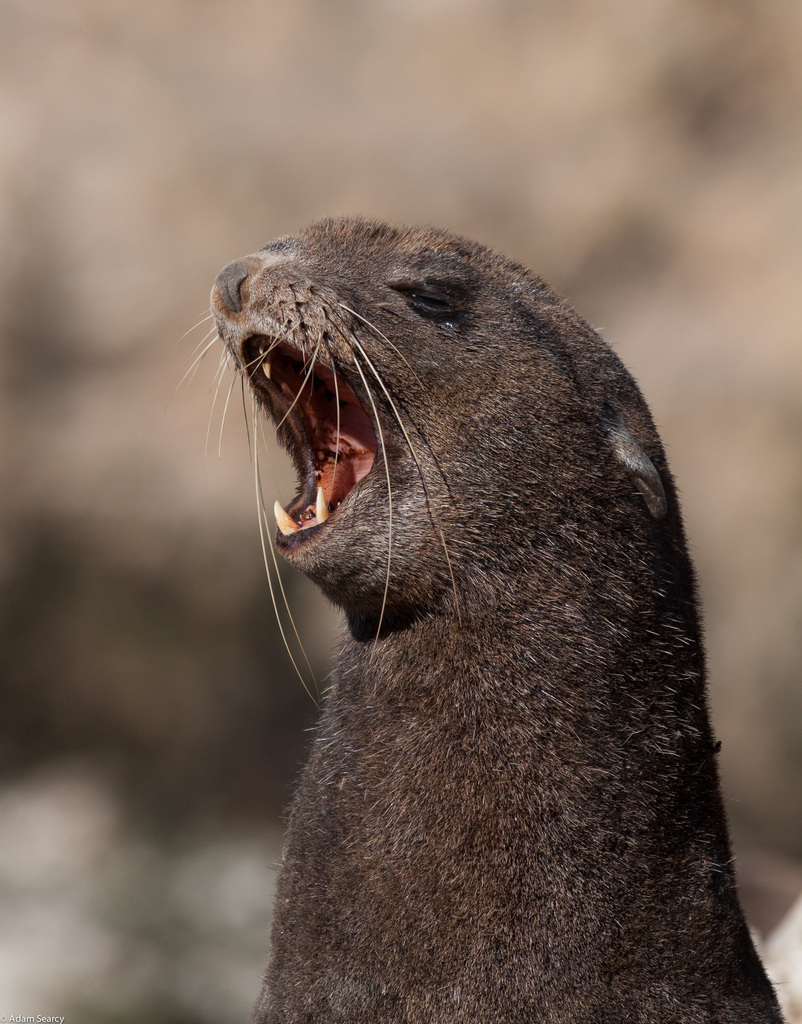
(c) Adam J. Searcy, some rights reserved (CC BY) · licence
Family: Unknown · Class: Unknown · Order: Unknown
Conservation status: G3 S1
Callorhinus ursinus (Northern Fur-seal) is a California animal in the Unknown family.
The Northern fur seal is a sexually dimorphic pinniped with males significantly larger than females. Adult males reach 1.5 to 2.1 meters (5 to 7 feet) in length and weigh 180 to 270 kilograms (400 to 600 pounds), while females measure 1.0 to 1.4 meters (3.3 to 4.6 feet) and weigh 30 to 50 kilograms (66 to 110 pounds). Males develop a thick, dark brown to black pelage with a pronounced sagittal crest and robust neck, while females and juveniles display lighter brown to gray coloration. Both sexes possess external ear flaps and can rotate their rear flippers forward for terrestrial locomotion, distinguishing them from true seals. Historically, Northern fur seals ranged throughout the North Pacific Ocean from Japan to California. In California waters, they occur primarily in offshore pelagic environments and occasionally haul out at specific coastal locations. The species is documented at Point Bennett on San Miguel Island, where approximately 5,000 individuals breed alongside other pinnipeds (California Department of Fish and Wildlife). Additional California sightings include the Farallon Islands and various coastal areas from Año Nuevo to Bodega Head, though these represent non-breeding occurrences. Northern fur seals inhabit cold, nutrient-rich waters of the North Pacific, spending most of their lives in pelagic environments. During breeding season, they aggregate on rocky beaches and islands with suitable haul-out areas. In California, breeding occurs primarily on San Miguel Island's Point Bennett, one of the world's largest seal and sea lion rookeries. Outside breeding season, the species ranges far offshore in deep oceanic waters, following prey distributions and oceanographic features. The species exhibits a highly migratory lifestyle, with individuals traveling thousands of kilometers between breeding and foraging areas. Breeding occurs from May through August, with males establishing territories on beaches before females arrive. Males fast during the breeding season while defending harems of 10 to 40 females. Females give birth to single pups after an 11-month gestation period that includes delayed implantation. Pups nurse for approximately four months while mothers alternate between nursing and foraging trips. Northern fur seals are primarily piscivorous, feeding on schooling fish, squid, and krill in surface and mid-water environments. The Northern fur seal is protected under the Marine Mammal Protection Act, and the Southwest Alaska Distinct Population Segment is listed as depleted under this act. In California, the species maintains a small breeding population estimated at approximately 5,000 individuals on San Miguel Island. Primary threats include commercial fishing interactions, climate change affecting prey availability, pollution, and potential disturbance at breeding sites. Ocean warming and altered prey distributions associated with El Niño events can significantly impact foraging success and reproductive output. The species' global rank of G3 indicates it is vulnerable to extirpation, while its California rank of S1 reflects its critically imperiled status within the state.
Classification
Class: Unknown · Order: Unknown · Family: Unknown
Conservation status
G3 S1
Frequently asked questions
How is Callorhinus ursinus classified?
Callorhinus ursinus belongs to class Unknown, order Unknown, family Unknown.
What family does Callorhinus ursinus belong to?
Callorhinus ursinus is in the Unknown family.
Is Callorhinus ursinus protected or of conservation concern?
Callorhinus ursinus carries the following status: G3 S1.
What is Callorhinus ursinus?
The Northern fur seal is a sexually dimorphic pinniped with males significantly larger than females.
Is Callorhinus ursinus found in California?
Yes. Callorhinus ursinus is recorded in California in The California Species Project's catalogue.
Related species
Other California species in the same genus, family, or bioregion.
Data from The California Species Project — 14,000+ California species with verified data from CNPS, CDFW, USFWS, and more.