Callospermophilus lateralis
Golden-mantled Ground Squirrel
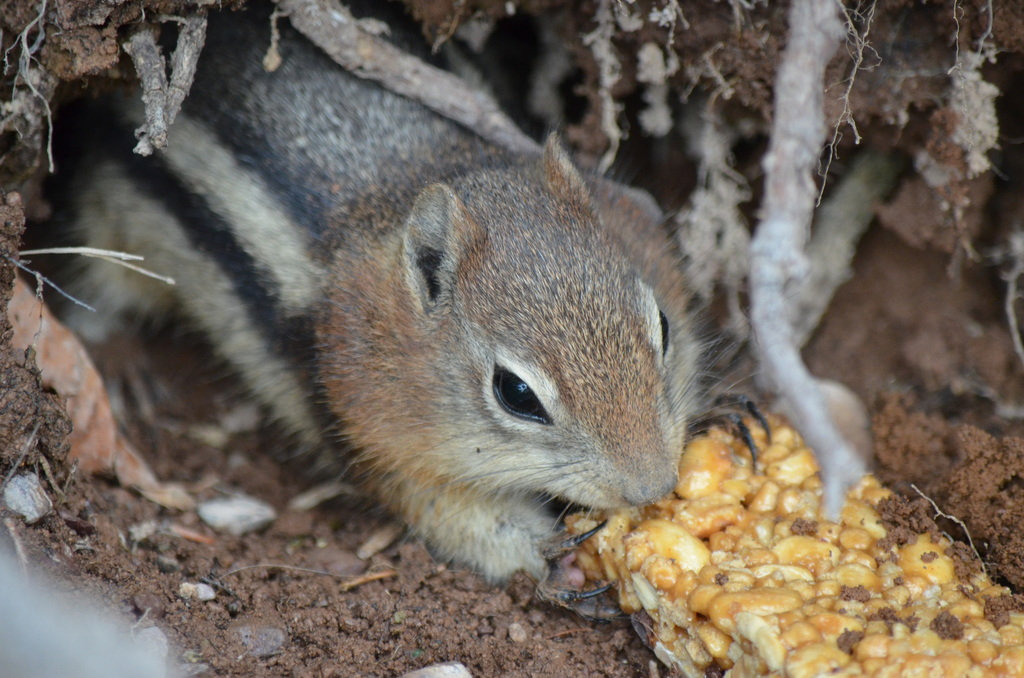
(c) Josiah Londerée, some rights reserved (CC BY) · licence
Family: Sciuridae · Class: Mammalia · Order: Rodentia
Callospermophilus lateralis (Golden-mantled Ground Squirrel) is a California animal in the Sciuridae family.
The golden-mantled ground squirrel is a medium-sized rodent measuring 230 to 300 mm (9.1 to 11.8 inches) in total length, with a tail length of 75 to 115 mm (3.0 to 4.5 inches). Adults typically weigh between 170 and 350 grams (6.0 to 12.3 ounces). The species is distinguished by its distinctive coloration pattern: a golden-brown to russet mantle extends from the head across the shoulders, contrasting with gray-brown sides and back. Two prominent white stripes bordered by black stripes run along each side of the body from the shoulders to the hips, creating a characteristic striped pattern. The underside is white to pale yellow, and the moderately bushy tail is gray-brown above with black edges and pale yellow below. Golden-mantled ground squirrels occur throughout the mountainous regions of western North America, with their California range extending through the Sierra Nevada, Cascade Range, and various mountain ranges in the northern and eastern portions of the state. The species is found from the Oregon border south to Kern County, typically at elevations between 1,200 and 3,400 meters (4,000 to 11,200 feet). Populations also occur in the Transverse and Peninsular Ranges of southern California. This species inhabits coniferous and mixed forests, meadows, rocky outcrops, and subalpine zones. Preferred habitat includes areas with loose, well-drained soils suitable for burrow construction, often near fallen logs, rock piles, or forest edges. Golden-mantled ground squirrels construct extensive burrow systems that may extend 1 to 2 meters underground, with multiple entrances and chambers for nesting and food storage. Golden-mantled ground squirrels are omnivorous, consuming seeds, nuts, fruits, green vegetation, fungi, and occasionally insects and small vertebrates. They are particularly fond of pine nuts and acorns, which they cache extensively for winter survival. The species exhibits true hibernation, entering torpor from October through April depending on elevation and local climate conditions. Breeding occurs shortly after emergence from hibernation, typically in May or June. Females produce a single litter annually of 4 to 6 young after a gestation period of approximately 28 days. Young are born blind and hairless, remaining in the burrow for about 30 days before emerging. The golden-mantled ground squirrel is not federally or state-listed and maintains stable populations throughout most of its range. The species benefits from protected habitat within national parks and forests across the Sierra Nevada and other mountain ranges. However, localized populations may face pressure from habitat fragmentation due to development, particularly at lower elevations. Climate change poses potential long-term concerns as warming temperatures may alter suitable habitat at higher elevations. The species serves important ecological roles as both seed disperser and prey species for various predators including hawks, weasels, and snakes.
Classification
Class: Mammalia · Order: Rodentia · Family: Sciuridae
Frequently asked questions
How is Callospermophilus lateralis classified?
Callospermophilus lateralis belongs to class Mammalia, order Rodentia, family Sciuridae.
What family does Callospermophilus lateralis belong to?
Callospermophilus lateralis is in the Sciuridae family.
What is Callospermophilus lateralis?
The golden-mantled ground squirrel is a medium-sized rodent measuring 230 to 300 mm (9.1 to 11.8 inches) in total length, with a tail length of 75 to 115 mm (3.0 to 4.5 inches).
Is Callospermophilus lateralis found in California?
Yes. Callospermophilus lateralis is recorded in California in The California Species Project's catalogue.
Related species
Other California species in the same genus, family, or bioregion.
Data from The California Species Project — 14,000+ California species with verified data from CNPS, CDFW, USFWS, and more.