Calonectris diomedea
Cory's Shearwater
no rights reserved · CC0
Family: Procellariidae · Class: Aves · Order: Procellariiformes
Calonectris diomedea (Cory's Shearwater) is a California animal in the Procellariidae family.
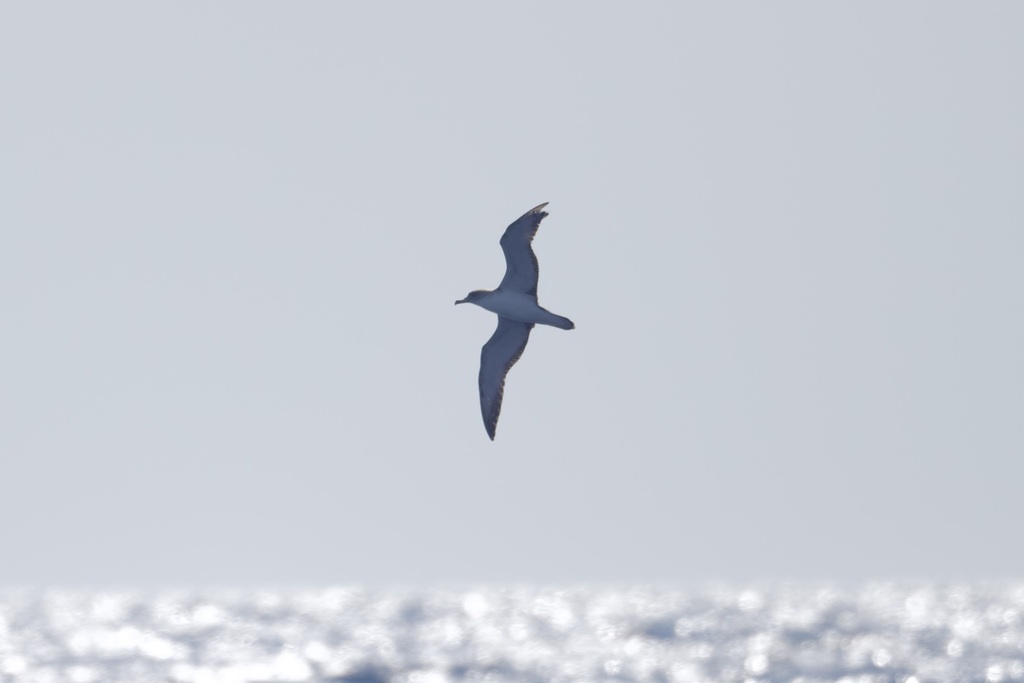
Cory's Shearwater is a large seabird in the family Procellariidae, measuring 45 to 56 cm (18 to 22 inches) in length with a wingspan of 100 to 125 cm (39 to 49 inches). Adults weigh between 500 and 900 grams. The species displays brownish-gray upperparts and white underparts, with a distinctive yellowish bill. The head appears pale grayish-brown, contrasting with the darker back and wings. In flight, the species shows characteristic white patches at the base of the primaries on the underwing. Cory's Shearwater breeds primarily on islands in the Mediterranean Sea and eastern Atlantic Ocean, including the Canary Islands, Azores, and Madeira. During the non-breeding season, the species undertakes extensive migrations, with some populations moving into the western Atlantic. In California waters, Cory's Shearwater occurs as a rare visitor, typically observed offshore during late summer and fall months. Sightings are most frequent in waters beyond the continental shelf, particularly from August through October. The species inhabits pelagic marine environments, foraging in open ocean waters over continental shelves and deeper oceanic zones. During the breeding season, nests are constructed in crevices, caves, or burrows on rocky islands and coastal cliffs. Outside the breeding period, the species remains entirely at sea, utilizing warm oceanic currents and upwelling areas that concentrate prey species. Cory's Shearwater feeds primarily on small fish, squid, and crustaceans, obtained through surface-seizing and shallow diving techniques. The species often follows fishing vessels to exploit discarded bycatch and offal. Breeding occurs from April through October, with peak egg-laying in May and June. Females deposit a single white egg in the nest site, and both parents share incubation duties for approximately 54 days. The chick remains in the nest for 84 to 103 days before fledging. The species exhibits high site fidelity, with individuals returning to the same breeding colonies annually. Globally, Cory's Shearwater populations appear stable, though some breeding colonies have experienced declines due to habitat degradation, introduced predators, and fishing pressure. The species faces threats from plastic pollution, oil spills, and climate change impacts on prey availability. Longline fishing operations pose risks through bycatch mortality. In California, the species' status as a rare visitor means it faces minimal direct conservation threats, though broader oceanic changes affecting prey distribution could influence occurrence patterns. The International Union for Conservation of Nature lists Cory's Shearwater as Least Concern globally, reflecting stable population trends across most of its range.
Classification
Class: Aves · Order: Procellariiformes · Family: Procellariidae
Frequently asked questions
How is Calonectris diomedea classified?
Calonectris diomedea belongs to class Aves, order Procellariiformes, family Procellariidae.
What family does Calonectris diomedea belong to?
Calonectris diomedea is in the Procellariidae family.
What is Calonectris diomedea?
Cory's Shearwater is a large seabird in the family Procellariidae, measuring 45 to 56 cm (18 to 22 inches) in length with a wingspan of 100 to 125 cm (39 to 49 inches).
Is Calonectris diomedea found in California?
Yes. Calonectris diomedea is recorded in California in The California Species Project's catalogue.
Related species
Other California species in the same genus, family, or bioregion.
Data from The California Species Project — 14,000+ California species with verified data from CNPS, CDFW, USFWS, and more.