Caloptilia azaleella
Azalea Leafminer
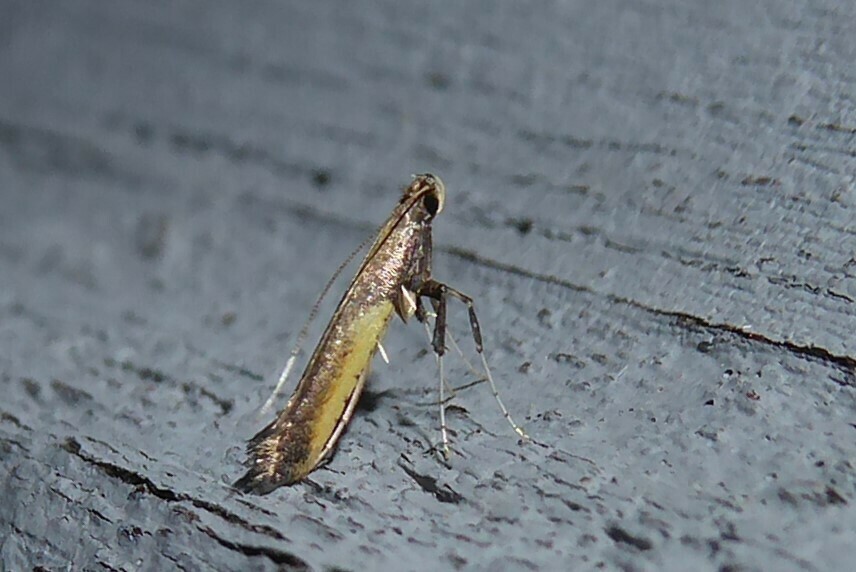
(c) Aalbert Rebergen, some rights reserved (CC BY) · licence
Family: Gracillariidae · Class: Insecta · Order: Lepidoptera
Caloptilia azaleella (Azalea Leafminer) is a California animal in the Gracillariidae family.
The Azalea Leafminer (Caloptilia azaleella) is a small moth in the family Gracillariidae whose larvae create distinctive leaf mines in azaleas and rhododendrons. Adults are tiny moths with a wingspan of 8 to 12 millimeters (0.3 to 0.5 inches). The forewings are golden-brown to bronze with darker brown markings and a metallic sheen, while the hindwings are narrow and fringed with long scales. When at rest, adults hold their forewings roof-like over the body with the head end elevated. Originally native to Japan, the Azalea Leafminer was first detected in North America in Nova Scotia in 1987 and has since spread to several U.S. states. In California, established populations have been documented in coastal counties including Marin, San Mateo, Santa Clara, and Los Angeles counties. The species continues to expand its range through natural dispersal and human transport of infested plant material. The species is closely associated with plants in the genus Rhododendron, including cultivated azaleas and rhododendrons commonly used in landscaping. Adults and larvae are found primarily in urban and suburban environments where these ornamental plants are grown, including residential gardens, parks, and nurseries. The moth shows a preference for certain rhododendron species and cultivars, with some varieties being more susceptible to infestation than others. Azalea Leafminer larvae are leaf miners that feed between the upper and lower leaf surfaces, creating characteristic serpentine mines that begin as narrow tunnels and expand into blotch-like areas. Young larvae initially mine within the leaf tissue, while older larvae may exit the mine to feed externally on the leaf surface or roll leaf edges to create shelters. The species typically completes two to three generations per year in California's climate. Adults emerge in spring and lay eggs singly on the underside of young rhododendron leaves. Larvae develop through five instars over approximately 30 days during warm weather. Pupation occurs within the leaf mine or in a cocoon on the leaf surface. Adults are active from spring through fall, with peak activity during warm, humid conditions. The Azalea Leafminer is not listed under any conservation status, as it is considered an introduced pest species rather than a conservation concern. Since its introduction, the moth has caused significant damage to ornamental azaleas and rhododendrons in affected areas. Heavily infested plants exhibit reduced aesthetic value due to mining damage, premature leaf drop, and potential secondary infections. Management typically involves monitoring for early detection, removal of infested leaves, and targeted pesticide applications when necessary. The species' continued spread in California represents an ongoing challenge for the ornamental horticulture industry and urban forest management.
Classification
Class: Insecta · Order: Lepidoptera · Family: Gracillariidae
Frequently asked questions
How is Caloptilia azaleella classified?
Caloptilia azaleella belongs to class Insecta, order Lepidoptera, family Gracillariidae.
What family does Caloptilia azaleella belong to?
Caloptilia azaleella is in the Gracillariidae family.
What is Caloptilia azaleella?
The Azalea Leafminer (Caloptilia azaleella) is a small moth in the family Gracillariidae whose larvae create distinctive leaf mines in azaleas and rhododendrons.
Is Caloptilia azaleella found in California?
Yes. Caloptilia azaleella is recorded in California in The California Species Project's catalogue.
Related species
Other California species in the same genus, family, or bioregion.
Data from The California Species Project — 14,000+ California species with verified data from CNPS, CDFW, USFWS, and more.