Calothorax lucifer
Lucifer Hummingbird
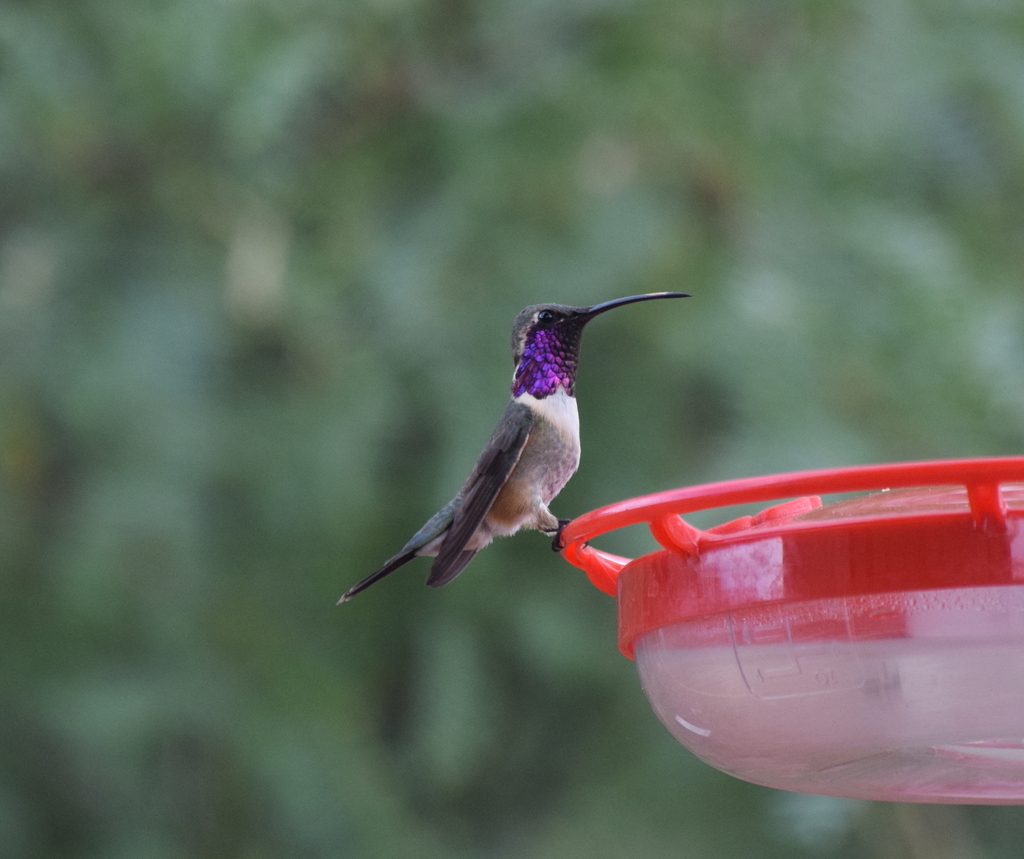
(c) William Harmon, some rights reserved (CC BY) · licence
Family: Trochilidae · Class: Aves · Order: Apodiformes
Calothorax lucifer (Lucifer Hummingbird) is a California animal in the Trochilidae family.
The Lucifer Hummingbird is a small, sexually dimorphic hummingbird species with males measuring approximately 9 cm (3.5 inches) in length and females slightly larger at 10 cm (4 inches). Males display an iridescent purple-magenta gorget that extends down the sides of the neck, creating a distinctive forked appearance, paired with a metallic green back and crown. Females lack the colorful gorget and instead show buff-colored underparts with green backs and white-tipped outer tail feathers. Both sexes possess a distinctively curved, needle-like bill adapted for nectar feeding. The species breeds primarily on the arid plateau and mountain slopes of central and northern Mexico, with populations barely extending into the United States in west Texas, southwest New Mexico, and southeast Arizona (Birds of the World). In California, the Lucifer Hummingbird is considered a vagrant species, with only occasional sightings recorded in the southeastern desert regions. The U.S. Fish and Wildlife Service includes this species on its Birds of Conservation Concern list, recognizing its limited breeding range within American borders. Lucifer Hummingbirds inhabit dry, open desert habitats characterized by agave, ocotillo, and desert scrub vegetation. The species occupies elevations ranging from desert floors to mountain slopes, utilizing a wide elevational range throughout the year. Breeding occurs primarily in arid environments where flowering plants provide adequate nectar resources. Most wintering birds are found at middle elevations of central Mexico (Birds of the World). This species exhibits typical hummingbird foraging behavior, combining nectar feeding with insect consumption through fly-catching. The Lucifer Hummingbird has developed notable ecological relationships with agave plants, acting as a nectar thief from large agave flowers that are primarily adapted for bat pollination. Males establish territories around prime nectar sources and perform courtship displays for females. The species constructs small cup nests, often utilizing dead agave flower stalks and other desert vegetation. Breeding typically occurs from March through July in the southwestern United States. The Lucifer Hummingbird maintains stable populations throughout most of its range in Mexico, but its limited presence in the United States places it on conservation watch lists. The species appears on the U.S. Fish and Wildlife Service Birds of Conservation Concern 2021 list, reflecting concerns about its restricted U.S. breeding range and potential vulnerability to habitat changes. Climate change and desert habitat modification represent potential threats to breeding areas, particularly in borderland regions. The species benefits from desert conservation efforts and the preservation of native flowering plant communities that provide essential nectar resources. Population monitoring remains limited due to the species' remote habitat preferences and the challenges of surveying desert environments. Conservation efforts focus on maintaining habitat connectivity between breeding areas in Mexico and marginal U.S. populations.
Classification
Class: Aves · Order: Apodiformes · Family: Trochilidae
Frequently asked questions
How is Calothorax lucifer classified?
Calothorax lucifer belongs to class Aves, order Apodiformes, family Trochilidae.
What family does Calothorax lucifer belong to?
Calothorax lucifer is in the Trochilidae family.
What is Calothorax lucifer?
The Lucifer Hummingbird is a small, sexually dimorphic hummingbird species with males measuring approximately 9 cm (3.5 inches) in length and females slightly larger at 10 cm (4 inches).
Is Calothorax lucifer found in California?
Yes. Calothorax lucifer is recorded in California in The California Species Project's catalogue.
Related species
Other California species in the same genus, family, or bioregion.
Data from The California Species Project — 14,000+ California species with verified data from CNPS, CDFW, USFWS, and more.