Calpodes ethlius
Brazilian Skipper
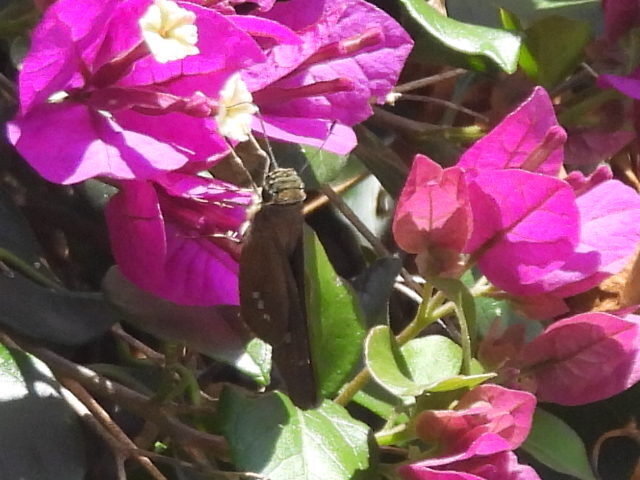
(c) Oscar Alejandro Morales Juárez, some rights reserved (CC BY-SA) · licence
Family: Hesperiidae · Class: Insecta · Order: Lepidoptera
Calpodes ethlius (Brazilian Skipper) is a California animal in the Hesperiidae family.
The Brazilian skipper is a large butterfly in the family Hesperiidae, with adults measuring 50 to 60 mm (2.0 to 2.4 inches) in wingspan. The dorsal wing surfaces are dark brown to black with distinctive white spots scattered across both forewings and hindwings. Males possess a prominent black stigma or scent patch on each forewing. The ventral surfaces are lighter brown with more pronounced white spotting. The head and thorax are covered in dark brown scales, while the abdomen displays alternating bands of brown and white. The antennae are club-shaped with a distinctive hooked tip, characteristic of skipper butterflies. The Brazilian skipper ranges from South Florida and South Texas south through the West Indies, Mexico, and Central America to Argentina. The species periodically strays and colonizes north to southern Nevada, north Texas, Illinois, and Massachusetts. In California, Brazilian skippers are occasional visitors, most commonly reported in southern counties during warmer months. These northern populations are typically temporary, as the species cannot survive freezing temperatures and relies on continuous migration from southern breeding areas. This species inhabits tropical and subtropical environments, favoring areas with abundant host plants and warm, humid conditions. Brazilian skippers are commonly found in gardens, parks, and agricultural areas where cultivated canna plants are present. The species thrives at elevations from sea level to approximately 1,500 meters (4,900 feet), preferring areas with consistent moisture and protection from strong winds. Adults are frequently observed around flowering plants that provide nectar sources. Brazilian skipper larvae feed exclusively on various cultivated plants in the canna family (Marantaceae), including ornamental canna lilies, bird-of-paradise plants, and ginger species. The caterpillars create distinctive leaf rolls by cutting and folding leaves, securing them with silk to form protective shelters. Larvae are greenish-white with dark heads and can reach 60 mm (2.4 inches) in length when fully developed. Adults are active during daylight hours and exhibit rapid, darting flight patterns typical of skipper butterflies. Males establish territories around host plants and engage in aerial courtship displays. The species reproduces year-round in tropical climates, with females depositing single eggs on the undersurfaces of host plant leaves. The Brazilian skipper is not federally or state listed and faces no significant conservation concerns. The species benefits from widespread cultivation of ornamental canna plants in warm climates. In northern regions of its range, populations fluctuate based on seasonal migration patterns and winter survival rates. Climate change may potentially expand the species' permanent range northward as winter temperatures moderate. Urban and suburban landscaping practices that include diverse flowering plants support both adult nectar sources and breeding habitat, contributing to local population stability in suitable climates.
Classification
Class: Insecta · Order: Lepidoptera · Family: Hesperiidae
Frequently asked questions
How is Calpodes ethlius classified?
Calpodes ethlius belongs to class Insecta, order Lepidoptera, family Hesperiidae.
What family does Calpodes ethlius belong to?
Calpodes ethlius is in the Hesperiidae family.
What is Calpodes ethlius?
The Brazilian skipper is a large butterfly in the family Hesperiidae, with adults measuring 50 to 60 mm (2.0 to 2.4 inches) in wingspan.
Is Calpodes ethlius found in California?
Yes. Calpodes ethlius is recorded in California in The California Species Project's catalogue.
Related species
Other California species in the same genus, family, or bioregion.
Data from The California Species Project — 14,000+ California species with verified data from CNPS, CDFW, USFWS, and more.