Calypte costae
Costa's Hummingbird
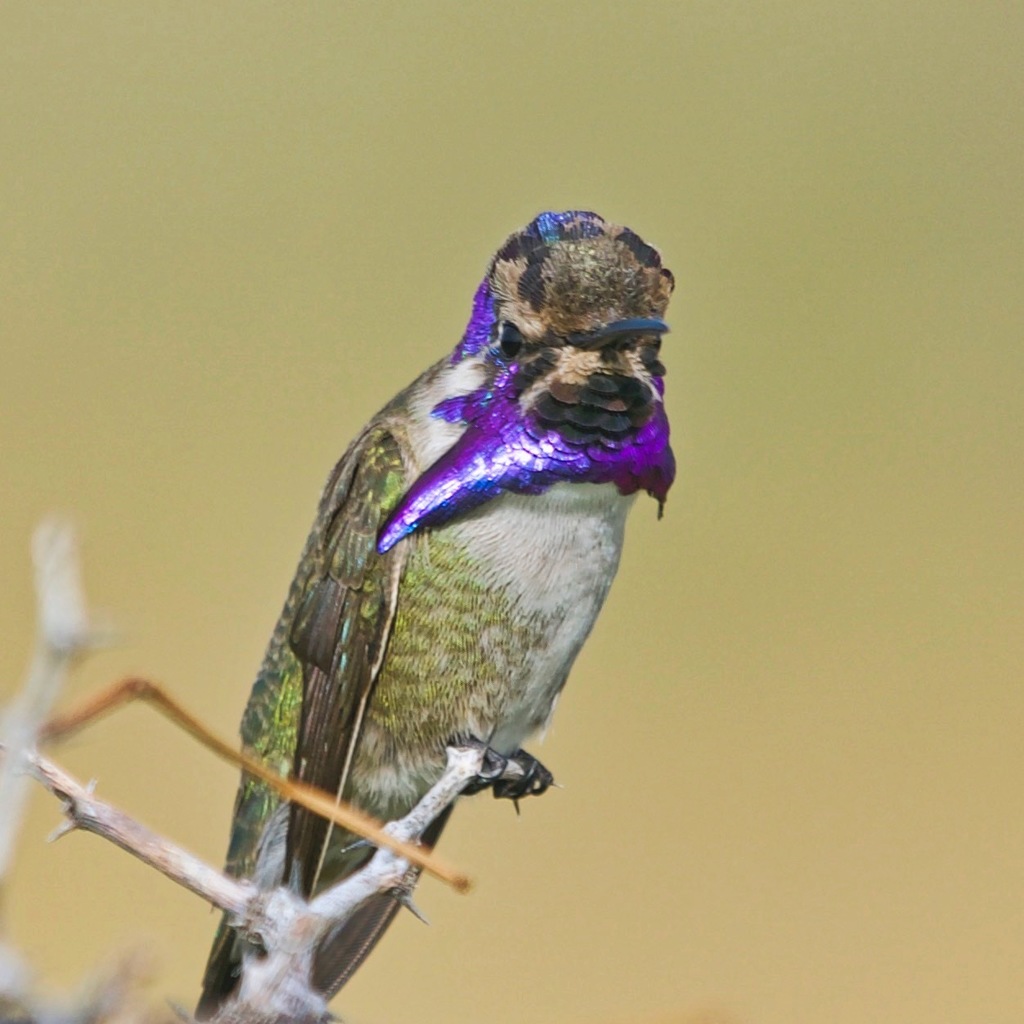
(c) Bill Levine, some rights reserved (CC BY) · licence
Family: Trochilidae · Class: Aves · Order: Apodiformes
Conservation status: G5 S4
Calypte costae (Costa's Hummingbird) is a California animal in the Trochilidae family.
Costa's Hummingbird is a small desert hummingbird measuring 7.6 to 9.0 centimeters (3.0 to 3.5 inches) in length with a wingspan of approximately 11 centimeters (4.3 inches). Males weigh 2.8 to 3.4 grams, while females are slightly larger at 3.2 to 4.2 grams. Adult males display iridescent violet-purple gorgets and crowns that extend well beyond the throat to form distinctive elongated side patches. The back and upperparts are metallic green, contrasting with white underparts. Females lack the colorful gorget, showing grayish-green upperparts with white underparts and subtle gray flanking on the sides. Costa's Hummingbird is a year-round resident of the Sonoran and Mojave Desert regions of California, extending from the Mexican border north through the Central Valley and into portions of the San Francisco Bay Area. The species occurs primarily in desert and semi-arid habitats below 915 meters (3,000 feet) elevation, though individuals have been recorded up to 2,135 meters (7,000 feet) in mountainous areas. The range includes Imperial, Riverside, San Bernardino, Kern, Tulare, Fresno, Kings, and scattered coastal counties. The species inhabits desert scrub, chaparral, riparian woodlands, and urban areas with appropriate flowering plants. Primary habitat consists of arid landscapes dominated by ocotillo, palo verde, desert willow, and various cacti species. Costa's Hummingbirds readily adapt to suburban environments with exotic flowering plants and feeders. Water sources are critical habitat components, with birds frequently found near desert springs, streams, and artificial water features. Costa's Hummingbirds are primarily nectarivorous, feeding on flowers of desert plants including ocotillo, chuparosa, desert willow, and various penstemons. They supplement nectar with small arthropods for protein, particularly during breeding season. Males establish feeding territories around productive flower patches and defend them vigorously from other hummingbirds. Breeding occurs from February through June, earlier than most North American hummingbirds. Females construct cup-shaped nests 1.5 to 3.0 meters above ground in desert shrubs, often in cholla cacti or palo verde trees. Clutch size is invariably two white eggs, incubated for 15 to 18 days. Nestlings fledge after 20 to 23 days but remain dependent on the female for an additional 5 to 7 days. Costa's Hummingbird is not federally or state listed and maintains stable populations throughout most of its range. The species is ranked G5 (globally secure) and S4 (apparently secure) in California. Primary conservation concerns include habitat loss due to urban development, renewable energy projects in desert areas, and climate change impacts on desert ecosystems. The species has shown adaptability to human-modified landscapes, with some populations increasing in urban areas where appropriate flowering plants and water sources are maintained. Climate change may shift suitable habitat northward and to higher elevations, potentially expanding the species' California range.
Classification
Class: Aves · Order: Apodiformes · Family: Trochilidae
Conservation status
G5 S4
Frequently asked questions
How is Calypte costae classified?
Calypte costae belongs to class Aves, order Apodiformes, family Trochilidae.
What family does Calypte costae belong to?
Calypte costae is in the Trochilidae family.
Is Calypte costae protected or of conservation concern?
Calypte costae carries the following status: G5 S4.
What is Calypte costae?
Costa's Hummingbird is a small desert hummingbird measuring 7.6 to 9.0 centimeters (3.0 to 3.5 inches) in length with a wingspan of approximately 11 centimeters (4.3 inches).
Is Calypte costae found in California?
Yes. Calypte costae is recorded in California in The California Species Project's catalogue.
Related species
Other California species in the same genus, family, or bioregion.
Data from The California Species Project — 14,000+ California species with verified data from CNPS, CDFW, USFWS, and more.