Camponotus laevissimus
Hairy Smooth Carpenter Ant
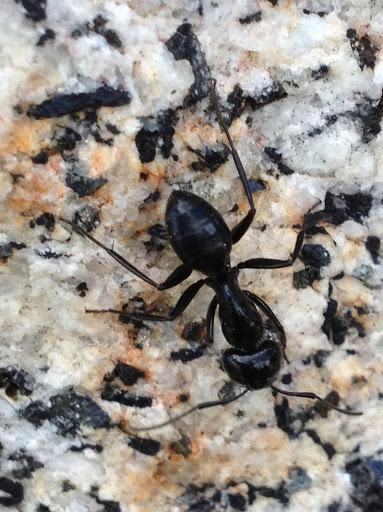
(c) 101595408250610106310, some rights reserved (CC BY) · licence
Family: Formicidae · Class: Insecta · Order: Hymenoptera
Camponotus laevissimus (Hairy Smooth Carpenter Ant) is a California animal in the Formicidae family.
The Hairy Smooth Carpenter Ant (Camponotus laevissimus) is a large carpenter ant species belonging to the subfamily Formicinae. Workers are polymorphic, with major workers (soldiers) reaching 10-13 mm in length and minor workers measuring 6-9 mm. The species exhibits a distinctive black coloration with a smooth, hairless appearance despite its common name suggesting otherwise. The thorax and head are notably glossy, and the gaster (abdomen) may show slight bronze reflections under certain lighting conditions. Camponotus laevissimus occurs across western North America, with documented populations in California, Arizona, Colorado, New Mexico, Washington, and British Columbia (BugGuide). In California, the species has been recorded primarily in mountainous and foothill regions, though specific county-level distribution data remains incomplete. The species appears to have a broader western range than many carpenter ant species, extending from the Pacific Northwest down through the southwestern United States. This carpenter ant inhabits forested environments, particularly coniferous and mixed coniferous-deciduous forests. The species typically nests in dead or decaying wood, including fallen logs, dead tree trunks, and occasionally wooden structures. Unlike some carpenter ants that prefer moist wood, C. laevissimus appears to tolerate a range of moisture conditions in its nesting sites. Elevation preferences have not been well documented, though collections suggest the species occurs from foothill elevations up to montane zones. Colonies of C. laevissimus follow the typical carpenter ant social structure, with a single reproductive queen, sterile female workers, and seasonal production of winged reproductive males and females. Based on BugGuide observations, adult activity peaks during late spring and early summer months, with most sightings recorded from April through July. Workers are primarily nocturnal foragers, leaving the nest to search for protein sources including dead insects and honeydew from aphids and other hemipterans. The species likely feeds on tree sap and other sugary substances as well. Reproductive flights typically occur during warm spring evenings, with mated queens establishing new colonies by excavating galleries in suitable dead wood. Colony founding is a slow process, as with other carpenter ants, with colonies taking several years to reach maturity and produce winged reproductives. Workers do not consume wood but rather excavate it to create nesting galleries, pushing out characteristic wood shavings. Currently, Camponotus laevissimus has no federal or state conservation listing status. The species appears to maintain stable populations throughout its range, though comprehensive population assessments have not been conducted. As with many forest-dwelling insects, potential threats include habitat loss through logging and forest management practices that reduce dead wood availability. Climate change may also affect the species through alterations to forest composition and moisture regimes in its preferred habitats. Detailed ecological studies of this species remain limited. The information presented here synthesizes available observations from taxonomic databases and community reports. Additional research on specific habitat requirements, colony demographics, and ecological relationships would enhance understanding of this western North American carpenter ant.
Classification
Class: Insecta · Order: Hymenoptera · Family: Formicidae
Frequently asked questions
How is Camponotus laevissimus classified?
Camponotus laevissimus belongs to class Insecta, order Hymenoptera, family Formicidae.
What family does Camponotus laevissimus belong to?
Camponotus laevissimus is in the Formicidae family.
What is Camponotus laevissimus?
The Hairy Smooth Carpenter Ant (Camponotus laevissimus) is a large carpenter ant species belonging to the subfamily Formicinae.
Is Camponotus laevissimus found in California?
Yes. Camponotus laevissimus is recorded in California in The California Species Project's catalogue.
Related species
Other California species in the same genus, family, or bioregion.
Data from The California Species Project — 14,000+ California species with verified data from CNPS, CDFW, USFWS, and more.