Camponotus modoc
Western Black Carpenter Ant
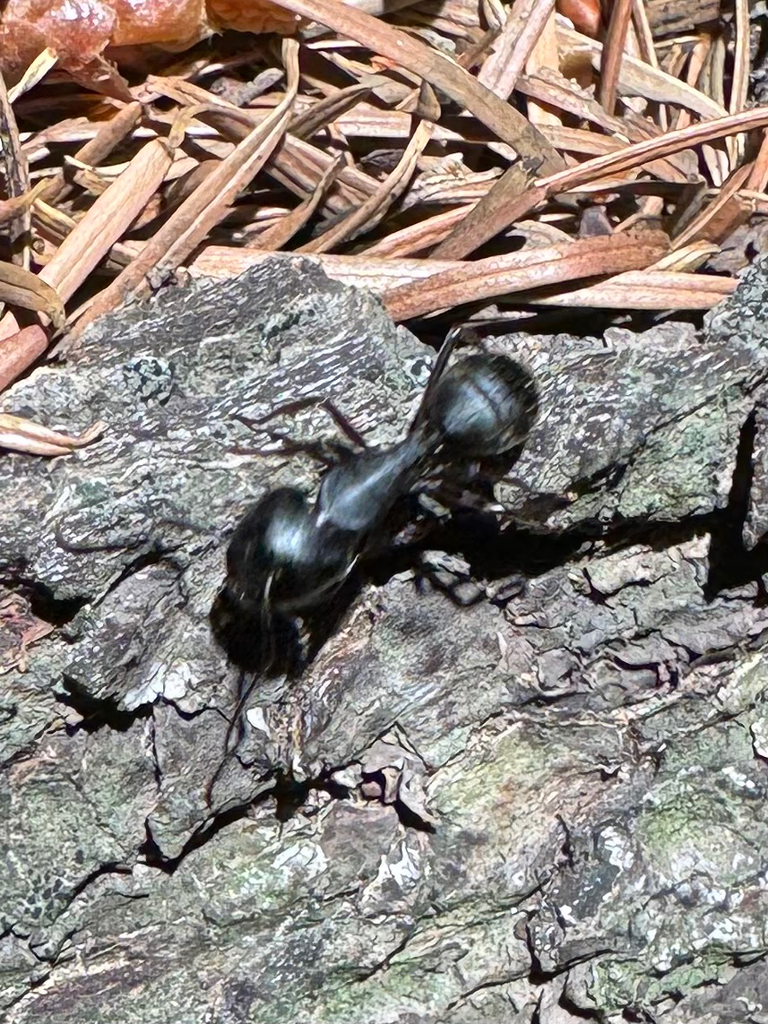
(c) Carlos A. Armenta, some rights reserved (CC BY-SA) · licence
Family: Formicidae · Class: Insecta · Order: Hymenoptera
Camponotus modoc (Western Black Carpenter Ant) is a California animal in the Formicidae family.
The Western Black Carpenter Ant (Camponotus modoc) is a large polymorphic ant species native to western North America. Workers exhibit considerable size variation within colonies, ranging from 7 to 13+ mm in length, while queens measure 9 to 20 mm and males 5 to 13 mm (BugGuide). The species displays the characteristic flattened or weakly curved dorsal mesosomal profile typical of the genus Camponotus, with antennal bases separated from the clypeal border by a space at least equal to the maximum diameter of the scape. Coloration is predominantly black, though some individuals may show dark brown tones. Camponotus modoc occurs throughout much of western North America, with populations documented from British Columbia south through California and extending into parts of the southwestern United States. The species inhabits diverse forested ecosystems, particularly coniferous and mixed forests, from near sea level to montane elevations. In California, populations are found in both coastal and interior mountain ranges, including the Sierra Nevada, Cascade Range, and Coast Ranges. This species typically nests in dead or decaying wood, including fallen logs, tree stumps, and structural timber. Unlike termites, carpenter ants do not consume wood but excavate galleries for nesting sites, creating smooth-walled chambers and tunnels. Colonies prefer moist wood that has been softened by fungal decay, though they may also establish satellite colonies in drier locations. Nesting sites are commonly found in Douglas fir, pine, oak, and other native tree species. Western Black Carpenter Ants are omnivorous foragers that play important ecological roles as both predators and scavengers. Workers collect protein sources including dead insects, small arthropods, and carrion, while also harvesting carbohydrates from plant secretions, aphid honeydew, and nectar. The species exhibits mutualistic relationships with aphids and other honeydew-producing insects, providing protection in exchange for sugary secretions (Xerces Society). Colonies are typically founded by single queens following nuptial flights, which occur during warm periods in late spring and summer. Workers emerge from the nest primarily during evening and nighttime hours to forage along established trails. Colony development is relatively slow, with new colonies requiring several years to reach maturity and begin producing reproductive individuals. Mature colonies may contain several thousand workers and can persist for many years. The species exhibits seasonal activity patterns, with reduced activity during winter months when workers remain clustered in the nest. Camponotus modoc is not listed under federal or state endangered species legislation and appears to maintain stable populations throughout most of its range. As a native species that fills important ecological niches as decomposer and predator, the Western Black Carpenter Ant contributes to forest ecosystem health. However, like many forest-dependent species, populations may face pressure from habitat loss due to logging, development, and altered fire regimes. Climate change may also affect the species through changes in forest composition and moisture regimes that influence suitable nesting sites.
Classification
Class: Insecta · Order: Hymenoptera · Family: Formicidae
Frequently asked questions
How is Camponotus modoc classified?
Camponotus modoc belongs to class Insecta, order Hymenoptera, family Formicidae.
What family does Camponotus modoc belong to?
Camponotus modoc is in the Formicidae family.
What is Camponotus modoc?
The Western Black Carpenter Ant (Camponotus modoc) is a large polymorphic ant species native to western North America.
Is Camponotus modoc found in California?
Yes. Camponotus modoc is recorded in California in The California Species Project's catalogue.
Related species
Other California species in the same genus, family, or bioregion.
Data from The California Species Project — 14,000+ California species with verified data from CNPS, CDFW, USFWS, and more.